Why Successful People Run Their Life Like a Business (CEO Examples + How It Helps You Achieve Your 2026 Goals)
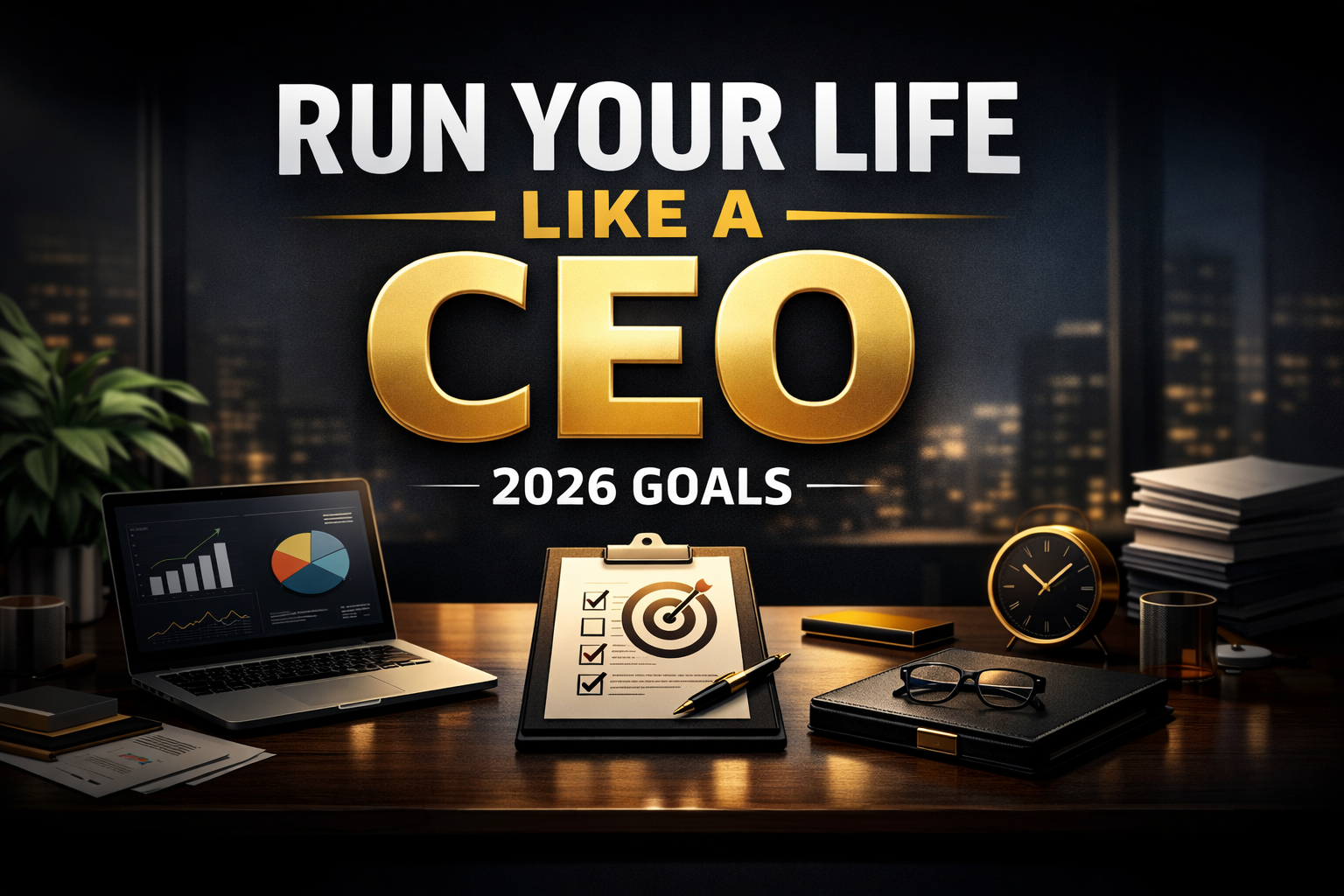
A lot of successful people don't treat life like a vague "hope it works out" situation.
They treat it like a business.
Not in a cold way—more like this:
- they set clear targets
- they protect their resources (time, energy, attention)
- they review performance regularly
- they cut what doesn't work
- they invest in what compounds
That "CEO mindset" is one of the fastest ways to make your 2026 goals real—because it replaces random effort with a system.
Below are examples of well-known CEOs and the business-style principles they're associated with, then a simple framework you can apply to your own life.
What "run your life like a business" really means
It doesn't mean you treat yourself like a robot.
It means you operate with:
Clarity
You know what you're building in 2026.
Priorities
You choose what matters most.
Systems
You don't rely on motivation.
Measurement
You track progress honestly.
Reviews
You adjust based on reality.
Most people skip these and live in reaction mode.
CEOs don't have that luxury—because businesses fail if they drift.
CEO examples: what to learn (and how it translates to your life)
These examples aren't about copying their lifestyle. It's about copying the principles.
1) Jeff Bezos: long-term thinking and customer obsession
Bezos is strongly associated with playing long-term games and focusing on fundamentals (especially the customer experience).
Business principle: long-term compounding beats short-term mood.
Life translation for 2026: set a stable direction for the year and stop changing the plan every week.
Apply it:
- choose 1 main 2026 goal
- stick to it for a quarter before you judge it
- adjust tactics, not the mission
2) Tim Cook: operational discipline and consistency
Tim Cook is widely seen as an operations-driven CEO: execution, reliability, supply chain, systems.
Business principle: predictable systems beat heroic effort.
Life translation for 2026: build routines that make progress automatic.
Apply it:
- schedule recurring "deep work" blocks
- run the same weekly review
- keep a simple daily must-win task
3) Elon Musk: first-principles thinking and bottleneck removal
Musk is known for aggressive problem-solving and asking "what's the constraint?"
Business principle: identify the bottleneck and attack it.
Life translation for 2026: stop trying to improve everything—fix the one thing limiting your progress.
Apply it:
- if your goal is revenue: bottleneck might be lead flow or conversion
- if your goal is fitness: bottleneck might be sleep or consistency
- if your goal is content: bottleneck might be topic selection or publishing cadence
4) Satya Nadella: growth mindset and cultural reset
Nadella is strongly associated with pushing a "learn-it-all" culture instead of "know-it-all."
Business principle: learning speed becomes competitive advantage.
Life translation for 2026: treat mistakes like feedback, and improve your system monthly.
Apply it:
- do a monthly review: "what did I learn, what changes next month?"
- focus on iteration, not perfection
5) Jensen Huang: long-term bets and relentless execution
Jensen Huang's style is often described as long-horizon conviction paired with intense execution.
Business principle: make big bets, then execute consistently for years.
Life translation for 2026: pick fewer priorities and stay with them long enough to compound.
Apply it:
- 3 priorities max for the quarter
- ship weekly on the main goal
- don't distract yourself with side quests
Why this mindset helps with 2026 goals
A business hits goals by doing 5 things well:
- set a target
- create a plan
- execute consistently
- track metrics
- adjust quickly
That's exactly how personal goals work too.
If you run your 2026 goals like business targets, you stop depending on motivation and start depending on process.
The "CEO mindset": your time and energy are the budget
In business, money is limited.
In life, your limited resources are:
- time
- attention
- energy
- mental clarity
CEOs protect resources because wasted resources kill results.
2026 rule: treat your best hours like prime inventory.
The 5 business principles that will upgrade your life in 2026
1) Set a clear objective (your 2026 North Star)
Pick:
- 1 main goal
- 1–2 supporting goals
If everything matters, nothing moves.
2) Build a strategy (how you'll win)
Strategy means choosing:
- what you will do
- what you will not do
This is where most people fail: they never choose.
3) Run weekly operations (execution cadence)
Businesses don't plan once a year.
They operate weekly.
Weekly operations (15 minutes):
- choose 1–3 outcomes
- schedule the hardest block first
- decide what you'll ignore
4) Track simple KPIs (3–5 metrics)
Pick a few numbers that reflect progress.
Examples:
- deep work hours/week
- workouts/week
- outputs shipped/week
- leads/week
- conversion rate / revenue
Track inputs weekly, results monthly.
5) Review and adjust (iteration loop)
This is the secret weapon.
Weekly review questions:
- What worked?
- What didn't?
- What's the one adjustment for next week?
Monthly review questions:
- Are we on track for 2026?
- What's the bottleneck now?
- What should be cut?
How to apply this to your life: a one-page "2026 CEO Plan"
Copy this:
Mission (1 sentence):
What are you building in 2026?
Top goals (max 3):
1)
2)
3)
Key projects:
- Project A
- Project B
- Project C
KPIs (3–5):
Constraints (protect these):
- sleep
- deep work
- health
- relationships
Weekly cadence:
- weekly review day: ___
- must-win task daily: ___
Final takeaway
Successful people run life like a business because it creates:
- clarity instead of confusion
- priorities instead of chaos
- systems instead of motivation dependence
- measurable progress instead of guessing
- fast adjustments instead of drifting
If you treat your 2026 goals like business targets—with weekly operations and simple metrics—you won't need more pressure.
You'll have a better operating system.
And that's what makes big goals achievable.

AI Powered Task Manager
Plan smarter, execute faster, achieve more
Create tasks in seconds, generate AI-powered plans, and review progress with intelligent summaries. Perfect for individuals and teams who want to stay organized without complexity.
Get started with your preferred account