Getting Out of Tough Times: How Successful People Do It (And How You Can Apply It in 2026)
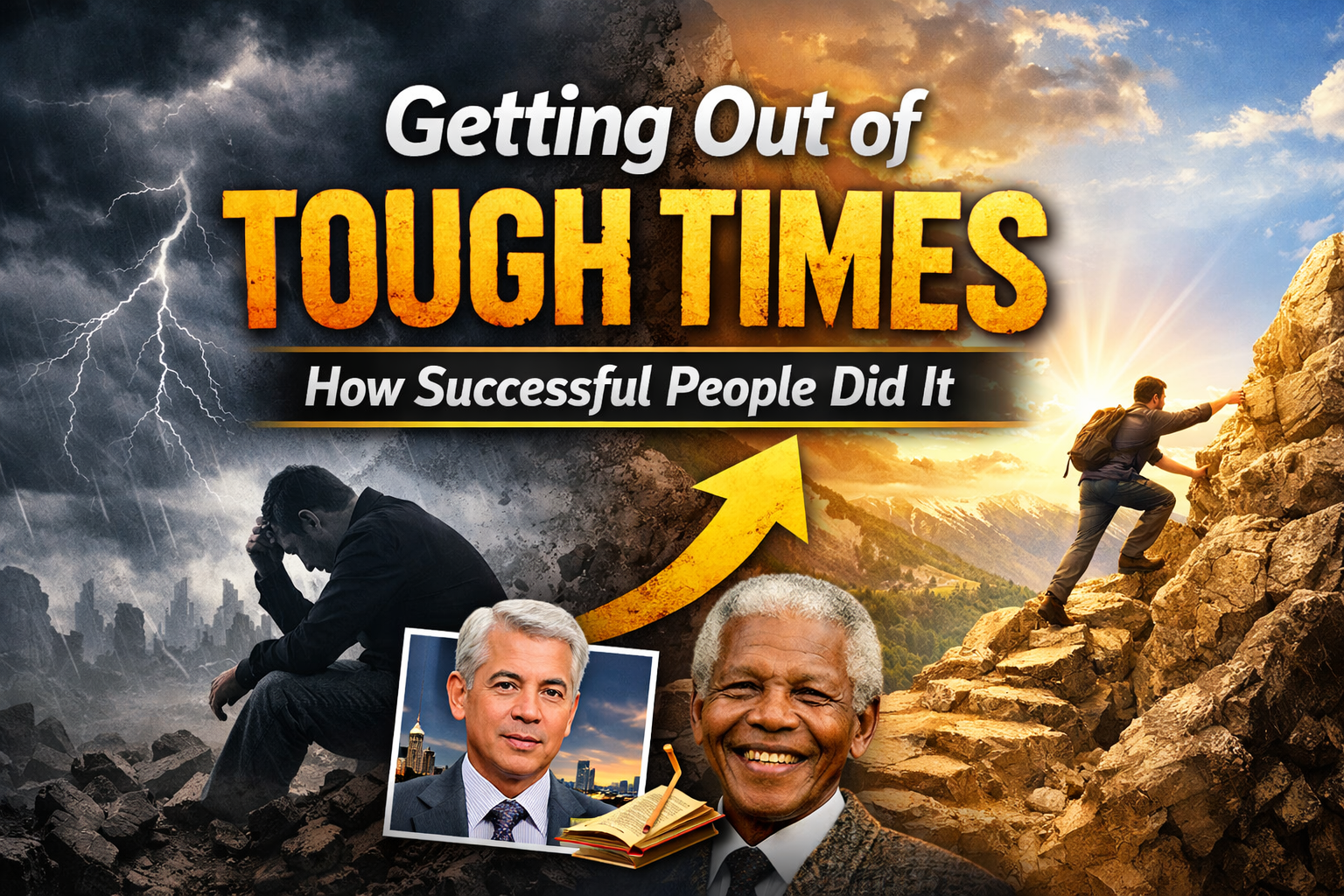
Tough times are part of life.
Most of us have already been through something hard—or we will. A career hit. A business dip. A breakup. A financial mess. A health scare. A period where nothing seems to work.
The problem isn't that tough times exist.
The problem is that tough times can steal your 2026 goals by pushing you into survival mode, bad decisions, and hopelessness.
This article is a practical playbook: how successful people get through dark periods, plus a simple system you can apply when life gets heavy.
The most important mindset shift: you don't "jump out" of tough times — you climb out
Almost every comeback story has the same shape:
- stabilize the basics
- focus on the next step
- make small progress daily
- let momentum compound
The goal isn't to feel amazing tomorrow.
The goal is to move forward even when you don't feel like it.
Example 1: Bill Ackman — "personal compounding" and the next step
Bill Ackman described a period where his fund was down ~30–35%, he was dealing with intense negative press, litigation tied to Valeant, and going through a divorce—"about as bad as it gets."
His solution wasn't one big dramatic move.
It was what he called applying compounding to life: make a little progress every day, don't look back (it creates discouragement), and focus only on the next step. He even framed it as "0.1% progress every day," and said you often don't feel meaningful change for weeks—but around ~90 days the curve starts to show.
What to learn for your 2026 goals:
When life gets hard, don't try to "fix the whole year."
Try to win today, in a small measurable way.
Example 2: Airbnb — when you're broke, creativity becomes your lifeline
In 2008, Airbnb's founders were out of money, in debt, and desperate for traction. They did something weird: they created and sold political-themed cereal ("Obama O's" and "Cap'n McCain's") to survive, get attention, and keep going long enough to reach the next opportunity (Y Combinator).
What to learn for your 2026 goals:
Tough times reward resourcefulness, not perfection.
Ask: "What's the scrappiest move that buys me time and momentum?"
Example 3: Steve Jobs / Apple — focus on the one lever that can change everything
When Jobs returned to Apple in 1997, the company was struggling and needed a hit. He pushed for a product that would matter, partnering closely with Jony Ive—work that led into the iMac era and helped pull Apple back from the brink.
What to learn for your 2026 goals:
In a crisis, you don't need 30 priorities.
You need one lever that changes the trajectory.
Example 4: J.K. Rowling — keep going through rejection
Rowling's early Harry Potter journey included repeated publisher rejections (often cited as 12) before Bloomsbury accepted it.
What to learn for your 2026 goals:
Rejection isn't a verdict—it's part of the process.
Progress often looks like: submit → get rejected → improve → resubmit.
Example 5: Nelson Mandela — hope + meaning + endurance
Mandela's life is one of the clearest examples of enduring extreme hardship without surrendering direction: 27 years imprisoned, continuing to hold onto hope and purpose.
What to learn for your 2026 goals:
When you can't control the situation, you can still control:
- your attitude
- your daily actions
- your meaning and direction
The common pattern successful people use to climb out
1) Reduce the problem to "the next step"
Not "fix my life." Not "save 2026."
Just: what's the next step I can execute today?
2) Make progress measurable (even tiny)
Small wins rebuild confidence. Ackman calls it personal compounding.
3) Protect the basics (health, sleep, support)
Ackman explicitly emphasized health basics (exercise, nutrition, sleep) and being around people who support you.
(Important: don't treat this as medical advice—if you're struggling, talk to a qualified professional.)
4) Get creative when resources are low
Airbnb's cereal story is basically "survive long enough to find the real path."
5) Stay in the game long enough for the curve to turn
Most comebacks feel slow before they feel fast.
A simple system you can use when life gets hard (and still protect your 2026 goals)
The "90-day compounding plan"
Daily (10 minutes):
- One Must-Win: the smallest meaningful action today
- One Stabilizer: sleep/walk/meal/clean-up/pay one bill (something that reduces chaos)
- One Support Move: message a friend, ask for help, check in with someone
Weekly (15 minutes):
- What improved by 0.1% this week?
- What made things worse?
- What's the next smallest adjustment?
Rule: Don't judge the whole year while you're in the hole. Judge the next step.
Final takeaway
Tough times aren't proof you're failing.
They're proof you're human.
Successful people don't escape hard periods with one heroic move—they climb out with:
- small daily progress
- stable basics
- focus on the next step
- support
- patience with the compounding curve

AI Powered Task Manager
Plan smarter, execute faster, achieve more
Create tasks in seconds, generate AI-powered plans, and review progress with intelligent summaries. Perfect for individuals and teams who want to stay organized without complexity.
Get started with your preferred account