Momentum and Progress for Your 2026 Goals (With Examples From Successful People)
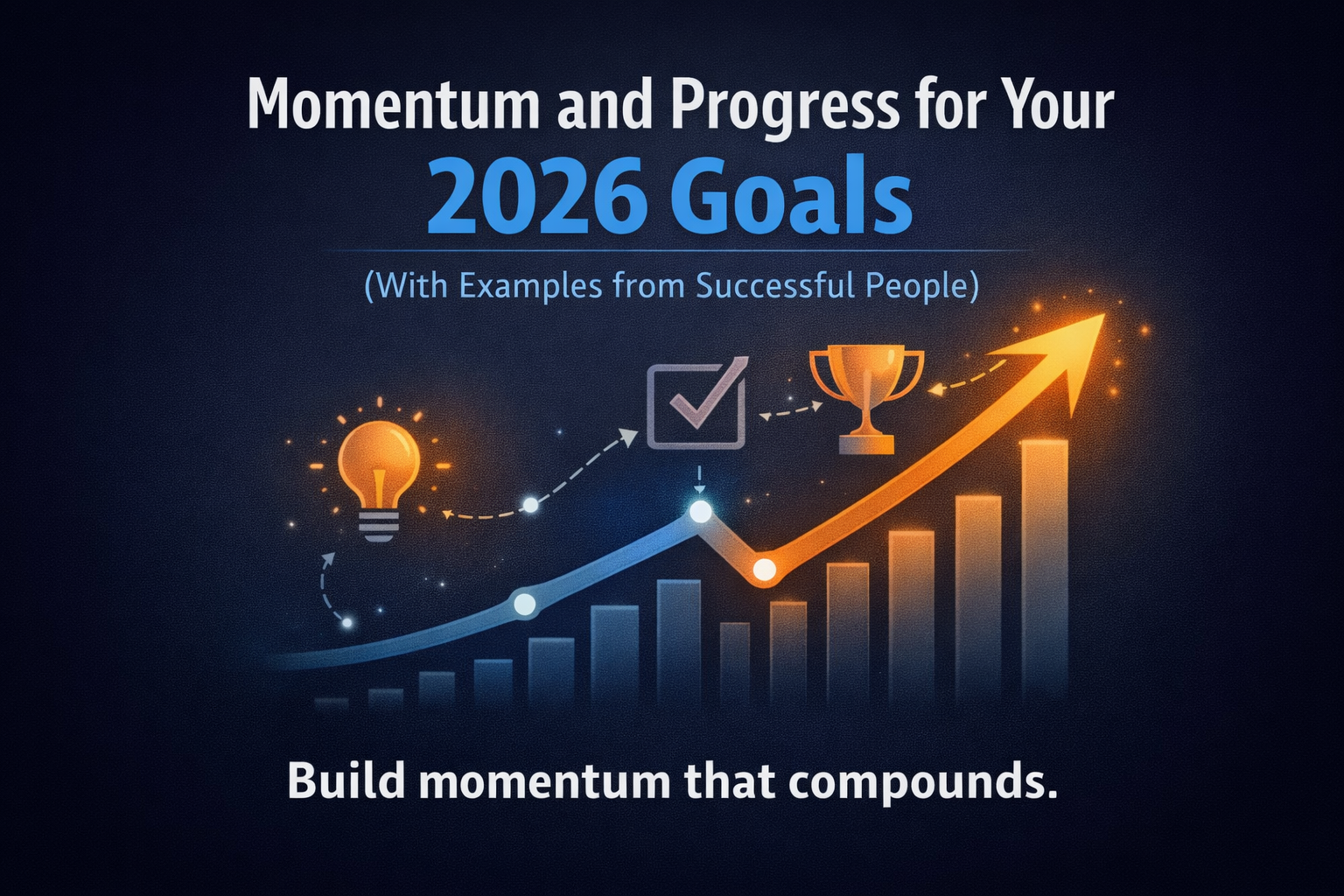
Most people fail their 2026 goals for one simple reason:
They rely on motivation.
Motivation is a feeling. It spikes in January, fades in February, and disappears the first week life gets messy.
Momentum is different.
Momentum is what happens when progress becomes automatic—because you've built a rhythm that keeps pulling you forward.
And if you look closely, momentum is the common thread behind most successful people: they weren't "always inspired." They were consistent long enough for progress to compound.
Momentum vs motivation (quick clarity)
Motivation says: "I feel inspired today."
Momentum says: "This is just what I do now."
Momentum is a system, not a mood.
Progress creates momentum (not the other way around)
You don't wait for momentum and then start.
You start small, get progress, and momentum builds.
Small action → small progress → confidence → repeat
That loop is how most big wins are created.
Why momentum matters specifically for 2026 goals
Your 2026 goals will take time.
Which means you will hit:
- slow weeks
- boring middle phases
- unexpected setbacks
- distractions and "urgent" tasks
Momentum is what keeps you moving through that reality.
Without momentum, every interruption resets you.
With momentum, interruptions become speed bumps.
Examples of successful people who used momentum (not motivation)
1) Michael Jordan: momentum through daily practice reps
Jordan is often used as the example of someone who built greatness through repetition.
What created momentum: training and skills reps, day after day.
What to learn for 2026: don't "try hard sometimes." Do a smaller version consistently.
Steal this: build your 2026 goal around reps:
- "Write 300 words/day"
- "Ship 1 product improvement/week"
- "Train 4x/week"
2) J.K. Rowling: momentum through persistence in the boring middle
Rowling's early journey included major rejection and a long period where progress wasn't visible.
What created momentum: continuing the process despite uncertainty.
What to learn for 2026: the middle is always slow—momentum is staying in the game long enough for results to show.
Steal this rule:
"No quitting during the boring middle."
3) Kobe Bryant: momentum through routine, not emotion
Kobe's mindset was basically: don't negotiate with the routine.
What created momentum: discipline that didn't depend on mood.
What to learn for 2026: if your plan only works on "good days," it's not a plan.
Steal this: create a "minimum viable day":
- even on bad days, you do a 10–20 minute version
4) Thomas Edison: momentum through iteration (failure as feedback)
Edison is associated with repeated experimentation.
What created momentum: treating failed attempts as steps, not identity.
What to learn for 2026: most goals require iterations, not perfection.
Steal this loop:
"Ship → measure → adjust → repeat"
5) Jeff Bezos: momentum through long-term consistency
Bezos is known for long-term thinking and building systems that compound.
What created momentum: staying consistent with the direction, even while tactics changed.
What to learn for 2026: don't change goals every week. Adjust execution, not the mission.
Steal this: set a quarterly focus and stick to it.
The 3 types of momentum you want in 2026
1) Execution momentum
You start faster and procrastinate less.
2) Clarity momentum
You know what matters and say "no" more easily.
3) Results momentum
Results begin to show up (usually later than you want).
Most people chase results momentum first.
Successful people build execution momentum first.
How to build momentum for your 2026 goals (simple system)
Step 1: Pick one "Main Goal" for 2026
You can have multiple goals, but choose one main win.
If everything is equal, nothing is prioritized.
Step 2: Convert it into weekly outcomes
Year goals are too big to execute daily.
Examples:
- Goal: "Grow revenue" → Weekly: "Improve onboarding + publish 1 marketing piece"
- Goal: "Get fit" → Weekly: "4 workouts + 2 long walks"
- Goal: "Grow audience" → Weekly: "2 posts + 1 video"
Keep it to 1–3 outcomes per week.
Step 3: Use a daily "Must-Win" task
Your Must-Win is the smallest meaningful action that moves the goal forward.
Examples:
- 300 words
- 1 feature commit
- 5 outreach messages
- 30 minutes training
- 20 minutes learning + notes
If the Must-Win happens, the day is a win.
Step 4: Make progress visible (or your brain won't believe it)
Track one simple thing:
- streak of Must-Win days
- hours of deep work
- workouts completed
- outputs shipped
Invisible progress feels like "nothing is happening."
Visible progress creates momentum.
Step 5: Create a "minimum viable day"
This protects momentum during chaos.
Examples:
- 10 minutes writing
- 10 minutes workout
- 1 micro-task shipped
- 1 sales follow-up
Rule: Never go to zero.
Zero breaks the chain and makes restarting harder.
The "boring middle" is where 2026 goals are won
Every big goal has 3 phases:
- exciting start
- boring middle
- visible results
Most people quit in phase 2.
Momentum is what gets you through phase 2.
So the real skill isn't "getting inspired."
It's staying consistent while the outcome is still uncertain.
When you fall off: the rule that saves your year
You will miss days.
The problem isn't missing—it's letting one miss become a new identity.
Rule: Never miss twice if you can help it.
One miss is an accident. Two misses is a pattern.
A 2026 momentum plan you can copy
Main goal for 2026: ________
Weekly outcomes (1–3):
- ---
- ---
- ---
Daily Must-Win: ________
Minimum viable day (10–20 min): ________
Tracker: ________ (streak / hours / output / sessions)
Weekly review question:
"What's the one adjustment that makes next week easier?"
Final takeaway
Motivation gets you started.
Momentum gets you finished.
Most successful people didn't win because they were endlessly excited.
They won because they built a rhythm of progress—small enough to sustain, long enough to compound.
Do that in 2026, and your goals won't feel like a yearly wish.
They'll feel like an inevitable result of your system.

AI Powered Task Manager
Plan smarter, execute faster, achieve more
Create tasks in seconds, generate AI-powered plans, and review progress with intelligent summaries. Perfect for individuals and teams who want to stay organized without complexity.
Get started with your preferred account