Why Priorities Are the Missing Link in Productivity (And How to Set Them to Actually Hit Your 2026 Goals)
Most people don't fail their goals because they're lazy.
They fail because they try to do everything—and "everything" always beats "the important thing" in the moment.
Priorities are the filter that turns effort into results.
Without priorities, productivity becomes:
- checking boxes that don't matter
- reacting to emails and requests
- being "busy" but not moving forward
- ending the week wondering what you actually accomplished
With priorities, productivity becomes:
- choosing what matters
- making progress visible
- reducing stress (because you're not guessing all day)
- finishing your year with real wins, not just activity
This article explains why priorities are essential, and gives you a practical system to prioritize your work so your 2026 goals don't stay stuck as "ideas."
Productivity isn't doing more. It's doing what matters.
If you do 50 tasks this week, but none of them move your big goal forward, your week was productive-looking… but not productive.
Priorities answer one question:
"Out of all the things I could do, what should I do first?"
That "first" is everything.
Because time, attention, and energy are limited. Your calendar will fill either way. The only choice is what fills it.
Why priorities matter more in 2026 than ever
2026 is not a low-distraction environment.
You're competing against:
- notifications
- AI-generated content everywhere
- endless "quick wins" that feel productive
- more tools, more options, more noise
When everything is easy to start, the real skill becomes:
deciding what deserves your next hour.
Priorities protect your time from the modern default: reaction mode.
The "priority gap" that kills goals
Here's what most people do:
- Set goals in January
- Work hard
- Get busy
- Drift
- End the year surprised
Not because they didn't want it.
Because their daily actions weren't linked to their goals.
Priorities are the bridge between:
year goals → quarterly focus → weekly outcomes → today's actions
If that bridge is missing, your day will be controlled by what's urgent, not what's important.
What a real priority is (and what it isn't)
A priority is not:
- "Everything is important"
- a long list of 12 "top priorities"
- a vague intention like "work on the business"
- an anxiety-driven guess
A real priority is:
- specific enough to act on
- connected to an outcome
- chosen intentionally (not by default)
- limited (because time is limited)
A good priority creates clarity. A bad one creates guilt.
The 3 levels of priority (use all three)
To actually accomplish 2026 goals, you need priorities at three levels:
1) Year priorities (direction)
These are the "big outcomes" you want by end of 2026.
Examples:
- reach $X revenue
- launch version 2 of your product
- lose 10 kg and build consistency
- build a personal brand and publish weekly
You can have multiple goals—but only a few can be top-level.
Rule: Pick 3–5 max.
2) Quarter priorities (focus)
Your year goals are too big for daily execution. The quarter turns them into focus.
Example:
- Goal: "Grow revenue"
- Q1 priority: "Increase conversions from trial → paid"
- Q2 priority: "Add a key feature + onboarding improvements"
Rule: Pick 1–2 per quarter, per area.
3) Week / day priorities (execution)
This is where goals become real.
Your daily priority should be the thing that, if completed, makes the day a win.
Rule: Pick 1 "Must Win" per day.
Everything else is secondary.
How to prioritize in a way that actually works
Here's a practical prioritization system you can apply immediately.
Step 1: List your 2026 goals (no editing)
Write everything you want. Don't filter yet.
Then circle the ones that are:
- high impact
- deeply important
- worth sacrificing for
Step 2: Use the "1-year tradeoff" test
Ask:
"If I only achieved ONE of these by end of 2026, which one would make the others easier?"
That's usually your #1 priority.
Examples:
- getting healthy improves everything
- building distribution (audience) makes sales easier
- shipping the product unlocks feedback, customers, momentum
Step 3: Convert goals into "priority drivers"
Goals are outcomes. Priorities are drivers.
Turn each goal into a driver that can be acted on weekly.
Examples:
- "Grow Self-Manager revenue" → Improve conversion + retention
- "Build audience" → Publish 2 high-quality posts/week
- "Become better engineer" → Ship 1 meaningful improvement/week
- "Get in shape" → Train 4 days/week + daily steps
Drivers create motion.
Step 4: Pick your "Top 3 for the next 90 days"
Now you're in quarterly territory.
Choose 3 max:
- One business priority
- One personal priority
- One skill / system priority
(Adjust to your life, but keep the limit.)
If you choose 7, you chose none.
Step 5: Decide what you will NOT do
This is the part most people skip.
Every priority requires a "no list."
Examples:
- no new side project this quarter
- no redesigning your website again
- no chasing low-ticket clients
- no "I'll just tweak the app for 3 hours" unless it supports the quarter
Your "not now" list is what protects your "yes."
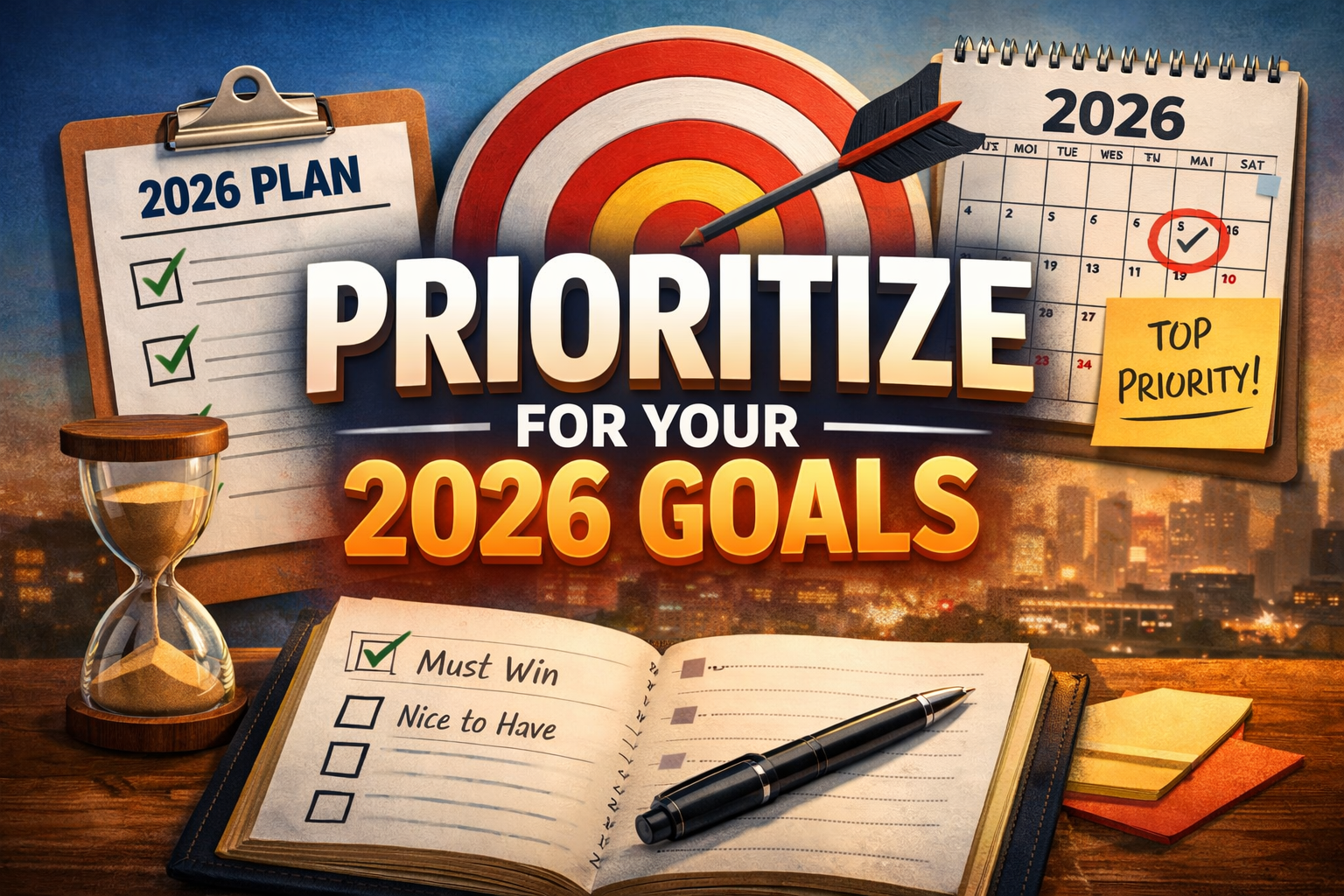
The simplest daily method: "Must Win + Nice to Have"
Each day, do this:
Must Win (1 task)
The one task that moves a top priority forward.
Nice to Have (2–5 tasks)
Smaller tasks that support the day.
If you complete Must Win, the day is successful—even if the rest stays.
This removes the emotional chaos of huge lists.
A prioritization filter you can use in 10 seconds
When deciding what to work on next, ask:
- Does this directly support a 2026 goal?
- Is this the highest-leverage thing I can do today?
- If I don't do this now, what happens?
- If I do this now, what becomes easier?
If it fails #1, it's usually a "later" task.
Common prioritization traps (avoid these in 2026)
Trap 1: Prioritizing what's loudest
Emails, messages, notifications—loud doesn't mean important.
Fix: Start your day with your priority before communication.
Trap 2: Confusing motion with progress
Meetings, planning, organizing, research… can become procrastination.
Fix: Your daily priority must create an output: ship, publish, sell, build, practice.
Trap 3: "Too many priorities"
If you're overwhelmed, it's often not workload—it's lack of selection.
Fix: Cut the list until you feel calm.
Trap 4: Switching goals every week
Consistency beats intensity.
Fix: Keep quarterly priorities stable. Adjust tactics, not direction.
How a productivity tool helps you prioritize (without overcomplicating it)
Priorities are a thinking problem—but tools can help you execute them.
A good productivity system should let you:
- connect daily tasks to bigger goals
- plan by date (so priorities show up on your calendar)
- review weekly/monthly so you don't drift
- see what you actually did (not just what you intended)
That's the real power: priorities + visibility + review.
Because when you can see your time, you can steer it.
A simple 2026 prioritization plan you can copy
Use this template:
2026 Top Goals (3–5):
- …
- …
- …
Q1 Priorities (1–3):
- …
- …
- …
Weekly Outcomes (choose 1–3):
- Outcome A: …
- Outcome B: …
- Outcome C: …
Daily Rule:
- 1 Must Win task before anything else
No List (for this quarter):
- Not now: …
- Not now: …
- Not now: …
That's it. Simple enough to follow, strong enough to work.
Final reminder: your priorities are your life, in calendar form
The calendar always gets filled.
Your job is to make sure it's filled with things that move your 2026 goals forward.
Priorities are not pressure.
They're relief—because you stop waking up and guessing.
If you pick the right priorities and repeat them consistently, 2026 won't be a year of "trying."
It will be a year of finishing.

AI Powered Task Manager
Plan smarter, execute faster, achieve more
Create tasks in seconds, generate AI-powered plans, and review progress with intelligent summaries. Perfect for individuals and teams who want to stay organized without complexity.
Get started with your preferred account