How 2026 Yearly Goals of Famous People Might Look (And What to Learn From Them)
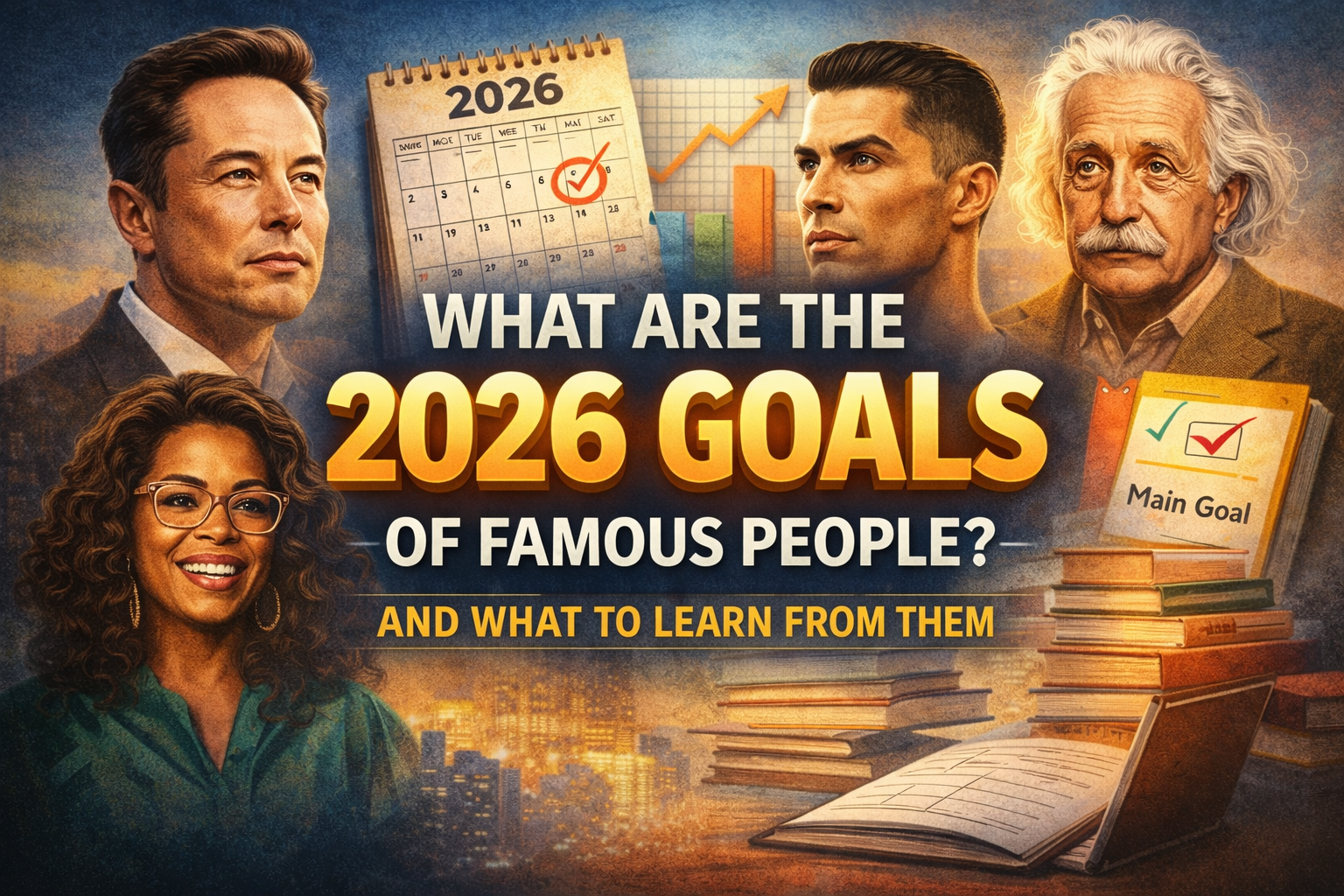
Most "famous people goals" sound glamorous from the outside.
But when you look at how high performers actually operate, their yearly goals usually come down to a few repeatable themes:
- one main bet
- a small set of measurable outputs
- a strong health / energy baseline
- a system to reduce distractions
- tight feedback loops (shipping, testing, learning)
This article shows what 2026 goals could look like for famous people (based on how they publicly work), and what you can steal from their approach—without needing their money, teams, or status.
First: a quick reality check (so we don't romanticize it)
We don't know the exact private goals of most famous people. What we can do is infer realistic goal structures from:
- what they repeatedly emphasize in interviews / letters / podcasts
- what their work patterns show (output, cadence, constraints)
- what public commitments they've made (books, tours, product launches)
So think of these as goal templates inspired by real patterns.
1) The "Investor" style goals (Warren Buffett / Charlie Munger style)
How their 2026 goals might look
- Make 0–2 high-conviction decisions all year
- Read 500–1,000 hours (daily reading habit)
- Avoid "forced activity" (no busy work meetings)
- Protect decision quality: sleep, routine, calm
What to learn
Your best year might come from fewer decisions, not more.
If you're always "doing," you might be avoiding thinking.
Steal this: set a yearly goal for decision quality:
- "Make 3 high-leverage moves this year."
- "Say no to 80% of low-value commitments."
2) The "Founder/Operator" goals (Elon Musk / hard-driving operator archetype)
How their 2026 goals might look
- Ship one massive product milestone (a launch, a scale-up, a manufacturing step)
- Remove one major bottleneck (cost, throughput, reliability, hiring)
- Increase output speed by tightening feedback loops
- Recruit a few elite people for key roles
What to learn
Operators don't "goal set." They bottleneck hunt.
Steal this: make one of your 2026 goals:
- "Identify the #1 constraint in my business and remove it."
Examples:
- Conversion rate
- Lead flow
- Onboarding friction
- Retention
- Shipping speed
- Support load
3) The "Creator" goals (YouTubers, writers, educators)
How their 2026 goals might look
- Publish X outputs (videos, essays, episodes) with a consistent cadence
- Improve quality by one clear lever (story, thumbnails, editing, research)
- Build distribution: email list, community, collaborations
- Build a content "engine" (templates, batching, reusable workflow)
What to learn
Creators win by consistency + iteration, not by one viral hit.
Steal this: pick an output-based yearly goal:
- "Publish 50 pieces in 2026."
Then add a quality lever:
- "Improve hooks + titles every month."
4) The "Athlete" goals (discipline + measurable performance)
How their 2026 goals might look
- Peak for 2–3 key events (not "be in peak shape all year")
- Build base strength + conditioning cycles
- Hit measurable targets: VO2, sprint times, lifts, recovery metrics
- Reduce injury risk via sleep, mobility, physio
What to learn
Athletes plan in seasons, not constant max effort.
Steal this: treat your work like training cycles:
- Q1: build base (skills, systems)
- Q2: increase volume (shipping/output)
- Q3: peak (launch, sell, scale)
- Q4: recover + review + rebuild
5) The "Scientist/Thinker" goals (Einstein archetype)
How their 2026 goals might look
- Protect deep work blocks (hours/day)
- Explore 1–2 core questions all year
- Publish less, but with higher depth/novelty
- Keep input quality extremely high (books, papers, fewer feeds)
What to learn
Deep work requires aggressive boundary setting.
Steal this: add one "negative goal":
- "No notifications during deep work."
- "No social media before noon."
- "Two deep work blocks 4x/week."
6) The "Politician/Leader" goals (public messaging + coalition building)
How their 2026 goals might look
- Increase public support / trust metrics
- Win specific influence battles (policy, votes, alliances)
- Control narrative through disciplined communication
- Avoid unforced errors (media training, message consistency)
What to learn
Leaders protect their message and minimize mistakes.
Steal this: treat your personal brand like a narrative:
- "In 2026, I want to be known for X."
Then align weekly output with it.
7) The "Artist" goals (musicians, actors, performers)
How their 2026 goals might look
- Create a body of work (album, film, show)
- Master one craft lever (voice, writing, performance)
- Build a sustainable creative routine
- Collaborate with 3–10 top people (producers, directors, etc.)
What to learn
Artists don't wait for inspiration. They build rituals.
Steal this: set a process goal:
- "Create every day for 30 minutes."
Small daily creation beats occasional big bursts.
What all high performers' yearly goals have in common
Even across totally different careers, most "great 2026 goals" share these patterns:
1) They choose one main bet
One "big thing" that makes the year a win.
2) They measure outputs, not vibes
"Publish 50 videos" beats "grow my channel."
3) They protect energy
Health + sleep + routines aren't optional. They're strategy.
4) They reduce noise
They say no. They limit inputs. They avoid random tasks.
5) They build feedback loops
Ship → measure → adjust → repeat.
A practical template: build your "famous-person style" 2026 goals
Use this structure (simple but powerful):
1) One Main Outcome (the big bet)
- Example: "Reach $10k MRR" / "Launch v2" / "Lose 10kg" / "Publish weekly"
2) Output Targets (what you will do)
- Example: "Ship 40 product updates"
- "Write 52 posts"
- "Do 4 workouts/week"
3) Constraint Goal (remove one bottleneck)
- Example: "Improve trial → paid conversion"
- "Reduce churn"
- "Fix sleep schedule"
4) Energy Standard (non-negotiable baseline)
- Example: "7h sleep average"
- "No caffeine after 2pm"
- "Daily walk"
5) Noise Limits (your "no list")
- Example: "No new side projects in Q1"
- "No social media before deep work"
What to learn from famous people without copying their life
Don't copy their lifestyle. Copy their structure:
- fewer goals
- clearer priorities
- more outputs
- better review rhythm
Fame isn't the advantage.
Focus is.
If you build a 2026 goal system that prioritizes focus and measurable outputs, you'll get the real benefit high performers rely on—without needing their resources.

AI Powered Task Manager
Plan smarter, execute faster, achieve more
Create tasks in seconds, generate AI-powered plans, and review progress with intelligent summaries. Perfect for individuals and teams who want to stay organized without complexity.
Get started with your preferred account