Why Perfect Memory Is a Force Multiplier for Productivity (And Why Date-Based Planning Works)
Most productivity problems aren't caused by laziness.
They're caused by bad memory.
Not "forgetting your keys" memory — but this:
- forgetting what you decided last week
- forgetting what you tried last month
- forgetting why a task exists
- repeating the same mistakes because you don't remember the pattern
- making plans without learning from what actually happened
In 2026, we do hundreds of micro-actions on computers and phones every week. Work, admin, messages, ideas, links, client notes, small decisions.
If that information isn't stored somewhere useful, it disappears.
And when your memory resets every week, your productivity resets too.
That's why "perfect memory" is a force multiplier: it makes your future decisions smarter, faster, and more accurate.
The core idea: productivity improves when your history becomes usable
A normal brain remembers feelings:
"I was busy."
"I worked hard."
"I think I made progress."
But feelings aren't data.
A good personal project manager gives you something different:
- a real history of what you did
- what you planned vs what you finished
- what got delayed (and why)
- what kept stealing your time
- what actually moved your goals forward
That's the difference between guessing and steering.
This is also why accountability tools work: they reduce "drift" by turning your year into a visible timeline.
Why "perfect memory" compounds results
Perfect memory creates compounding benefits:
1. Better decisions
You stop rethinking the same things and stop re-learning the same lessons.
2. Faster reviews
Weekly/monthly reviews become quick and accurate, not emotional and vague.
3. Less context switching
When the context is saved with the work, you don't waste time reconstructing it.
4. Cleaner prioritization
You can prioritize based on patterns ("this always slips") instead of mood.
5. Less repetition of mistakes
You can literally see "we tried this 3 times and it failed for the same reason."
The problem with most tools: they store tasks, but they don't store reality
Many apps become a dumping ground:
- tasks with no dates
- ideas mixed with urgent work
- "someday" projects living next to "today" responsibilities
Even if you write things down, you often can't answer the most important question:
What did I actually do last week, and what should I do differently next week?
Why date-based planning is so powerful (because life is day-by-day)
A lot of project tools live in abstract space: boards, lists, backlogs.
But your life doesn't happen in abstract space.
It happens in days.
That's why a date-based system is powerful: it ties your plans to the unit that reality uses.
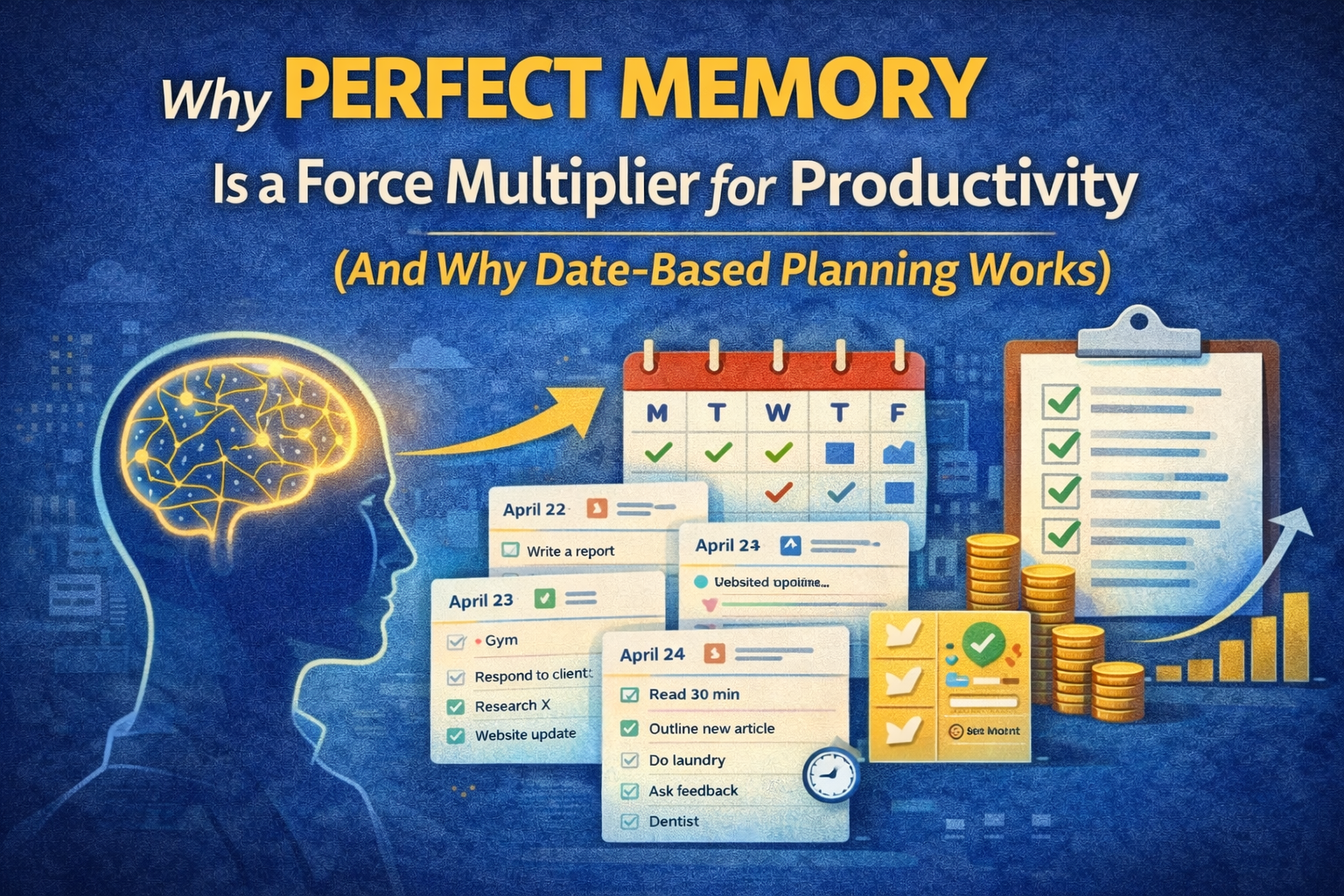
Self-Manager is built around a simple concept: each date represents a workday, and each date can hold multiple tables that organize tasks, notes, progress, comments, and logs.
That structure does something most apps can't:
It turns your work into a timeline you can review.
Open a day from the past and you can immediately see what you worked on.
That's "perfect memory" in practice.
The review loop is where perfect memory becomes a multiplier
Storing history is useful.
But the real power comes when you review it consistently.
Self-Manager supports that through an AI Period Summary workflow: you can select a week or month and chat with AI about what you did in that period (optionally including comments for more context).
This turns review into a repeatable loop:
- What happened?
- What moved forward?
- What stalled?
- What should be the focus next week?
When reviews get easier, you do them more often.
And when you do them more often, your year becomes steerable.
Real use-cases: how "perfect memory" helps in personal productivity
1) Weekly review that actually teaches you something
Instead of "I was busy," you see the real story:
- which projects progressed
- what got postponed repeatedly
- where your time went
2) Learning from experiments
Trying a new routine, content strategy, study plan, gym program, marketing approach?
Perfect memory lets you compare weeks and see what worked (and what didn't).
3) Faster ramp-up after interruptions
If you lose a few days (life happens), you can re-enter the project without rebuilding context from scratch.
4) Better long-term goals
Yearly goals fail when weeks drift.
A time-based plan forces the question: "When exactly will this happen?"
That's how goals become real.
Simple takeaway
If you want more productivity in 2026, don't just optimize effort.
Optimize memory.
Because when your system remembers everything:
- your reviews get sharper
- your planning gets simpler
- your decisions get faster
- your progress compounds
And date-based planning fits how life actually works: day by day.

AI Powered Task Manager
Plan smarter, execute faster, achieve more
Create tasks in seconds, generate AI-powered plans, and review progress with intelligent summaries. Perfect for individuals and teams who want to stay organized without complexity.
Get started with your preferred account