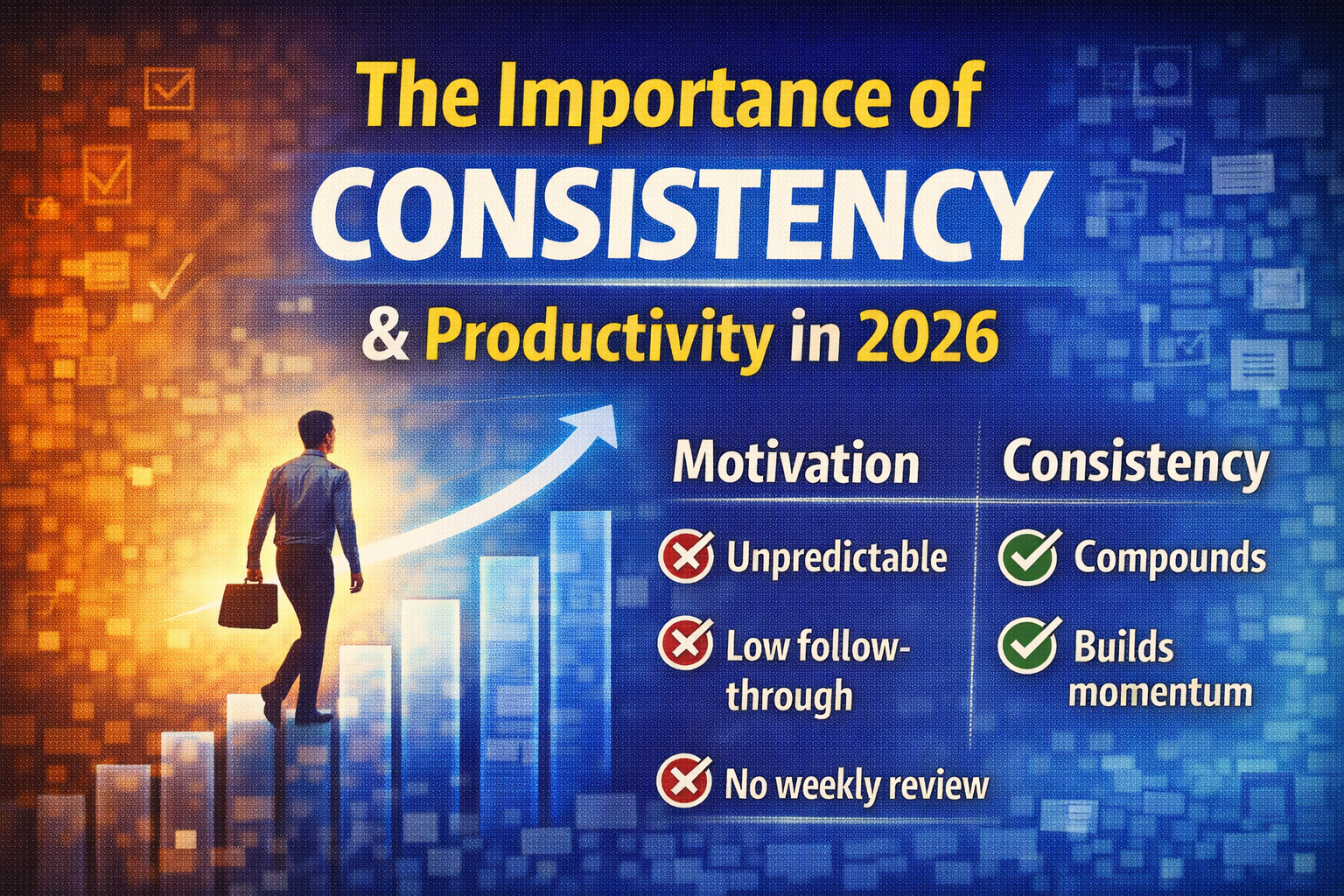
The Importance of Consistency in Productivity (Why It Beats Motivation in 2026)
Introduction
Most people think productivity comes from intensity.
A "perfect" day. A huge burst of motivation. A long sprint where everything gets done.
That feels good, but it rarely changes your life.
What changes your life is consistency.
Consistency is what turns small actions into:
- real progress
- momentum
- skill growth
- business growth
- better health
- finished projects
- long-term confidence
In 2026, consistency matters more than ever because distractions are endless and tools make starting easy - but finishing still requires repetition.
Why consistency is a force multiplier
Consistency is powerful because it creates compounding.
One workout doesn't change your body. One day of writing doesn't create a book. One day of marketing doesn't grow a business.
But small actions repeated for months do.
Consistency turns effort into a predictable result.
Motivation is unreliable (and that's normal)
Motivation is a feeling.
It depends on:
- sleep
- mood
- stress
- weather
- life problems
- confidence
So if your productivity requires motivation, your results will be random.
Some weeks you'll feel unstoppable. Other weeks you'll drift.
Consistency doesn't rely on how you feel. It relies on what you do.
Consistency creates momentum (and momentum makes work easier)
The hardest part is starting after a gap.
When you skip for a week:
- tasks feel heavier
- your brain resists
- you lose clarity
- you feel guilty
- you procrastinate more
When you stay consistent:
- your brain expects the routine
- the workload stays manageable
- you don't need a "restart"
- progress becomes normal
Momentum is not hype. It's reduced friction.
Consistency is mostly about reducing friction, not "trying harder"
People fail consistency because the system is too hard.
Examples:
- goals are too big
- routines take too long
- planning is complicated
- tools are scattered
- distractions are too easy
The fix is not "more discipline."
The fix is building a system where the next action is easy.
The 7 Rules of Consistency That Actually Work
1) Make it small enough to never skip
If your daily habit requires 2 hours, you'll miss it on busy days.
Better:
- 20 minutes daily
- or even 5 minutes daily
Consistency beats size.
Rule: Make the habit so small that the excuse disappears.
2) Protect a fixed time slot (same time, same trigger)
Habits stick when they are attached to a trigger:
- after coffee
- after lunch
- after work
- before dinner
Rule: Same time, same place, same start ritual.
3) Use "minimum commitment" rules
This is how you stay consistent even on bad days:
Examples:
- write 50 words (minimum)
- do 10 pushups (minimum)
- do 5 minutes of planning (minimum)
- open the project and do 1 small fix (minimum)
Rule: Never miss twice.
4) Track streaks of action, not perfection
Perfection kills consistency.
One missed day doesn't ruin a year. Quitting does.
Rule: Track simple streaks:
- days you showed up
- deep work blocks done
- weekly reviews completed
5) Build weekly reviews (consistency needs steering)
A week is the best time horizon.
Without weekly review:
- you drift
- priorities disappear
- your calendar fills
- goals become "someday"
Rule: Weekly review every Sunday (or your chosen day).
6) Reduce decisions (decision fatigue kills consistency)
If you decide every day:
- what to do
- when to do it
- how to do it
…you'll eventually stop.
Rule: Make defaults:
- 3 priorities max
- deep work first
- same planning routine
- same review checklist
7) Design your environment to make the right action easy
If distractions are one tap away, consistency dies.
Rule:
- phone out of work area
- notifications off
- work setup ready
- capture tasks instantly
Environment beats willpower.
Consistency vs intensity: the simple truth
Intensity feels productive. Consistency produces results.
Intensity:
- hard to maintain
- creates burnout
- depends on mood
Consistency:
- sustainable
- compounds
- builds confidence
If you want a better 2026, don't ask: "How can I do more?"
Ask: "How can I do the right things consistently?"
How Self-Manager.net helps with consistency
Consistency improves when:
- tasks are tied to real days
- progress is visible by week/month
- weekly reviews are easy to run
- your plan is always in one place
A date-based system supports that naturally:
- you see what you did each day
- you see when you drifted
- you can restart without losing your history
- you can plan the next week in minutes
Consistency isn't about being perfect.
It's about showing up enough times that success becomes predictable.

AI Powered Task Manager
Plan smarter, execute faster, achieve more
Create tasks in seconds, generate AI-powered plans, and review progress with intelligent summaries. Perfect for individuals and teams who want to stay organized without complexity.
Get started with your preferred account