Stop Confusing Yourself: Define the Productivity Problem — Then Solve It (Sam Ovens)
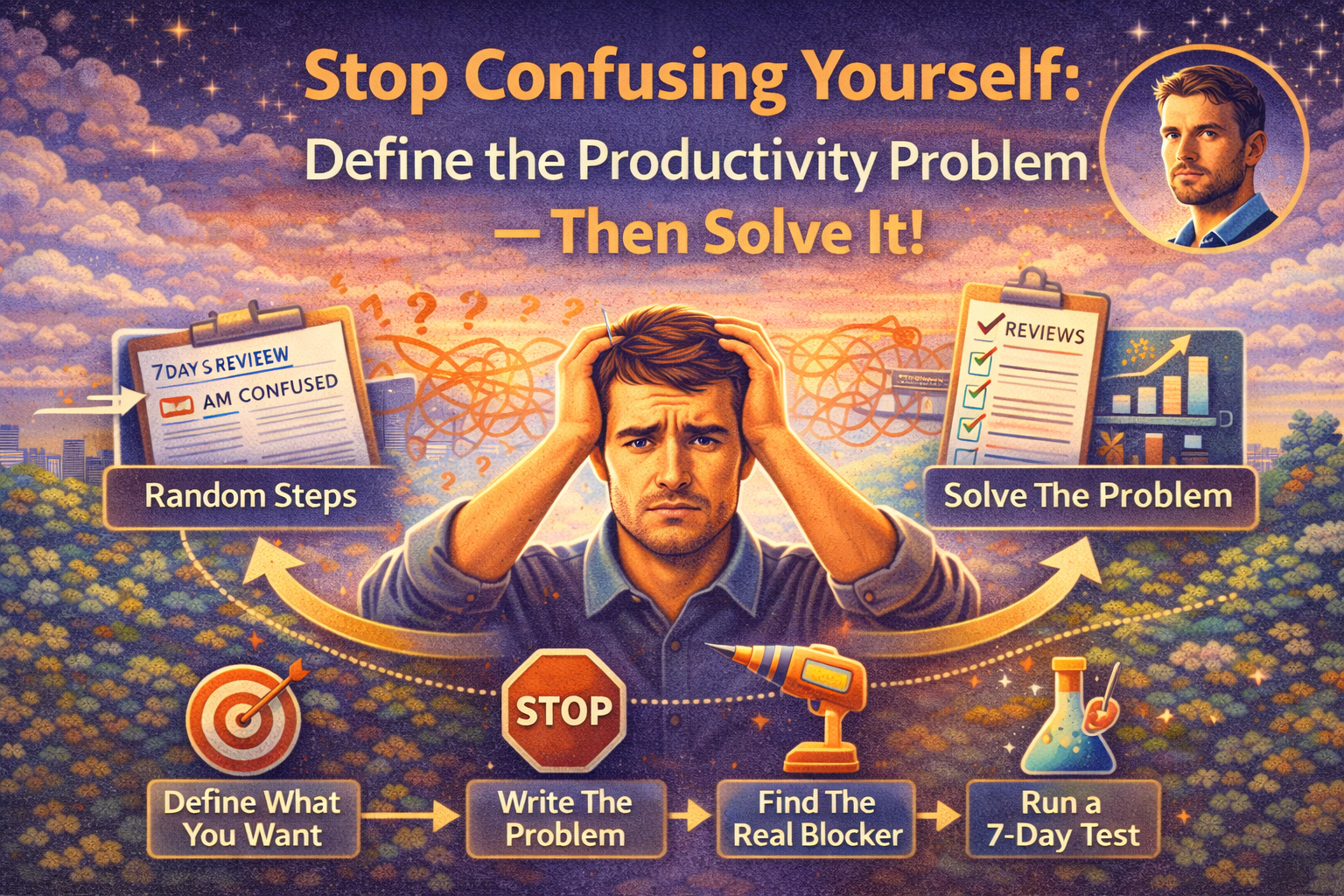
A lot of "productivity struggle" is actually confusion.
You feel busy, frustrated, scattered… but you can't clearly answer:
- What's the real problem?
- What do I want instead?
- What is the simplest next step to test?
Sam Ovens' point in "Stop Confusing Yourself — Define The Problem And Solve It!" is straightforward:
Confusion happens when you don't know what to do.
To know what to do, you must first define what you want.
Then choose actions based on how likely they are to achieve it — and do them until you get what you want.
This article turns that into a practical system for finding the one problem blocking your productivity.
The productivity trap: treating symptoms instead of the problem
Most people try to "solve productivity" with:
- a new app
- a new routine
- new motivation
- more hustle
But if you don't define the problem, you'll keep swapping tools while the real blocker stays.
Common symptoms:
- "I can't focus"
- "I'm overwhelmed"
- "I don't finish what I start"
- "I'm behind every week"
- "I'm working a lot but nothing ships"
Those are symptoms. The problem is underneath.
Step 1: Define what you want (in measurable terms)
If the goal is vague, the plan becomes noise.
Bad goal: "Be more productive."
Better goals:
- "Ship 2 meaningful outputs per week."
- "Do 10 hours of deep work per week."
- "Finish my top task 4 days per week."
- "Reduce admin time to under 5 hours/week."
Write what you want as a result, not a feeling.
This is the "north star" that reduces confusion.
Step 2: Write the problem as a single sentence
Use this format:
"I want ___, but ___ is preventing it."
Examples:
- "I want 10 deep work hours/week, but meetings + messages break my day."
- "I want to ship weekly, but my projects are not defined into next actions."
- "I want consistent progress, but I over-plan and under-execute."
- "I want to finish tasks, but I start too many things at once."
If you can't write it in one sentence, you're still in confusion mode.
Step 3: Find the real blocker (the "5 Whys" mini-drill)
Take your sentence and ask "Why?" up to 5 times.
Example:
- "I can't focus."
- Why? "I check messages constantly."
- Why? "I'm afraid of missing something."
- Why? "There's no defined response window."
- Why? "I don't have protected deep work blocks."
- Why? "I don't plan the week with constraints."
Now the problem isn't "focus."
It's lack of boundaries and scheduling constraints.
That's solvable.
Step 4: Design the smallest solution (a 7-day test)
Your goal is not to build a perfect system.
Your goal is to run a small experiment that proves/disproves your hypothesis.
Use this template:
Hypothesis: If I do ___, then ___ will improve because ___.
Test duration: 7 days
Success metric: ___
Examples of good tests:
- "One 90-minute deep block before any messages."
- "Plan only 3 tasks/day max + one 'Top 1' must-win."
- "Define every task as a 'next action' (verb-first)."
- "Batch admin to one daily window."
- "No meetings before 12:00 for one week."
This matches the "select what to do based on likelihood of achieving what you want — then do it" principle.
Step 5: Review results and iterate (avoid re-confusing yourself)
At the end of 7 days:
- What improved?
- What stayed stuck?
- What was the unexpected blocker?
- What will you change next week?
This is how you escape the loop of "I'm confused → I try random things → I'm confused again."
The 10-minute worksheet (copy/paste)
What I want (measurable):
Current reality (what's happening now):
Problem sentence: "I want ___, but ___ is preventing it."
5 Whys (root cause):
7-day test:
Metric to track:
Review date:
How to run this inside Self-Manager.net (simple workflow)
Create a "Problem → Solution" weekly table with 4 sections:
- What I want (this week) (one measurable outcome)
- The blocker (one sentence)
- The 7-day test (smallest experiment)
- Review (what worked / what didn't / next adjustment)
Then your productivity becomes a repeatable loop:
define → test → review → improve, instead of "try harder."
Final thought
Most people aren't lazy.
They're unclear.
Define what you want, define the real problem, run a small test, and review.
Confusion disappears when your next step is obvious.

AI Powered Task Manager
Plan smarter, execute faster, achieve more
Create tasks in seconds, generate AI-powered plans, and review progress with intelligent summaries. Perfect for individuals and teams who want to stay organized without complexity.
Get started with your preferred account