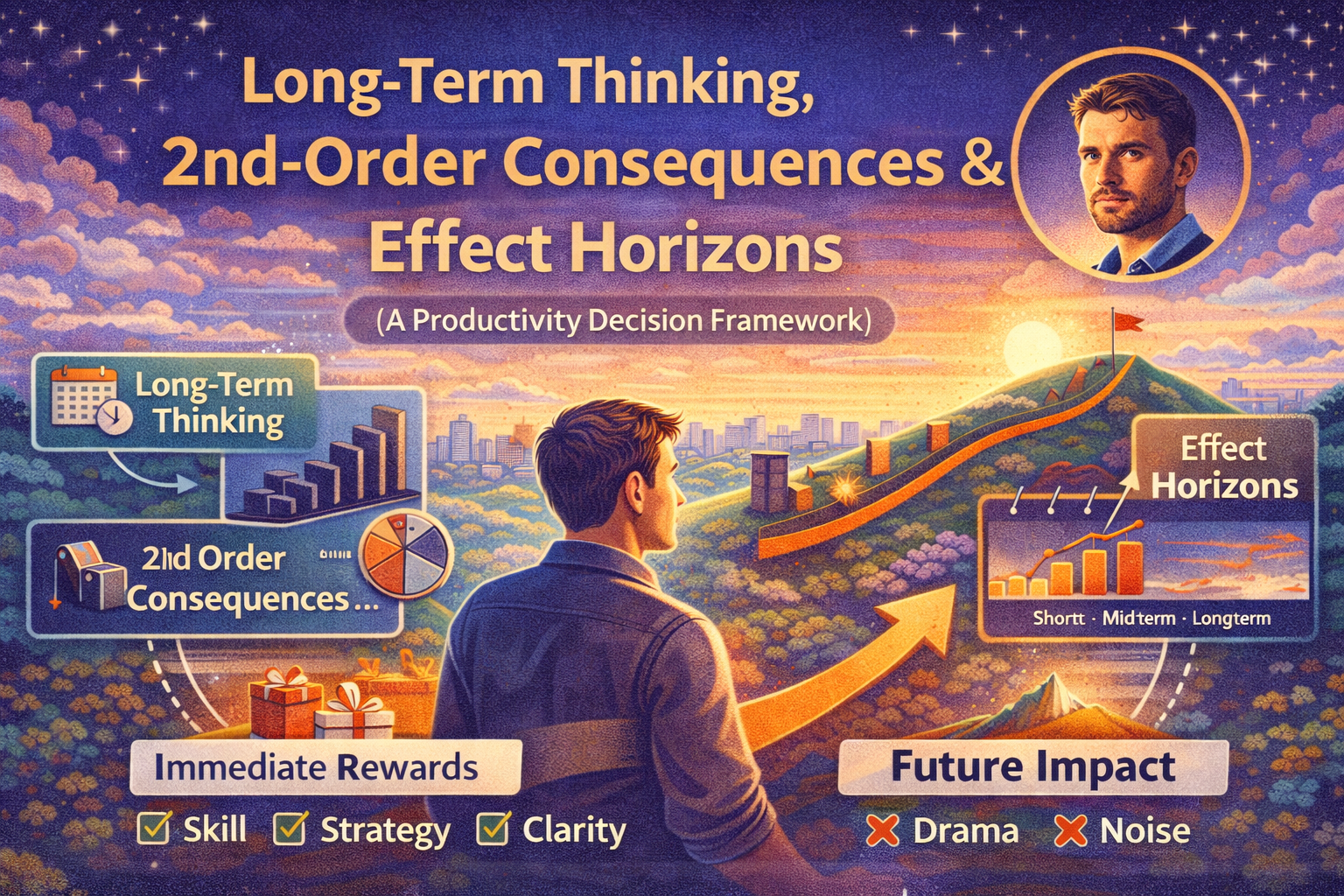
Long-Term Thinking, 2nd-Order Consequences & "Effect Horizons" (Sam Ovens) — A Productivity Decision Framework
Most productivity advice focuses on doing more.
This framework focuses on something deeper:
choosing actions whose benefits grow over time — and avoiding actions that feel good now but quietly destroy your future.
Sam Ovens explains this through:
- long-term thinking
- second-order consequences
- effect horizons (how outcomes unfold across time)
This article turns that into a practical, repeatable system you can use for real decisions in 2026.
The core idea: time changes the true value of decisions
Two actions can look similar today… but produce wildly different outcomes later.
That's why Sam frames time as the most powerful variable people forget to include in their "mental models" and daily decisions.
If you want better productivity, you don't just need better tactics.
You need better time-aware decision making.
Long-term thinking (simple definition)
Long-term thinking means accepting short-term discomfort to earn long-term, often compounding upside.
A useful rule of thumb from this worldview:
- Many "good" actions suck now but pay later (gym, reading, building systems).
- Many "bad" actions feel great now but cost later (doom scrolling, junk food, constant distraction loops).
Second-order consequences: "and then what?"
First-order thinking asks:
- "What happens immediately?"
Second-order thinking asks:
- "And then what happens after that?" (the ripple effects)
Second-order thinking is widely described as looking beyond the immediate result to the longer-term ripple effects of a decision.
Sam emphasizes that consequences create reactions, which create more consequences — and the chain can compound.
Effect horizons: the "graph" of a decision over time
An effect horizon is a mental picture of how a decision plays out across time:
- short term (today / this week)
- medium term (months)
- long term (years)
In Sam's framing: map the upsides/downsides across time so you don't choose the "easy now, painful later" path by accident.
The Productivity Lens: why this matters
A lot of people are "productive" in the short term while destroying long-term momentum.
Examples:
- answering messages all day (feels productive) → no deep work shipped (long-term stagnation)
- endless news/social updates (feels informed) → fragmented attention (long-term focus loss)
- optimizing tools weekly (feels like progress) → avoiding meaningful work (long-term delay)
This framework prevents that.
The 5-Step "Effect Horizon" Decision Worksheet (copy/paste)
Use this for any meaningful decision (habits, business moves, priorities):
Decision: _______________________
1) First-order effect (today / this week):
- What happens immediately?
2) Second-order effect (2–12 weeks):
- What new behaviors does this create?
- What does it displace?
3) Third-order effect (6–24 months):
- What identity/skill/system forms?
- Does this compound or decay?
4) Hidden cost:
- What will this quietly steal (time, energy, attention, reputation)?
5) "Hill or wheelchair?"
- Is this the easy path now that costs later, or the hard path now that pays later?
If you can't answer #2 and #3 clearly, you're probably choosing based on short-term emotion.
Practical examples (quick)
Example A: "Check social media in the morning"
- First-order: quick dopamine + updates
- Second-order: attention fragmentation, harder to start deep work
- Third-order: weaker focus baseline, less output, lower confidence
Result: feels harmless, compounds negatively.
Example B: "Do a 60–90 minute deep work block daily"
- First-order: discomfort, less "busywork" done
- Second-order: shipping increases, clarity improves
- Third-order: compounding skill, reputation, and momentum
Result: feels harder, compounds positively.
How to implement this inside Self-Manager.net
If you want this framework to actually change your life, you need a place to store decisions + reviews.
A simple workflow:
- Create a "Decision Log" table (weekly or monthly).
- For each big decision, paste the Effect Horizon worksheet.
- During your weekly review, ask:
- "Which decisions produced positive second-order effects?"
- "Which ones quietly created drag?"
- Convert the best long-term decisions into recurring actions (systems beat motivation).
That turns "long-term thinking" from a concept into a compounding practice.
Closing thought
Most people optimize for what feels good this week.
High performers optimize for what creates a better life next year — by understanding second-order consequences and choosing actions with better effect horizons.

AI Powered Task Manager
Plan smarter, execute faster, achieve more
Create tasks in seconds, generate AI-powered plans, and review progress with intelligent summaries. Perfect for individuals and teams who want to stay organized without complexity.
Get started with your preferred account