Cause & Effect Timeframes: Why Today's Results Came From Last Year's Work (Sam Ovens)
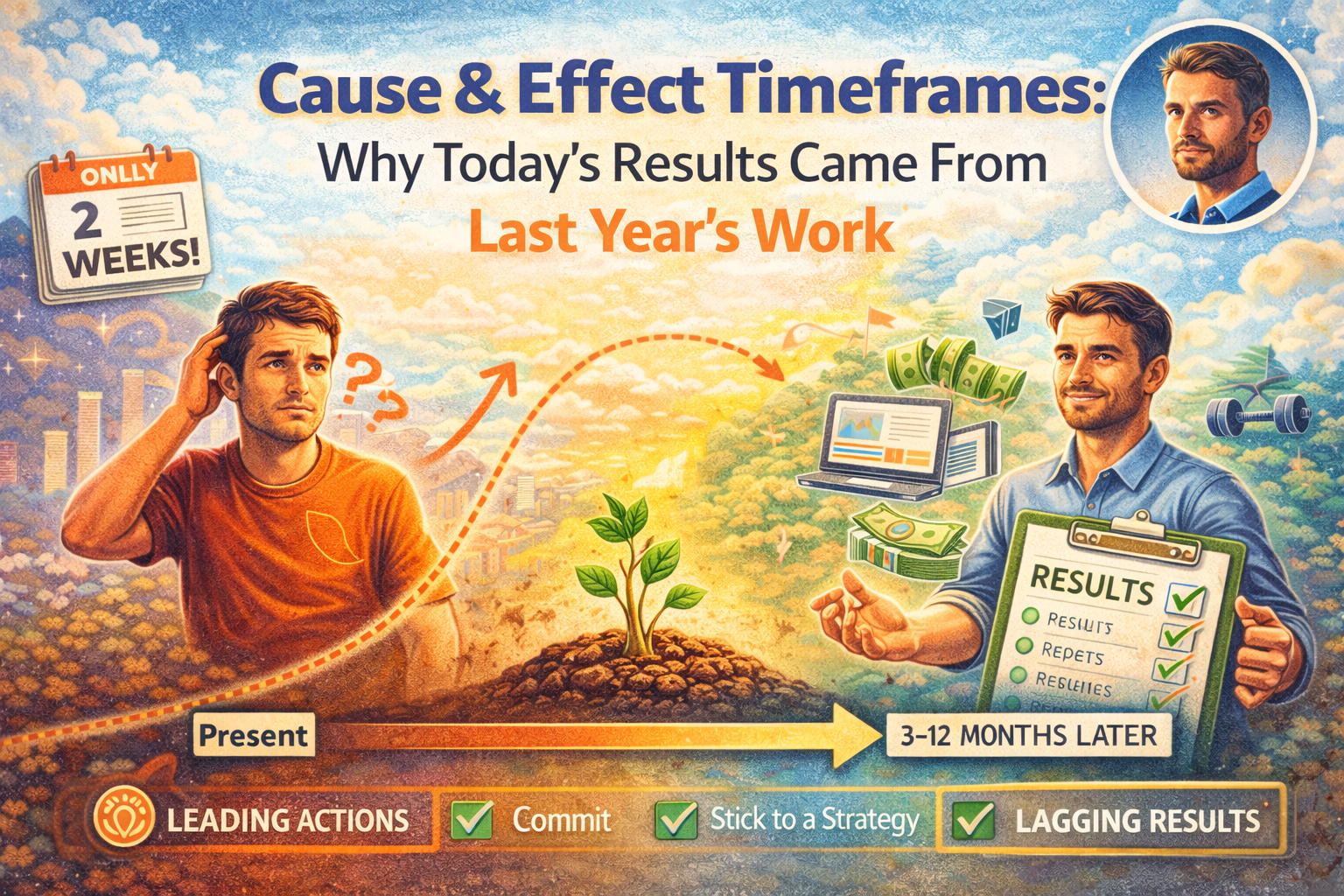
Most people quit too early because they expect results on the wrong timeline.
They take action for a week, don't see a reward, and assume it "didn't work." Then they switch strategies, restart, and repeat.
Sam Ovens' point in "Cause & Effect Timeframes: Why Today's Results Came From Last Years Work" is that many meaningful actions have a delayed payoff—often months to 1–2 years—and if you don't understand that delay, you'll keep abandoning the very actions that would have worked.
This article turns that idea into a practical productivity framework you can use in 2026.
The core idea: results are delayed signals
A lot of outcomes you see today are lagging indicators:
- your current fitness
- your reputation
- your audience growth
- your revenue stability
- your skill level
- your product's traction
They are not "today's work."
They're the consequence of actions you repeated months ago.
And that's why people get confused:
- they judge a long-term strategy on a short-term scoreboard
- they stop right before the compounding phase
Why this matters for productivity
If you only operate on "today / this week / this month" timeframes, you'll optimize for:
- quick wins
- easy tasks
- constant switching
- "shiny object" behavior
But the work that changes your life usually looks like this:
- boring repetition
- no immediate reward
- small progress
- long delay
- sudden visible result later
Sam highlights that many people don't see long-term cause/effect clearly and abandon actions when rewards aren't immediate, even though the real payoff often shows up much later.
The Cause & Effect Timeframes Framework
1) Separate leading actions from lagging results
Leading actions = what you do repeatedly
Lagging results = what shows up later
Examples:
Leading actions
- publish 2 posts/week
- outreach 20 messages/week
- deep work 10 hours/week
- ship one feature/week
- train 3x/week
Lagging results
- audience growth
- pipeline quality
- shipped output volume
- product adoption
- fitness changes
If you measure the wrong thing (lagging results too early), you'll quit.
2) Assign an "effect timeframe" to each goal
Ask:
"How long until this action realistically shows results?"
Typical reality:
- 1–7 days: cleanup, admin, clarity, small fixes
- 2–8 weeks: habits, content consistency, early momentum
- 3–12 months: reputation, skill jumps, meaningful growth
- 1–2 years: compounding outcomes (big shifts)
Sam's framing is basically: don't expect a 12-month effect from a 7-day effort.
3) Stop switching strategies inside the delay window
Most people "fail" by switching too early.
They plant seeds, dig them up every week to check progress, and then say, "Nothing grows."
The fix is simple:
- pick a strategy
- define the leading actions
- commit for the full effect timeframe
- review the actions weekly (not the final outcome daily)
A simple worksheet (copy/paste)
Goal (lagging result): __________
Expected effect timeframe: __________ (weeks/months)
Leading actions (weekly):
- ---
- ---
- ---
Leading scoreboard (track weekly):
- reps completed: ____ / ____
- deep work hours: ____
- outputs shipped: ____
Review question:
"Did I do the causes consistently enough to deserve the effect yet?"
Practical examples (so it clicks)
Example A: Building an audience
Lagging result: more inbound leads
Timeframe: 3–12 months
Leading actions: publish weekly, reply to comments, improve clarity
Scoreboard: # posts shipped, # conversations started, # improvements made
If you judge this in 2 weeks, you'll quit.
Example B: Improving focus and output
Lagging result: more shipped work
Timeframe: 4–12 weeks
Leading actions: daily deep block, fewer meetings, timeboxed admin
Scoreboard: deep work hours, # of "Top 1" days completed, outputs shipped
Example C: Getting stronger/leaner
Lagging result: visible body change
Timeframe: 3–6 months
Leading actions: workouts/week + protein + sleep
Scoreboard: workouts completed, sleep consistency, adherence %
How to implement this inside Self-Manager.net
Self-Manager.net is naturally built for this because it stores work by date, which makes cause → effect easier to see over time.
A clean setup:
- Create a weekly table called: "Causes I'm Committing To"
- Add your 3–5 leading actions as recurring items (your weekly reps)
- Track completion weekly (not emotionally daily)
- Add a monthly review table: what causes were consistent, what drifted, what to adjust
Over time, you'll literally see the timeline:
repeated causes (weeks) → visible effects (months).
Final thought
If you feel like "nothing is working," it might not be because your strategy is wrong.
It might be because you're checking results too early and switching inside the effect timeframe.
Track the causes. Give them time. Let the effects arrive.

AI Powered Task Manager
Plan smarter, execute faster, achieve more
Create tasks in seconds, generate AI-powered plans, and review progress with intelligent summaries. Perfect for individuals and teams who want to stay organized without complexity.
Get started with your preferred account