Music and Productivity: How the Right Sound Puts You in the "Work Mood" (And Why It Works)
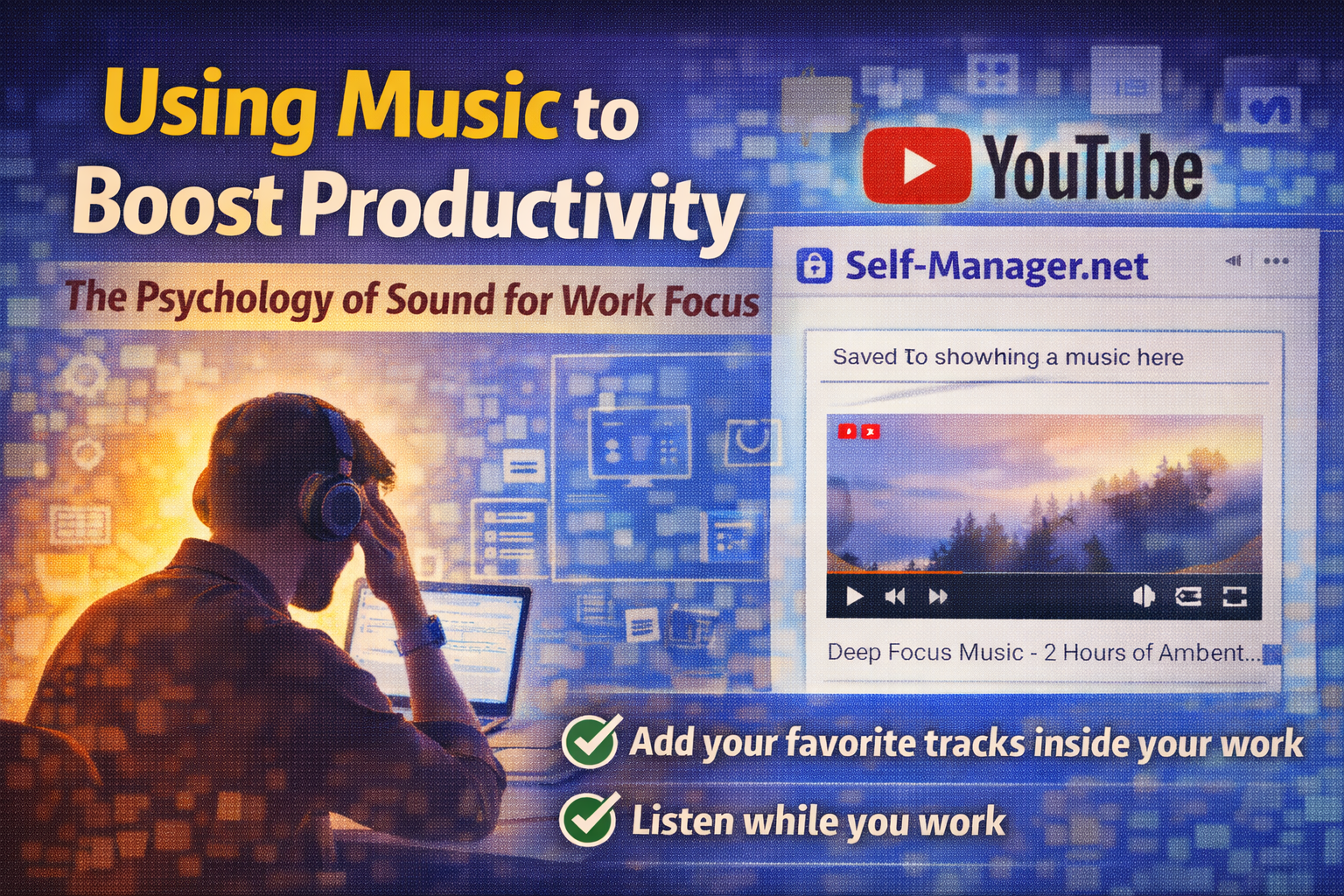
Introduction
Music isn't just entertainment.
For a lot of people, it's a tool:
- it relaxes you when you're stressed
- it lifts your mood when you feel low-energy
- it helps you start working when you're stuck
- it can make boring tasks feel easier
That's not imagination. It's basic human psychology.
We react strongly to music we like because it directly influences:
- emotion (how you feel)
- arousal (how energized you are)
- attention (what you focus on)
- habits (what routines you repeat)
And those are the real drivers of productivity.
Why music affects us so much (simple psychology)
1) Music changes your emotional state fast
Emotion drives behavior.
If you feel anxious, bored, or overwhelmed, you'll avoid hard work. Music can shift your emotional "baseline" in minutes:
- calmer
- more confident
- more energized
- less stressed
That makes starting easier.
2) Music is a mood cue (your brain learns association)
This is huge for productivity.
If you repeatedly listen to the same type of music when you work, your brain starts to associate it with "focus mode."
Just like:
- coffee = work mode
- gym playlist = training mode
Over time, music becomes a trigger that helps you switch states quickly.
3) Music can reduce the feeling of effort
Some tasks feel heavy because they're emotionally boring or repetitive.
Music adds stimulation. That makes the task feel less painful, so you can keep going longer.
4) Music reduces perceived stress
Even if the work is hard, music can lower the stress response. That helps you stay in the task instead of escaping into distractions.
The productivity benefits of music (when used correctly)
1) Faster "start" (breaks procrastination)
Often the hardest part is starting. Music can create a quick transition into action.
Tip: Have a "start playlist" that you only use for working.
2) Better mood = better decisions
Your mood influences your choices. Music you enjoy can lift you into a more resourceful state:
- you choose harder tasks
- you tolerate discomfort better
- you give up less easily
3) More endurance on repetitive tasks
For admin work, cleaning, organizing, boring tasks: music helps you sustain effort.
4) Less loneliness for solo work
If you work alone (freelancing, building a product), music creates a feeling of "presence," which can help people stay engaged.
The downside: music can also reduce deep focus
Not all music improves productivity.
Music can hurt deep work if:
- it has lyrics (your brain processes language)
- it's too stimulating
- you keep changing tracks (micro-distractions)
- you start browsing for the "perfect song"
So the key is choosing music that matches the type of work.
Best music types for different work modes
Deep work (writing, coding, thinking)
Best:
- instrumental
- ambient
- lo-fi
- classical
- film/game soundtracks
- brown noise / white noise (for some)
Why: Lyrics compete with your thinking.
Repetitive tasks (admin, email, cleaning, easy production)
Best:
- music you enjoy, even with lyrics
- energetic playlists
- upbeat tracks
Why: Your brain doesn't need maximum "thinking bandwidth."
Stress reduction (overwhelm, anxiety, shutdown)
Best:
- slow, calming music
- ambient
- piano, acoustic
- nature sounds
Why: You want down-regulation, not stimulation.
A simple "music system" for productivity
If you want to use music intentionally, do this:
1. Make 3 playlists:
- Focus (instrumental)
- Energy (upbeat)
- Calm (slow)
2. Use them as triggers:
- Focus playlist = deep work block
- Energy playlist = start + repetitive tasks
- Calm playlist = stress reset + planning/review
3. Don't search for music during work
Pick one playlist and leave it.
4. Keep volume low enough that it's background
If the music becomes the main activity, it's no longer helping.
Music as a ritual: how to use it to enter "work mode"
This is a powerful trick:
Create a 3-step ritual:
- put on headphones
- start the focus playlist
- open the one task you'll work on
Do that every day.
Your brain will learn: headphones + playlist = it's time to work
This reduces the mental friction of starting.
How Self-Manager.net fits this
Music helps you enter the right state. Self-Manager helps you know what to do once you're in that state.
A good combo is:
- Music to shift mood and start
- A daily view with clear next actions to execute
- Weekly review to notice what playlists work best for what work
You can even note in your daily logs:
- what music you listened to
- what type of work you did
- how productive it felt
Over time you'll learn your best "sound + task" pairings.
Conclusion
Music is a powerful productivity tool because it directly influences emotion, energy, attention, and habit formation—the core drivers of productive behavior.
The key is using music intentionally:
- Deep work: instrumental, ambient, lo-fi (no lyrics to compete with thinking)
- Repetitive tasks: upbeat, energetic music you enjoy
- Stress reduction: slow, calming sounds
Build a simple system: 3 playlists (Focus, Energy, Calm) used as state triggers. Don't search for music during work—pick a playlist and stay in it.
Music + ritual = faster work mode activation. Over time, headphones + your focus playlist becomes a conditioned signal: "it's time to work."
Combine music with a clear daily plan in Self-Manager, and you've got both the emotional state and the execution structure to actually get things done.

AI Powered Task Manager
Plan smarter, execute faster, achieve more
Create tasks in seconds, generate AI-powered plans, and review progress with intelligent summaries. Perfect for individuals and teams who want to stay organized without complexity.
Get started with your preferred account