Instant Gratification Is the Silent Productivity Killer (And How to Break the Habit in 2026)
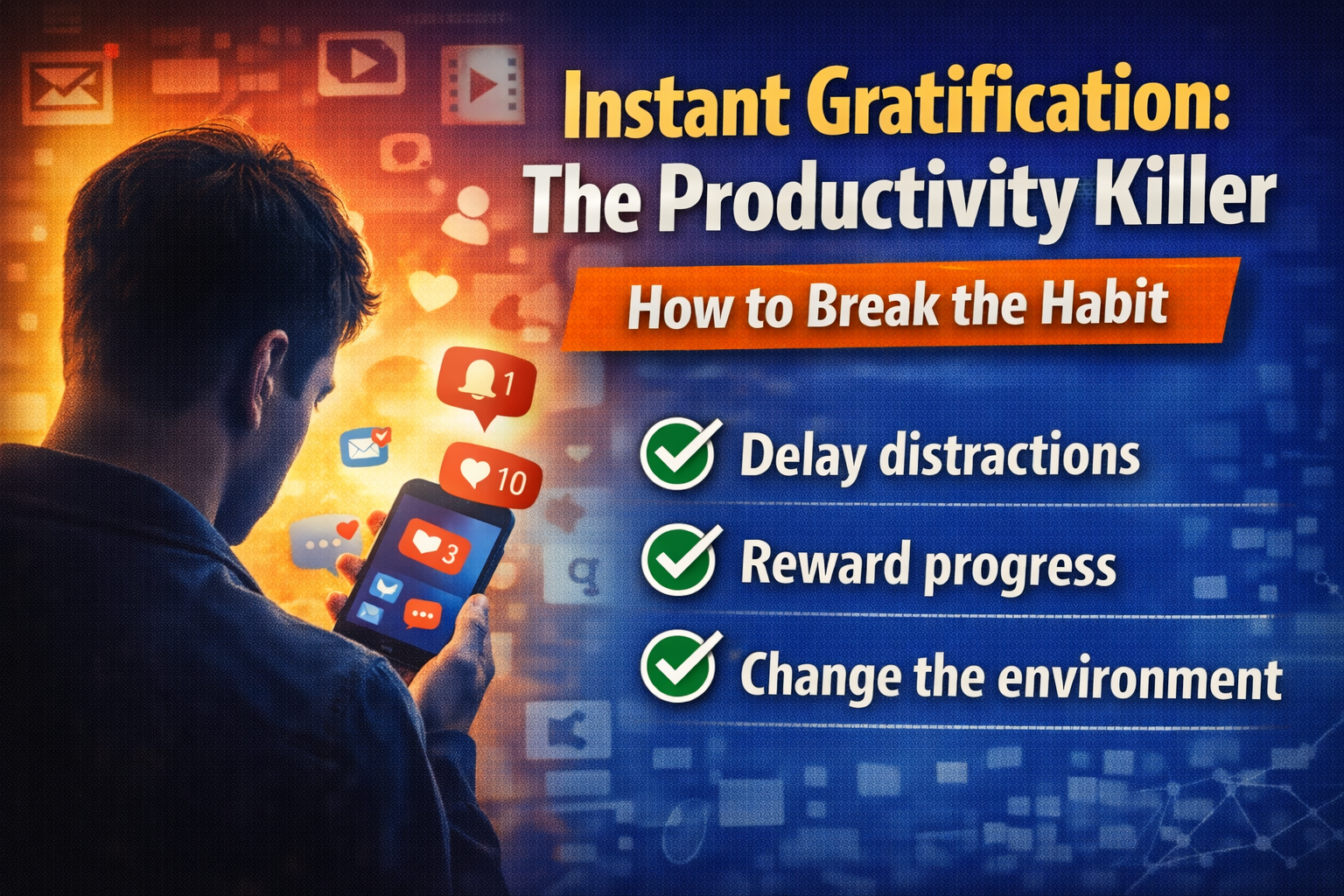
Instant gratification is the default setting of modern life.
Your brain gets trained to expect quick rewards:
- notifications
- short videos
- quick likes
- quick wins
- quick dopamine
The problem is that most meaningful progress is the opposite:
- slow
- quiet
- delayed
- boring in the beginning
- rewarding later
So you end up with a mismatch:
Your brain wants a reward now.
Your goals pay you later.
That gap is where productivity collapses.
This article explains what instant gratification is doing to your productivity and a practical system for getting out of the habit without relying on "willpower."
Why instant gratification pulls you off track
Instant gratification isn't "laziness." It's your brain doing something rational:
It chooses the sure reward over the uncertain reward.
Scrolling, snacks, checking messages, watching one more video…
they all pay immediately.
Deep work, learning, building a product, working out, writing, growing a business…
those rewards are delayed.
So your brain keeps doing what pays today.
The hidden cost: it destroys momentum
Instant gratification does 3 things that break momentum:
1. It breaks focus into tiny pieces
Even a 30-second distraction can reset your mental state.
2. It trains impatience
You start expecting progress to feel rewarding instantly.
But real projects feel messy before they feel good.
3. It removes "friction" from the wrong things
Apps and feeds are designed to be effortless.
Your real goals often have friction at the start.
So you default to the easiest reward.
The real solution is not "discipline"
Discipline helps, but discipline alone fails because:
- you get tired
- you get stressed
- you have bad days
- you lose motivation
The solution is to change your environment and your reward system so the right behavior becomes easier.
Think of it like this:
You don't beat instant gratification by fighting your brain.
You beat it by redesigning what your brain gets rewarded for.
9 Practical Ways to Break the Instant Gratification Habit
1) Create a "delay buffer" (make gratification slightly harder)
Instant gratification wins because it's instant.
So add a small delay.
Examples:
- remove social apps from your home screen
- log out of apps after each session
- keep your phone in another room during deep work
- block short-video sites during work hours
You're not "quitting." You're adding friction.
That tiny delay is often enough to break autopilot.
2) Replace "instant dopamine" with "instant progress"
Your brain wants a reward now. Give it one.
Instead of fighting that need, redirect it:
- make the reward "checking something off"
- "closing a loop"
- "finishing a small step"
Practical habit:
- start the day with a 10-minute win:
- write a paragraph
- fix one bug
- outline a page
- clean one inbox thread
- do 20 push-ups
That creates real momentum fast.
3) Use "micro-starts" (remove the painful first 2 minutes)
Most instant gratification happens at the start of work because starting is uncomfortable.
So make starting tiny.
Examples:
- "Open the project and write 2 lines"
- "Work for 5 minutes only"
- "Add the next action, not the whole plan"
- "Just set up the file and title"
Once you begin, resistance drops.
4) Make the goal visible daily (out of sight = out of action)
Instant gratification wins when your goals are invisible.
Practical habit:
- Put your weekly goals where you see them every day:
- pinned in your daily system
- on your desk
- as a simple daily note
If your goal isn't visible, your feed becomes the goal.
5) Schedule "guilt-free gratification"
If you try to suppress all gratification, you'll snap back harder.
Better approach:
- 30 minutes of guilt-free content at a specific time
- no random grazing all day
Your brain stops panicking because it knows it will get a reward later.
6) Track "streaks of focus," not just tasks
A lot of people track output but ignore attention.
Your attention is the asset.
Practical habit:
- Track one number daily:
- "Deep work blocks completed"
- "Minutes of focus"
- "Focus sessions without interruption"
This makes progress feel real fast.
7) Replace dopamine loops with reflection loops
A feed gives you novelty.
A review gives you meaning.
Practical habit:
- End of day: 2-minute review
- What did I do today that mattered?
- What did I avoid?
- What's the next action for tomorrow?
This trains your brain to get reward from progress, not novelty.
8) Design your environment for the person you want to be
You will become whatever is easiest to be.
So ask:
- What behavior is easiest in my current setup?
- What behavior do I want to be easiest?
Examples:
- keep a notebook open on desk
- keep tasks visible in a daily view
- block distractions by default
- keep workout gear ready
- keep your current project one click away
9) Use a "dopamine budget"
Not all instant gratification is bad.
But you need a budget.
Practical habit:
- Decide the daily limit in advance:
- 30–60 minutes total
- only after the key work block
- ideally in one session
If you control the dose, it stops controlling you.
A Simple 7-Day Reset Plan (No Willpower Required)
Day 1: Remove 1 easy distraction trigger (home screen / notifications)
Day 2: Add 1 friction step (phone outside room during work)
Day 3: Add a 10-minute "instant progress" habit
Day 4: Do 1 deep work block (25–50 mins) before any scrolling
Day 5: Add a guilt-free gratification window (scheduled)
Day 6: Start tracking focus blocks daily
Day 7: Do a weekly review and adjust your environment
This plan works because it changes the system, not just your intentions.
How Self-Manager.net Helps You Break Instant Gratification
Instant gratification thrives in chaos.
A date-based system reduces chaos by turning your day into a clear sequence:
- your goals are visible daily (so you don't drift)
- tasks are tied to real dates (so they stop floating forever)
- daily and weekly reviews create reward from progress
- AI summaries can highlight what you actually did (not what you intended)
When your progress is visible, the feed becomes less tempting.
Because your brain starts getting dopamine from real momentum again.

AI Powered Task Manager
Plan smarter, execute faster, achieve more
Create tasks in seconds, generate AI-powered plans, and review progress with intelligent summaries. Perfect for individuals and teams who want to stay organized without complexity.
Get started with your preferred account