Top Productivity Lessons Learned From Larry Ellison (That Still Work in 2026)
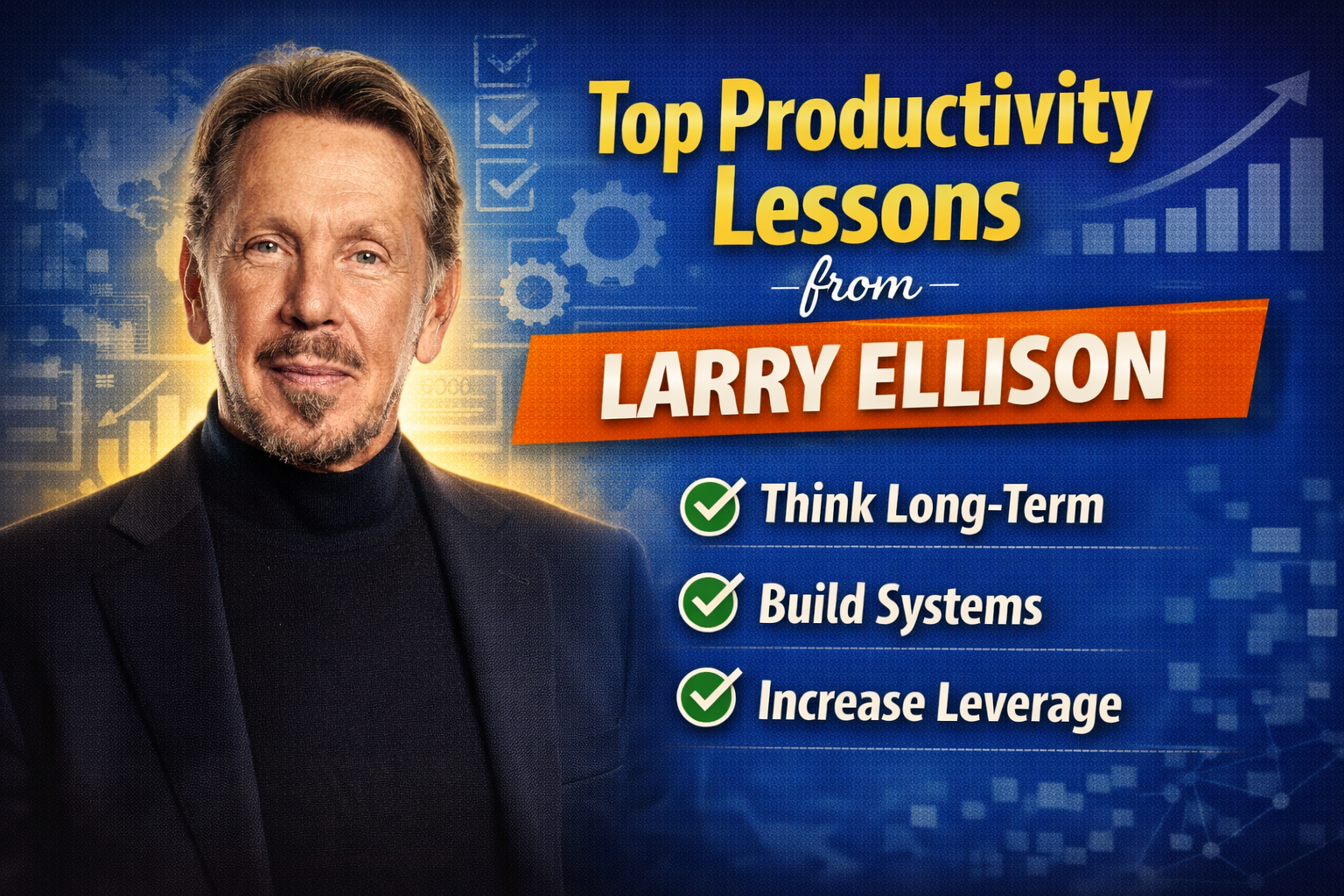
Larry Ellison built Oracle by playing a different game than most people: he stayed obsessively focused, thought in systems, and cared about durability (not quick wins). Whether you like his personality or not, his approach contains a bunch of productivity lessons that translate well to building products, running a business, or simply doing high-value work without drowning in noise.
This isn't "wake up at 4AM" advice. It's about clarity, leverage, and execution.
1) Obsession beats motivation (pick a mission and stay on it)
Ellison's career is basically an example of sustained obsession:
- one domain (enterprise software)
- one long time horizon
- relentless iteration and competition
Productivity lesson:
- Motivation is unreliable.
- Obsession creates a default direction.
Practical habit:
- Pick 1–2 "core missions" for the year (not 10 goals).
- Everything else becomes optional.
2) Think in systems, not tasks
Oracle is systems on systems: databases, infrastructure, enterprise processes. Ellison's worldview is naturally "architectural."
Productivity lesson:
- Tasks are output.
- Systems produce output repeatedly.
Practical habit:
- Don't ask "What tasks do I need to do?"
- Ask: "What system would make this happen every week without effort?"
Examples:
- Content system (2 posts weekly)
- Weekly review system (Sunday planning)
- Sales system (daily outreach + follow-ups)
- Shipping system (weekly release cadence)
3) Focus on competitive advantage, not generic improvement
Ellison competed hard, and competition forces clarity:
- What are we uniquely good at?
- Where do we win?
- What should we ignore?
Productivity lesson:
- Being "well-rounded" can dilute results.
- Doubling down on your advantage creates momentum.
Practical habit:
- Identify your "unfair advantage zone":
- fastest at execution
- strongest at design
- best at technical depth
- best at distribution
- Spend 70% of your deep work time there.
4) Build for scale early (avoid fragile workflows)
Ellison's products were built for large organizations, big loads, and long-term reliability. That mindset applies to your personal productivity too.
Productivity lesson:
- A system that only works when you feel perfect will collapse under stress.
- You want workflows that survive busy weeks.
Practical habit:
- "Stress test" your system:
- Can I still capture tasks in 10 seconds?
- Can I review the week in under 20 minutes?
- Can I keep priorities visible without re-planning daily?
If the answer is no, simplify.
5) Speed comes from clarity, not rushing
People confuse "move fast" with "rush." Ellison's style is closer to "decide clearly, then execute hard."
Productivity lesson:
- Most delays come from unclear priorities, unclear ownership, unclear next actions.
Practical habit:
- Every project needs:
- one sentence goal
- one next action
- one deadline (even internal)
- one "definition of done"
6) Use constraints as weapons (focus is a constraint)
Enterprise software thrives on constraints: rules, processes, architecture. Constraints reduce chaos.
Productivity lesson:
- Constraints eliminate decision fatigue.
- They protect your deep work.
Practical habit:
- Create 3 personal constraints:
- No inbox before deep work
- Max 3 priorities per day
- One weekly review, non-negotiable
Your schedule becomes calmer immediately.
7) Don't chase approval; chase outcomes
Ellison has never been known for optimizing for approval. That can be extreme, but the productivity lesson is real:
- Approval-seeking creates hesitation
- Hesitation creates delays
- Delays create unfinished work
Practical habit:
- Replace "Do people like this?" with:
- "Does this ship?"
- "Does this solve the problem?"
- "Does this create value?"
8) Aggressively remove low-value work
High performers often have one hidden skill: they remove work. They don't just add.
Productivity lesson:
- Your to-do list is not a badge.
- It's a liability.
Practical habit:
- Weekly deletion ritual:
- remove 1 commitment
- delete 10 tasks that don't matter
- stop 1 recurring meeting / workflow / habit that produces no outcomes
9) Build a "truth dashboard" (measure what matters)
Enterprise companies run on dashboards: uptime, revenue, costs, churn, throughput.
Personal productivity should be similar:
- You want feedback loops.
- You want to see reality.
Practical habit:
Track 3 numbers weekly:
- Output shipped (features/posts/sales calls)
- Deep work hours
- Key outcome metric (users, leads, revenue, progress)
10) Operate on long time horizons (compounding is the real productivity hack)
Oracle wasn't built in a year. The real "hack" is staying consistent long enough for compounding to kick in.
Productivity lesson:
- Your system should help you keep going when progress is slow.
Practical habit:
- Plan in quarters, execute weekly.
- Measure momentum monthly.
- Don't redesign your workflow every time you feel bored.
The "Ellison-Style" Productivity Framework
Daily
- 1 deep task in your best hours
- 1 high-leverage move that advances your core mission
- Keep priorities limited (max 3)
Weekly
- Review outcomes (what shipped, what moved)
- Delete low-value tasks and commitments
- Set next week's measurable targets
Quarterly
- Reconfirm your advantage zone
- Simplify systems that create friction
- Raise the bar on one core metric
How to Apply This With Self-Manager.net
Ellison's style fits perfectly with a date-based "operator system":
- Use the daily view to protect deep work and keep priorities limited.
- Use weekly reviews to measure output and delete noise.
- Use month/quarter tables for long time horizon planning (compounding).
- Keep your "truth dashboard" visible: what shipped, what's next, what's blocked.
The productivity lesson in one sentence:
Build a system that scales, protects focus, and compounds outcomes over time.

AI Powered Task Manager
Plan smarter, execute faster, achieve more
Create tasks in seconds, generate AI-powered plans, and review progress with intelligent summaries. Perfect for individuals and teams who want to stay organized without complexity.
Get started with your preferred account