If You Just Started a Productivity System, You Probably Won’t Get It Right at First (And That’s Normal)
Introduction
Most people fail at productivity systems for one simple reason: they expect the first version to be perfect.
They set up a new routine, copy a proven blueprint from someone successful, and then after a few weeks it feels wrong:
- the schedule is too strict,
- the tool is too complex,
- the habits don’t stick,
- or life interrupts and everything collapses.
And then they think:
“Maybe productivity systems don’t work for me.”
That’s the wrong conclusion.
A productivity system is not a one-time setup. It’s an iteration process.
Just like software.
Why copying someone else’s blueprint often fails
Other people’s systems are built on their:
- energy levels,
- job type,
- stress tolerance,
- family situation,
- personality,
- and even their attention span.
Two people can use the same tool and get totally different results.
Because humans are not templates.
Example
A “5 AM deep work routine” might work for:
- someone who sleeps early,
- has quiet mornings,
- and has high morning energy.
But for someone who:
- has kids,
- works late,
- or has peak energy at 10 PM…
that “proven” blueprint is actually a trap.
The biggest mistake beginners make: optimizing too early
When you’re new, you don’t yet know:
- how long tasks really take,
- what drains you,
- what you avoid,
- what you can handle per day,
- what routines you’ll actually follow.
So if you build a complex system upfront, you’re basically guessing.
And when it fails, you blame yourself.
Instead, use the correct mindset:
Version 1 is not the final product.
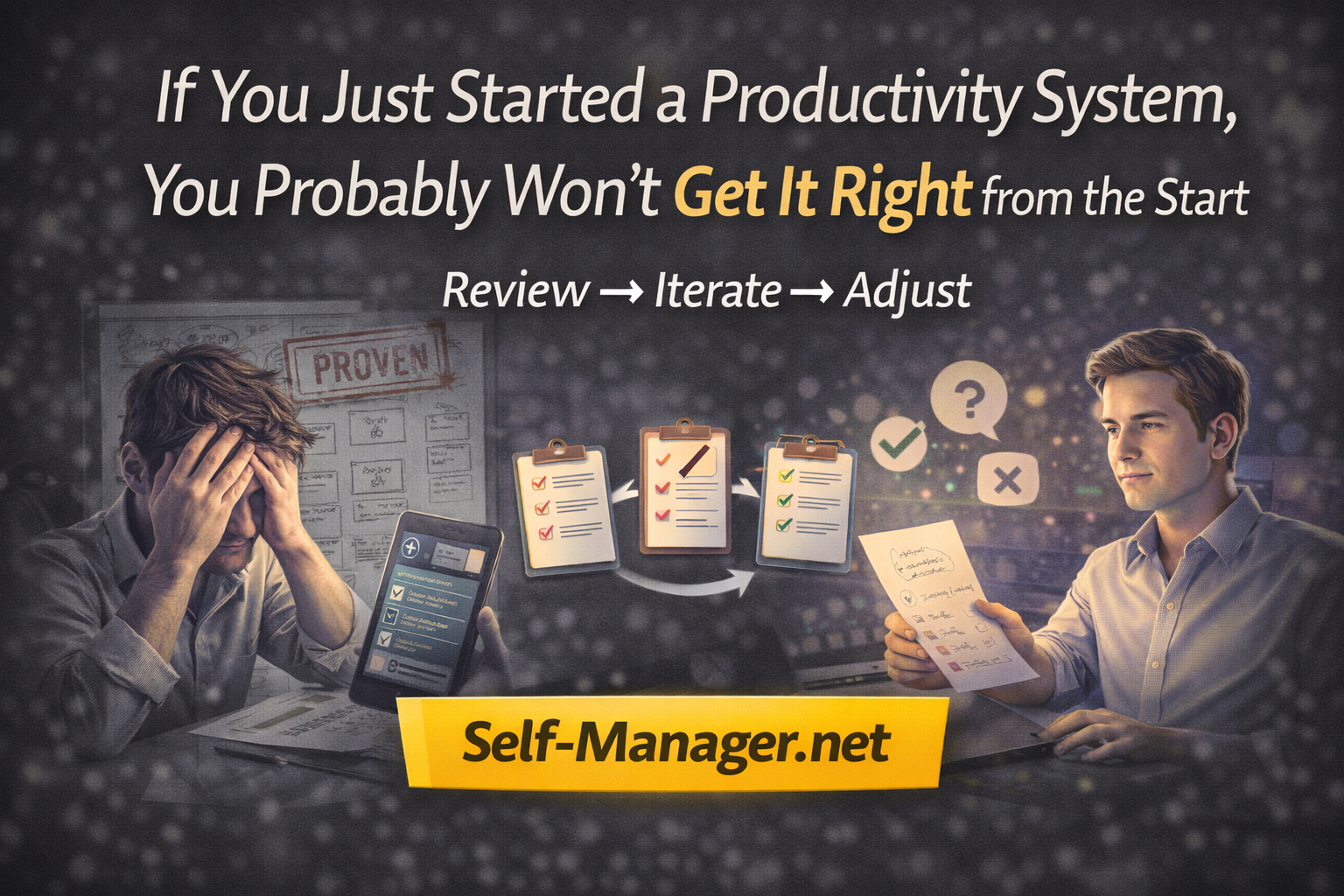
The right way to build a productivity system: Review → Iterate → Adjust
Think of your system like a product you’re improving.
Step 1: Start simple (minimum viable system)
Your “V1” should be extremely basic:
- one place where tasks live
- a daily plan (top 3)
- a weekly review
That’s enough.
Step 2: Observe (no judgment, just data)
For 1–2 weeks, notice:
- what didn’t get done
- what you avoided
- where your plan was unrealistic
- what caused stress
- what felt easy
Step 3: Adjust ONE thing at a time
Don’t change everything at once. Change one variable:
- fewer tasks per day
- a different time for deep work
- batching admin into one block
- reducing meetings
- adding a “next action” rule
- adding a shutdown routine
Then test again.
Step 4: Lock what works, remove what doesn’t
Your system should get simpler over time, not more complicated.
Why reviews are the secret weapon
Without reviews, you repeat the same mistakes for months.
The simplest weekly review (10 minutes)
Ask:
- What did I complete this week?
- What did I not complete, and why?
- What created stress or overload?
- What should I do differently next week?
- What are the top 3 priorities next week?
This is how you personalize productivity.
The goal is not to “do more” — it’s to fit your brain
The best productivity system is the one that matches:
- how you naturally think,
- how your energy behaves,
- and what your life allows.
Your goal is not perfection. Your goal is alignment.
How Self-Manager.net helps with iteration (not just planning)
A lot of tools are good at storing tasks.
But people fail because they don’t review and adjust.
Self-Manager.net is built around time-based planning:
- day
- week
- month
- quarter
That makes it easier to:
- plan realistically,
- see what actually happened,
- and iterate your system.
And if you use AI summaries or reviews, you get faster reflection without spending an hour writing notes.
In other words: it supports the real process.
Review → Iterate → Adjust
A simple mindset shift that changes everything
Instead of saying:
“I need the perfect system.”
Say:
“I’m building a system that improves every week.”
That mindset keeps you consistent.
Closing
If you’re new to productivity systems, don’t quit because the first version feels wrong. That’s expected.
Start simple, review weekly, iterate slowly.
And if you want a tool that is built around planning and reviewing (not just dumping tasks), try Self-Manager.net and do one weekly review inside it.

AI Powered Task Manager
Plan smarter, execute faster, achieve more
Create tasks in seconds, generate AI-powered plans, and review progress with intelligent summaries. Perfect for individuals and teams who want to stay organized without complexity.
Get started with your preferred account