Feel Like Your To-Do List Isn't Enough? You Probably Need a Task Manager — Here's Why (2026)
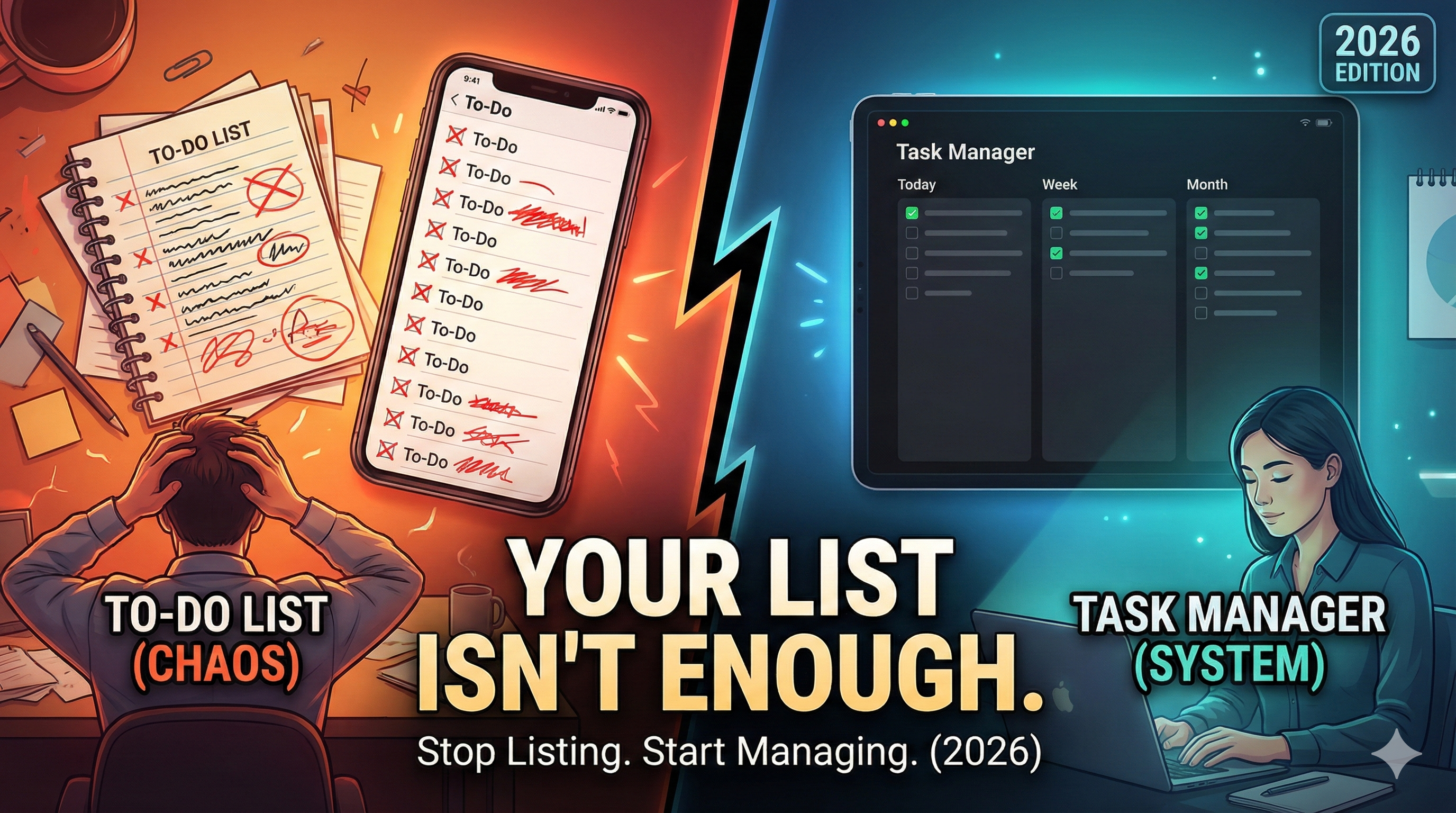
A to-do list is a great start.
But if you work on a computer, juggle multiple projects, and feel like your days get messy fast, a basic list eventually hits a wall.
You'll notice it when:
- your list grows but your progress doesn't,
- you forget small things,
- you keep rewriting the same tasks,
- or you finish the day tired without feeling "done."
That's the moment you don't need a longer list.
You need a task manager.
To-Do List vs Task Manager (the simplest explanation)
A to-do list answers:
- "What should I do at some point?"
A task manager answers:
- "What am I doing today, this week, this month?"
- "What's priority vs optional?"
- "What's blocked and why?"
- "What's due, what's scheduled, what's waiting?"
- "What did I actually finish last week?"
A list is a container.
A task manager is a system.
10 Signs Your To-Do List Isn't Enough Anymore
1) Your list keeps growing (but your output stays the same)
When tasks stack faster than you complete them, the list becomes guilt.
A task manager helps you:
- prioritize,
- schedule,
- and stop pretending everything is "today."
2) You rewrite tasks constantly
Rewriting feels productive, but it's often anxiety disguised as planning.
A task manager reduces rewriting because tasks have:
- a home,
- a date,
- and a status.
3) You forget the "small but important" things
To-do lists fail on tiny tasks:
- "send the invoice"
- "follow up"
- "cancel subscription"
- "reply to that email"
A task manager keeps these from slipping through.
4) You have multiple projects running at the same time
A list doesn't handle project context well.
A task manager can separate:
- project tasks,
- personal tasks,
- admin tasks,
- recurring tasks,
- and deadlines.
5) You don't know what to do next
If you stare at your list and feel overwhelmed, it's not because you're lazy.
It's because you don't have a "next action" system.
A task manager helps you choose:
- top priorities,
- and the next step.
6) Your day is reactive (messages control your schedule)
To-do lists don't protect your day from interruptions.
A task manager encourages:
- daily planning,
- and realistic execution blocks.
7) You don't review, so nothing improves
Without reviews, weeks blur together.
A task manager makes reviews natural:
- weekly review,
- monthly review,
- quarterly overview.
That's how you improve long-term.
8) You don't trust your list anymore
This is the big one.
When you stop trusting your list, you go back to your head:
- mental reminders,
- stress,
- anxiety.
A task manager restores trust by being consistent and organized.
9) Your list has no time structure
A list doesn't naturally answer:
- "What's happening this week?"
- "What's due next month?"
- "What did I plan for today?"
Task managers are built around time.
10) You feel busy but not progressing
When you're busy, but you can't point to clear outcomes, you need:
- priorities,
- tracking,
- and review.
A task manager gives you that visibility.
The hidden cost of using only a to-do list
Here's what most people don't notice:
When tasks live in your head + a messy list, you pay a daily tax:
- decision fatigue ("what now?")
- context switching
- memory stress ("don't forget…")
- lack of closure
It's not just inefficient.
It's exhausting.
What Self-Manager.net does differently
Many task managers are built around:
- projects,
- boards,
- workspaces,
- complex setup.
Self-Manager.net is built around a simple truth:
Your work happens on dates.
That's why it's date-centric:
- day
- week
- month
- quarter
So instead of your list feeling like a random pile, it becomes:
- a plan for today,
- a plan for the week,
- and a clear view of progress over time.
Plus, Self-Manager.net is designed for:
- simple execution
- and reviews (including AI summaries for periods)
It's not just "more tasks."
It's a better system.
The simplest way to upgrade (without overcomplicating your life)
If you're transitioning from a to-do list, do this:
Step 1: Plan just "Today"
Pick your top 3 tasks.
Step 2: Add a "This Week" list
Move non-urgent tasks there.
Step 3: Review once per week
Ask: what worked? what didn't? what's next?
That single rhythm changes everything.
Conclusion
If your to-do list feels like it's not enough, it's not because you need more discipline.
You need a better system.
Try Self-Manager.net and plan:
- today,
- then your week,
- then do one weekly review.
That's when a "list" turns into real productivity.

AI Powered Task Manager
Plan smarter, execute faster, achieve more
Create tasks in seconds, generate AI-powered plans, and review progress with intelligent summaries. Perfect for individuals and teams who want to stay organized without complexity.
Get started with your preferred account