If You Don't Use a Task Manager Yet, Here's What You Should Know About the Benefits (2026)
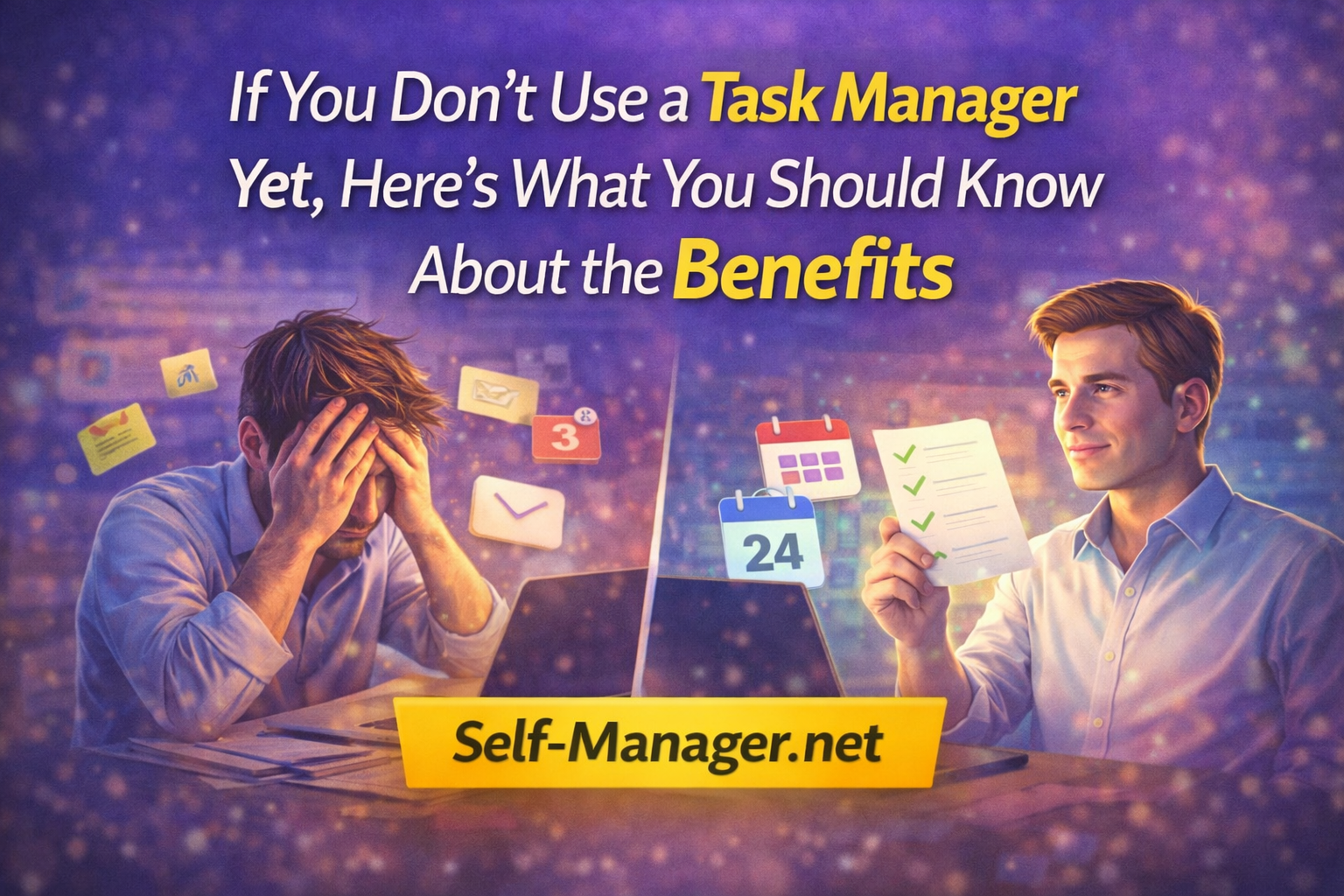
A lot of people avoid task managers for a good reason:
- they don't want another app,
- they think "I'll remember,"
- they've tried one before and it felt like extra work.
But in 2026, the biggest benefit of a task manager isn't "being organized."
It's this:
It removes mental load so you can think clearly and finish work consistently.
If you work on a computer (emails, projects, clients, admin, content, meetings), your day creates too many open loops for your brain to hold comfortably.
A task manager is basically an external brain that keeps your work lightweight in your head.
The real benefits (what changes in your life)
1) You stop relying on memory (and stop leaking energy)
When tasks stay in your head, your brain constantly does background processing:
- "Don't forget…"
- "I need to…"
- "Later I should…"
That feels like stress—even if nothing is "wrong."
A task manager turns those open loops into something visible and controlled.
2) You make fewer decisions (decision fatigue drops)
Without a system, you wake up and decide everything from scratch:
- what's most important,
- what to do next,
- what you're forgetting.
With a task manager, you decide once (during planning), then execute.
Less decision-making = more energy for real work.
3) Your week becomes intentional (not reactive)
If you don't plan, your week is shaped by:
- whoever messages you,
- whatever feels urgent,
- whatever pops into your head.
A task manager helps you build a week around:
- priorities,
- deadlines,
- and realistic capacity.
You still respond to reality—but you don't become a slave to it.
4) You finish more… because you can see "done"
One of the biggest psychological wins:
- you can actually see what you completed.
That creates momentum.
People who "feel unproductive" are often doing a lot—but they can't see it, so it doesn't register.
5) You become consistent (even when motivation is low)
Motivation is unreliable.
A task manager gives you a system:
- a daily plan,
- a weekly plan,
- a simple next step.
That's what keeps output consistent across months.
6) You reduce anxiety (because nothing feels "untracked")
Anxiety often comes from uncertainty:
- "What am I forgetting?"
- "Am I missing something important?"
- "Is my life under control?"
Even a simple task list reduces that uncertainty.
7) You create a "single source of truth"
If you use:
- notes app for ideas,
- email for requests,
- chat for action items,
- calendar for meetings,
- memory for everything else…
Your brain becomes the glue.
A task manager becomes the one place tasks live. Everything else becomes supporting context.
8) You plan realistically (and avoid burnout)
Many people burn out because they plan fantasy days.
A task manager makes it easier to:
- cap your daily plan,
- postpone intentionally,
- and stop pretending you can do 18 things today.
Realistic plans are calmer and more effective.
9) Reviews become possible (and improvement becomes visible)
Without a system, weeks blur together.
With a task manager, you can do simple reviews:
- what worked,
- what didn't,
- what you'll change next week.
That's how people improve their productivity long-term.
10) You reclaim your attention (less tab-hopping, less chaos)
When your tasks are clear, you stop constantly switching:
- "what should I do next?"
- "where is that thing?"
- "what's urgent?"
Clarity reduces switching. Less switching increases focus. More focus increases output.
"But task managers feel like extra work…" (a better approach)
If you've tried a task app and hated it, the mistake was probably one of these:
❌ You tried to track everything
Start small: only track tasks that have real consequences if forgotten.
❌ You kept reorganizing
Planning should be quick. Execution should be the focus.
❌ You didn't have a review rhythm
Without reviews, tasks pile up and the app becomes guilt.
The simplest way to start (5-minute setup)
Try this for 7 days:
- Create a Today list
- Add only tasks you must not forget
- Pick Top 3 for the day
- End of day: move unfinished items to tomorrow
- Once per week: review what got done
That's enough to feel the benefit.
Why Self-Manager.net is especially good for beginners
Many task managers are built around:
- projects,
- boards,
- workspaces,
- customization.
That can be intimidating if you're starting from zero.
Self-Manager.net is built around something more natural:
Your work happens on dates.
So it guides you into:
- daily planning
- weekly planning
- monthly/quarterly overview
- reviews (with AI summaries)
It's less "build a system" and more "use a system."
Conclusion
If you've never used a task manager, don't start by trying to become a productivity robot.
Start by removing mental load.
Try Self-Manager.net for a week:
- plan your day,
- do one weekly review,
- and feel what it's like to not carry everything in your head.

AI Powered Task Manager
Plan smarter, execute faster, achieve more
Create tasks in seconds, generate AI-powered plans, and review progress with intelligent summaries. Perfect for individuals and teams who want to stay organized without complexity.
Get started with your preferred account