Why Are There So Many Task Manager Apps? (And Why Self-Manager.net Does Things Differently)
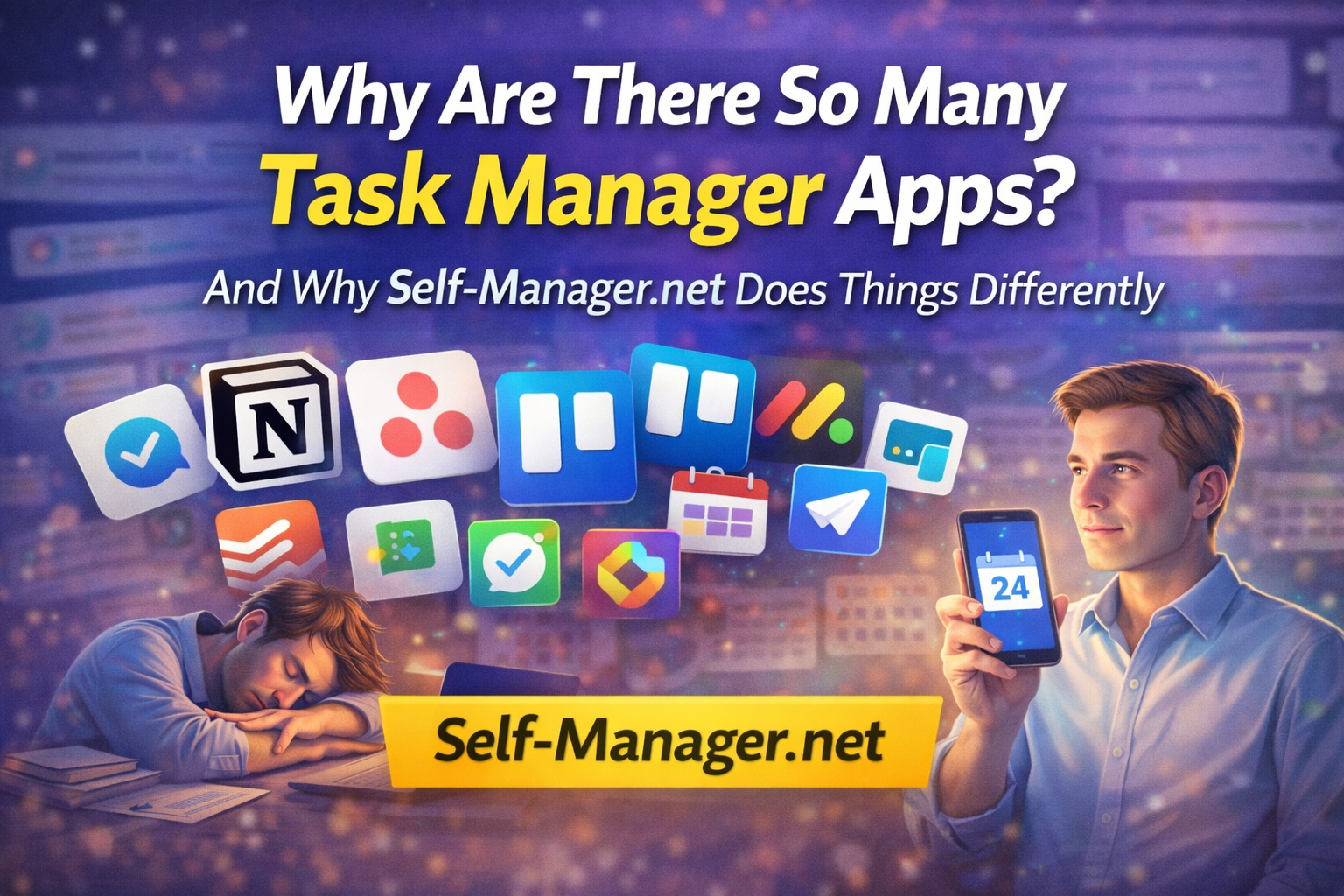
If you feel like there are hundreds of task managers in 2026… you're not imagining it.
There are more options than ever: personal to-do lists, team project managers, kanban boards, "work OS" platforms, calendar-first planners, AI assistants, note apps pretending to be task apps, and task apps pretending to be CRMs.
So why is this space so crowded?
And more importantly: why would anyone build another one—and why does Self-Manager.net exist?
Let's break it down.
1) "Task manager" isn't one category anymore
The phrase task manager covers completely different jobs:
- Personal execution: "What am I doing today?"
- Team coordination: "Who is doing what and when?"
- Planning: "What should my week look like?"
- Project tracking: "What's the status of this initiative?"
- Operations: "What's the process and the pipeline?"
- Documentation: "Where is the context and decision history?"
Different people buy "task managers" for different problems. That alone creates room for many tools.
2) Every workflow needs a different "view"
One person needs:
- a simple daily list
Another needs:
- kanban boards
Another needs:
- calendar planning
Another needs:
- Gantt/timelines
Another needs:
- reports + dashboards
Because a "task" isn't the same thing in every job, tools specialize in different ways.
3) The market is huge and sticky (once you adopt one, you rarely leave)
Task managers are:
- used every day
- tied to habits
- tied to team processes
- full of history and context
That makes them extremely "sticky." If a tool wins you, you're likely to stay for years.
That's exactly the kind of market where a lot of companies try to compete.
4) Most apps optimize for teams, not for the individual knowledge worker
Here's a big reason the space keeps growing:
Many tools are built for organizations:
- permissions
- roles
- workflows
- dashboards
- processes
But the average knowledge worker's pain is more basic:
- "I forget things."
- "My week is chaos."
- "I'm busy but not progressing."
- "I'm always behind."
So new products keep appearing that try to solve productivity from the individual side.
5) "Productivity" is personal, so people want different philosophies
Some tools are built around:
- GTD
- kanban
- agile
- time blocking
- OKRs
- note-first workflows
- calendar-first workflows
- automation-first workflows
A task manager is basically a philosophy of work disguised as software.
And because people disagree on the "right" philosophy, more apps exist.
6) AI created a new wave (but it also created more complexity)
In 2026, many tools now add:
- AI summaries
- AI planning suggestions
- AI meeting notes
- AI "smart" task generation
But adding AI often creates the same problem:
- more features
- more settings
- more complexity
So the space gets even more competitive: some apps go "AI everywhere," others go "calm productivity."
So… why does Self-Manager.net do things differently?
Self-Manager.net exists because most tools miss one key truth:
Your work happens on dates
Not in "workspaces." Not in "folders." Not in "boards." Not in "pages."
It happens on:
- today
- this week
- this month
- this quarter
That's the core difference.
1) Self-Manager is date-centric (day → week → month → quarter)
Most task apps are built around:
- projects
- boards
- lists
- pages
Self-Manager is built around time.
That means the natural questions become:
- What am I doing today?
- What is the plan for this week?
- What did I actually do last week?
- How is my month/quarter going?
This creates clarity without forcing you to constantly reorganize your system.
2) It's built for execution, not endless setup
Many tools accidentally become hobbies:
- templates
- databases
- dashboards
- custom workflows
Self-Manager is designed for:
- quick input
- clear daily planning
- fast execution
Less "build your second brain." More "do the work and move forward."
3) Reviews are not an afterthought (they're the engine)
Most apps are focused on creating tasks.
Self-Manager is focused on:
- creating tasks and
- reviewing outcomes
Because burnout and stagnation often come from this pattern:
"I'm doing a lot… but I'm not improving."
Weekly/monthly/quarterly reviews fix that.
4) It reduces the biggest productivity tax: mental load
If tasks live everywhere, your brain becomes the glue.
Self-Manager aims to be a single source of truth so you stop carrying:
- tiny tasks in memory
- open loops
- unresolved plans
That alone reduces stress and improves execution.
5) It's designed for calm productivity (not "always-on hustle")
The goal isn't to cram more tasks into a day.
The goal is:
- realistic planning
- visible progress
- better decision-making
- sustainable output
That's how you stay productive without burning out.
Who is Self-Manager.net best for?
Self-Manager tends to click with people who say things like:
- "I want my tasks organized by day/week/month."
- "I need a weekly review that's simple."
- "I'm tired of overcomplicated tools."
- "I work on a computer all day and I need clarity."
- "I want progress, not chaos."
Conclusion
There are so many task managers because work is diverse, personal, and daily.
Self-Manager.net is different because it's built around the one thing everyone shares:
Time.
If you want a calmer, date-centric way to plan and execute, try Self-Manager.net and do one weekly review inside it.
AI Powered Task Manager
Plan smarter, execute faster, achieve more
Create tasks in seconds, generate AI-powered plans, and review progress with intelligent summaries. Perfect for individuals and teams who want to stay organized without complexity.
Get started with your preferred account