How Long-Term Thinking Prevents Stress (and Makes Daily Life Feel Lighter)
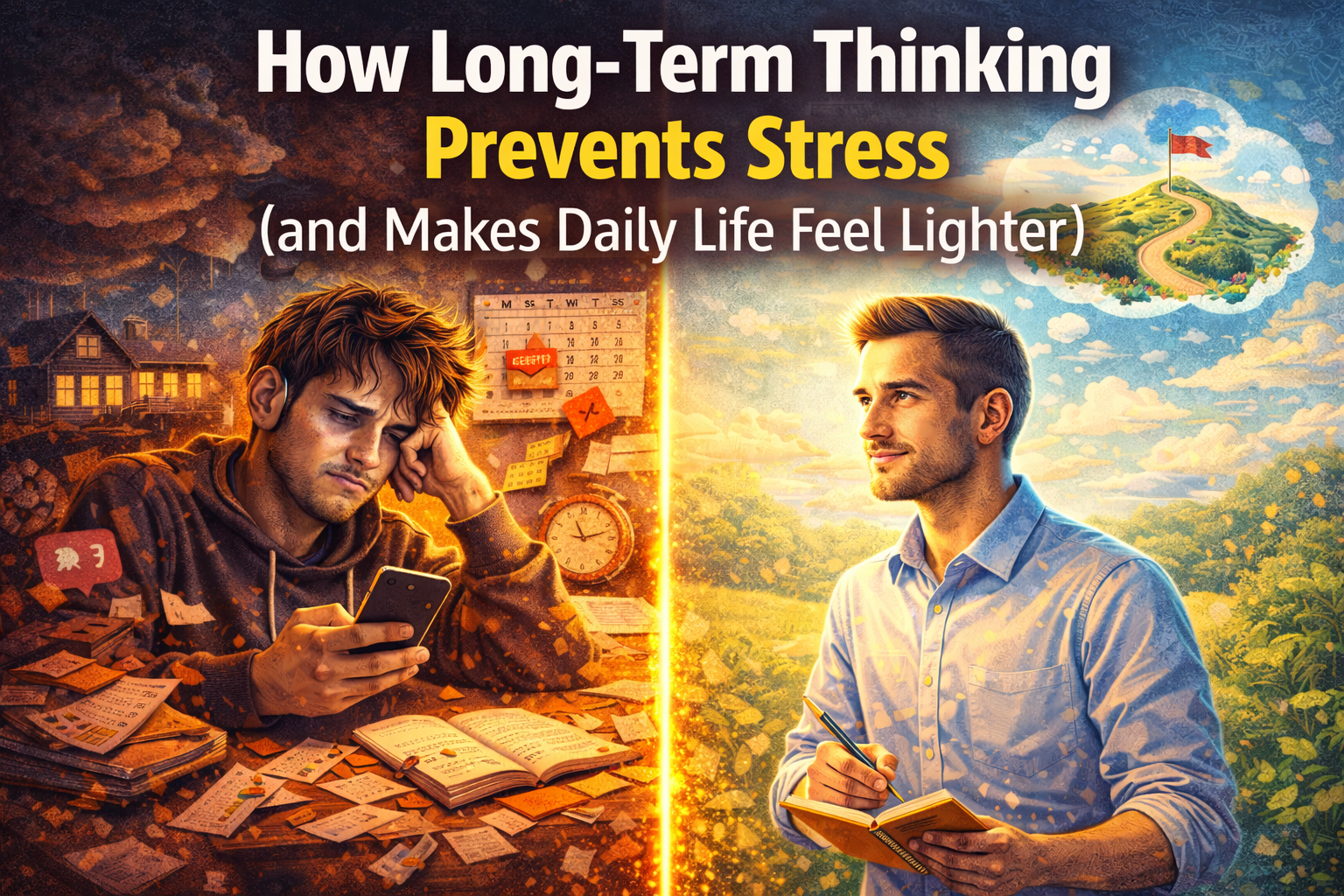
A lot of stress isn't caused by "too much work."
It's caused by short-term thinking.
Short-term thinking creates:
- rushed decisions
- constant urgency
- emotional reactions
- last-minute chaos
- fear of falling behind
- the feeling that everything is happening to you
Long-term thinking does the opposite.
It turns life into something you design instead of something you survive.
And that shift reduces stress massively.
Why short-term thinking creates stress
Short-term thinking makes you treat today like it's the whole game.
So every problem feels bigger than it is:
- one bad day feels like failure
- one missed task feels like disaster
- one negative comment feels personal
- one slow week feels like "I'm not progressing"
Short-term thinking also pushes you to chase quick relief:
- procrastination
- scrolling
- impulsive spending
- emotional reactions
- comfort choices
Which often creates more stress later.
So you get stuck in a loop:
stress → escape → regret → more stress
Long-term thinking makes today less emotionally heavy
When you zoom out, you realize:
- one bad day doesn't matter much
- one mistake is normal
- progress is built by averages, not by perfect days
- consistency beats intensity
Long-term thinking reduces stress because it gives you context.
Context is calming.
Without context, everything feels urgent.
Long-term thinking replaces urgency with direction
Stress often comes from the feeling:
"I don't know what I'm doing, but I'm busy."
Long-term thinking replaces that with:
"I know where I'm going, and today is one small step."
That changes your nervous system.
Because your brain relaxes when it can see a path.
How long-term thinking prevents the "everything is urgent" mindset
When you have long-term goals, you naturally learn to sort:
Real emergencies vs emotional emergencies
Most "urgent" feelings are emotional, not real.
Long-term thinkers ask:
- "Will this matter in 3 months?"
- "Will this matter in 1 year?"
- "Is this a real deadline or a pressure feeling?"
This question alone dissolves a lot of stress.
Long-term thinking reduces decision fatigue
Stress increases when you make too many decisions daily.
Long-term thinking builds defaults:
- routines
- principles
- systems
- priorities
So you stop negotiating with yourself constantly.
Examples:
- "I train 3 times per week." (no debate)
- "I don't open social media before work." (no debate)
- "I plan tomorrow the night before." (no debate)
Fewer decisions = less stress.
It also makes you more patient (and patience is anti-stress)
A lot of stress is impatience:
- "I want results now."
- "Why am I not further?"
- "I should be better already."
Long-term thinking teaches patience:
- skills take time
- businesses take time
- relationships take time
- health takes time
When you accept time as part of the process, you stop fighting reality.
Fighting reality is stressful.
Working with reality is calmer.
Practical long-term thinking habits that reduce stress
1) Use the "3-month rule"
When stressed, ask:
"In 3 months, will this matter?"
If yes: plan a response.
If no: let it shrink.
2) Make decisions for future-you
A simple filter:
"Will future-me thank me?"
This reduces impulsive stress behaviors.
3) Track progress in weeks, not days
Daily tracking creates emotional swings.
Weekly tracking creates stability.
A week contains both good and bad days — and that's normal.
4) Plan with buffers
Long-term thinkers expect life to happen.
So they plan:
- extra time
- simpler schedules
- margin for surprises
No margin = constant stress.
Margin = calm.
5) Build a "good enough" mindset
Perfection creates stress.
Long-term thinking focuses on:
- consistency
- progress
- learning
Not perfection.
The biggest stress relief: knowing you're on track
One of the most calming feelings in life is:
"I'm on track."
Not perfect.
Not done.
But on track.
Long-term thinking gives you that because you have:
- a direction
- a plan
- a review process
- proof of progress over time
Without that, stress becomes constant because you never feel safe.
How Self-Manager.net supports long-term thinking (and reduces stress)
Stress gets worse when your brain holds too much:
- open loops
- unfinished tasks
- vague goals
- forgotten decisions
Self-Manager.net helps reduce stress by making long-term planning visible and reviewable:
- Break big goals into daily/weekly actions (so nothing feels overwhelming)
- Keep tasks connected to dates (so you know what's now vs later)
- Review weeks and months to see real progress (not just feelings)
- Capture notes and decisions so your mind stops replaying them
- Maintain a calm system that tells you: "This is handled."
A system with memory reduces stress because you stop relying on mental juggling.
Final thought: long-term thinking is mental peace
Long-term thinking doesn't remove problems.
It changes how problems feel.
It gives you:
- context instead of panic
- direction instead of urgency
- patience instead of pressure
- systems instead of chaos
And when you have those, stress drops — not because life is easy, but because your mind is no longer trapped in short-term survival mode.

AI Powered Task Manager
Plan smarter, execute faster, achieve more
Create tasks in seconds, generate AI-powered plans, and review progress with intelligent summaries. Perfect for individuals and teams who want to stay organized without complexity.
Get started with your preferred account