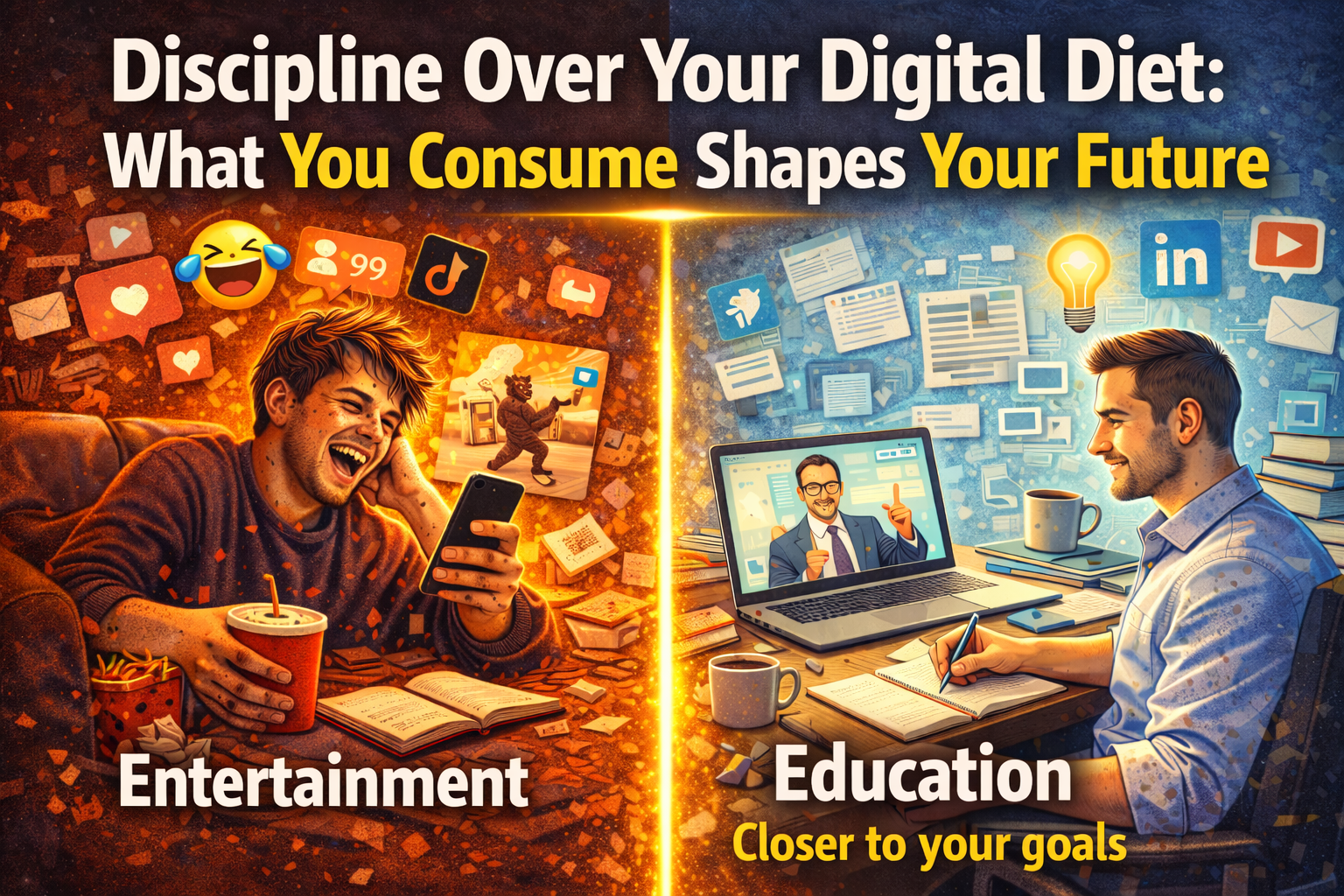
Discipline Over Your Digital Diet: What You Consume Shapes Your Future
We live in the most information-rich time in human history.
You have access to:
- the best books ever written (often in your pocket)
- world-class courses and tutorials
- interviews with top performers
- free articles, research, and tools
- communities where people share real experience
The entire "education layer" of humanity is available at any moment.
And yet… most people use the same device to consume:
- drama
- endless memes
- outrage content
- random trends
- "stupid stuff that makes me laugh"
- entertainment loops that never end
Entertainment has its place. It's not evil.
But here's the key idea:
Your digital consumption is either moving you toward your goals or away from them.
That's why discipline over what you consume is one of the highest-leverage habits you can build.
Your attention is your most valuable asset
Money is important.
Time is important.
But attention is the multiplier.
Because what you pay attention to becomes:
- what you think about
- what you learn
- what you care about
- what you normalize
- what you become
If your attention is constantly captured by low-value content, your life gets shaped by low-value inputs.
Not intentionally. By default.
The digital world is a buffet (and most people eat junk)
In history, information was scarce.
Now it's unlimited.
So the problem is no longer "how do I find information?"
It's:
how do I filter it?
And that is the modern discipline:
- choosing what you consume
- choosing who influences you
- choosing what mental environment you live in
Because unlimited access to information without filtering becomes:
- overwhelm
- distraction
- shallow thinking
- wasted years
Productive consumption compounds
If you consume something productive consistently, it compounds like interest.
Examples of productive consumption:
- learning a skill (coding, design, writing, sales)
- improving your health knowledge (sleep, nutrition, training)
- learning business fundamentals (marketing, pricing, positioning)
- listening to long-form interviews that improve your thinking
- reading books that upgrade your standards and decisions
Even 20 minutes a day, every day, can change your trajectory.
That's not motivational talk — it's simple math.
Entertainment also compounds (but in the wrong direction)
People underestimate how much entertainment "trains" them.
Constant entertainment consumption trains:
- short attention span
- impatience
- avoidance of discomfort
- dopamine dependency
- mental noise
- reduced motivation for slow, real work
Again, entertainment is not the enemy.
But if entertainment is your default, you're training a mind that struggles with:
- focus
- deep work
- consistency
- long-term goals
And that makes progress harder.
The uncomfortable truth: you can't expect to outperform while consuming like everyone else
If your daily inputs are:
- 2 hours scrolling
- 1 hour random videos
- 30 minutes drama content
…you're not just "relaxing."
You're spending your attention budget.
Meanwhile, someone else is using that same time to:
- learn
- build
- practice
- plan
- improve their system
- create content
- develop skills that pay
So the gap grows.
Not because they're smarter.
Because they're investing their attention differently.
A balanced mindset: entertainment has a place, but it must be intentional
A healthy digital diet isn't "no fun allowed."
It's:
- intentional entertainment
- intentional education
- intentional creation
The problem is unplanned entertainment that becomes a lifestyle.
A good rule:
Entertainment should be a reward, not a routine.
Or at least:
Entertainment should be limited, scheduled, and chosen — not infinite scrolling.
How to build discipline over what you consume
Here are practical ways to do it without becoming extreme.
1) Define your goals, then match your feed to them
If you don't know what you want, your feed will choose for you.
Pick 1–3 themes you care about for the month:
- productivity systems
- building a business
- becoming a better developer
- fitness and energy
- communication and confidence
Then follow content that supports those.
2) Replace "scrolling" with "searching"
Scrolling = passive.
Searching = intentional.
Open a platform and search for what you need.
Close it after you get it.
3) Use the 80/20 content rule
Aim for:
- 80% useful / educational / inspiring content
- 20% entertainment
Most people live the opposite.
Even shifting to 60/40 is a big upgrade.
4) Convert consumption into output
If you consume something useful, capture:
- 1 key idea
- 1 action to apply
Otherwise it becomes "productive entertainment."
5) Put friction on junk
- mute low-signal accounts
- remove apps from the home screen
- turn off notifications
- set a daily limit
You're not removing fun.
You're removing the "automatic trap."
The best use of the information age is self-education + execution
The winners of the next decade won't be the ones who had access.
Everyone has access.
The winners will be the ones who:
- filter better
- learn faster
- apply consistently
- build more than they consume
That's the real advantage.
Not secret information.
Better use of common information.
How Self-Manager.net helps turn your consumption into progress
One reason people over-consume entertainment is that learning feels "messy."
You watch something educational, then forget it tomorrow.
With Self-Manager.net, you can turn digital input into action:
- create a "Learning" table for saved ideas
- add notes tied to dates ("what I learned today")
- convert lessons into tasks ("apply this tomorrow")
- plan weekly learning goals (so you don't drift)
- review what you consumed and what actually helped your progress
That builds a feedback loop:
consume → capture → apply → review → improve
And that's how content becomes growth.
Final thought: your digital diet is your future
You don't have to quit entertainment.
But you do have to stop expecting big results while consuming like someone with no goals.
Because what you consume trains your mind.
And your mind shapes your life.
So choose your inputs like they matter.
They do.

AI Powered Task Manager
Plan smarter, execute faster, achieve more
Create tasks in seconds, generate AI-powered plans, and review progress with intelligent summaries. Perfect for individuals and teams who want to stay organized without complexity.
Get started with your preferred account