Sustainable Hours Beat Intense Sprints: Productivity for Knowledge Work Without Burnout
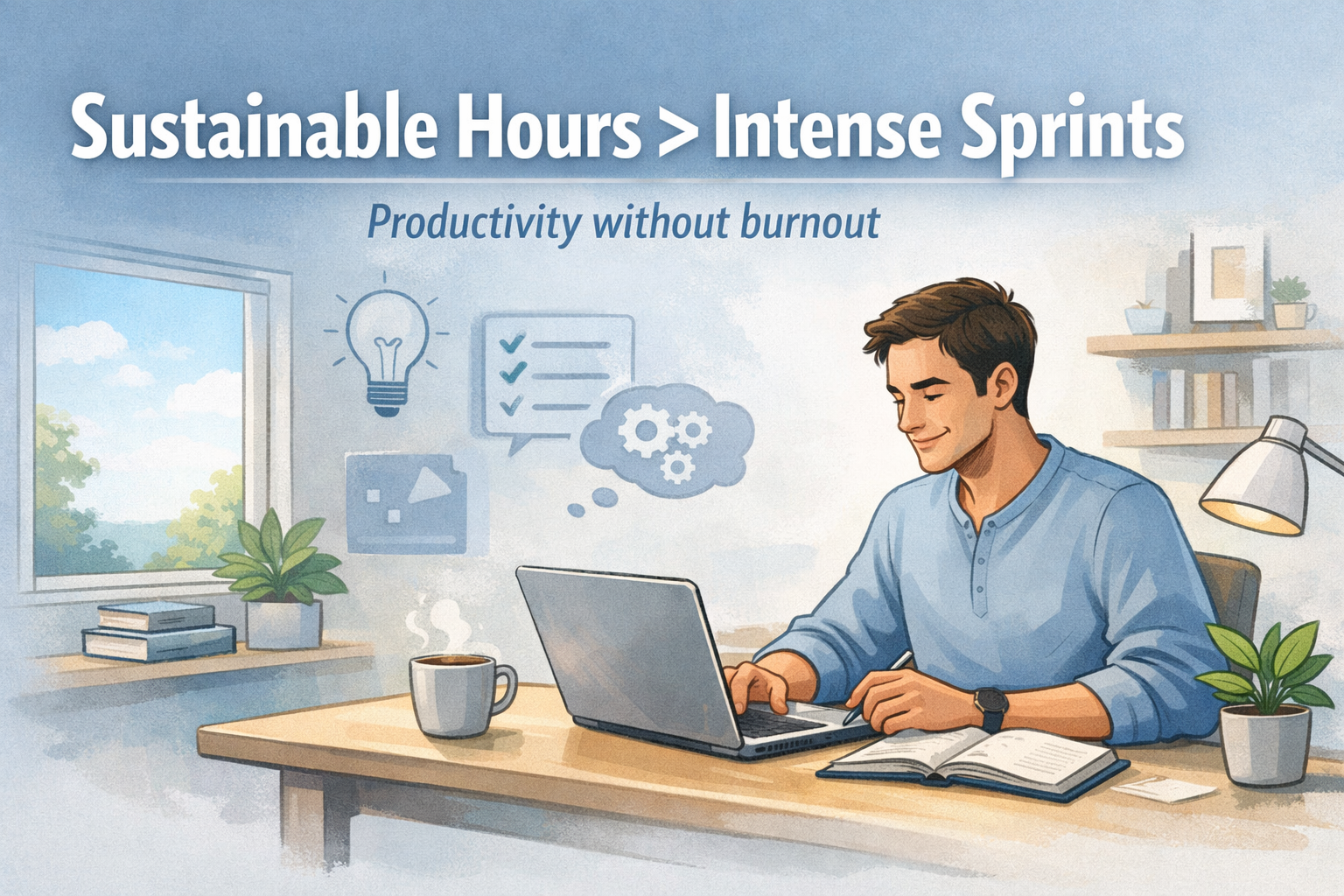
In knowledge work, productivity isn't about how hard you can push for a few hours.
It's about how consistently you can show up with a clear mind.
That's why, for most people, longer sustainable hours beat a few draining "intense" hours.
Not because intensity is bad — but because intensity has a cost. And if that cost destroys tomorrow, it destroys your weekly output.
This article is about building a work rhythm that produces results and keeps you sane.
Knowledge work is different: the mind is the bottleneck
Knowledge work relies on:
- attention
- thinking quality
- decision-making
- creativity
- problem solving
- communication
Those don't scale linearly with "hours worked."
A tired mind doesn't produce 80% quality.
It often produces 20% quality with 200% frustration.
So "working harder" can actually create less useful output — and more stress.
The productivity trap: hero hours and the hidden payback
Many people fall into the "hero hours" pattern:
- 8–12 intense hours in one day
- pushing with caffeine and willpower
- skipping breaks
- forcing focus
It feels productive because you're suffering.
But the hidden payback comes after:
- the next day is foggy
- you procrastinate because you're drained
- you need extra recovery
- you become emotionally reactive
- you avoid deep work because it feels painful
This is productivity on credit.
You borrow energy from tomorrow to perform today.
And the interest rate is high.
Why sustainable hours usually win
1) Consistency compounds
If you can do good work every day, you build compounding:
- better skills
- better systems
- better habits
- better outputs
But if your work style creates crashes, your progress gets reset constantly.
Sustainable work keeps the flywheel spinning.
2) Quality stays higher
In knowledge work, quality matters more than raw effort.
When you work sustainably, you keep:
- better attention
- better logic
- better writing
- better code
- better judgment
You make fewer mistakes and fewer "bad decisions that create future work."
That's huge.
3) You avoid the emotional burnout loop
Burnout isn't only tiredness.
It's when work becomes associated with:
- dread
- pressure
- guilt
- constant urgency
When your brain learns "work = pain," it fights you.
Sustainable hours keep work tolerable — and that keeps you consistent.
4) You reduce "recovery tax"
Every intense day needs recovery.
So the real question isn't:
"How many hours did I work today?"
It's:
"How much useful output did I get this week?"
Sustainable pacing reduces recovery time, which increases weekly output.
Intensity is not evil - it's just a tool
There are times when intense work is valuable:
- you're near a deadline
- you have a rare focus window
- you're in a short sprint (1–3 days)
- you're building momentum on a new project
But intensity becomes harmful when it becomes your default.
A sprint is fine.
Living in sprint mode turns your life into a constant emergency.
And that's how people become miserable while still feeling "behind."
A simple model: capacity + cadence
If you want a practical way to think about this, use:
Capacity
How many hours per day can you work without destroying tomorrow?
This varies by person, but for knowledge work it's often 3 to 6 high-quality hours.
Cadence
Can you repeat that capacity consistently across the week?
A sustainable rhythm might look like:
- 4–5 hours of real focus work
- 1–2 hours of admin / communication
- clean shutdown
- sleep and recovery
That beats a lifestyle of:
- 10 hours grind
- dopamine breaks
- poor sleep
- emotional stress
- recovery crash
The "useful output" metric is the real goal
In knowledge work, you're not paid for hours.
You're paid for results.
So track:
- pages written
- features shipped
- bugs fixed
- designs completed
- proposals sent
- decisions made
- systems improved
- clients helped
Many people work long hours but produce little value because:
- they're tired
- they're switching contexts
- they're distracted
- they're doing low-leverage work
Sustainable hours help you produce more valuable output per hour.
What sustainable productivity looks like (in real life)
Here's what "sustainable" often means:
Deep work blocks (not nonstop grind)
- 60–90 minutes focus
- 10–15 minutes break
- repeat 2–4 times
This respects how the brain actually works.
Stop before you're destroyed
A powerful rule:
End the day with a bit of energy left.
That leftover energy becomes:
- a calmer evening
- better sleep
- less dread
- a stronger tomorrow
Keep one low-cognitive block
When your energy dips, don't force deep thinking.
Do:
- admin tasks
- scheduling
- organizing notes
- cleaning up loose ends
That keeps momentum without burning your brain.
Have a shutdown ritual
A short shutdown prevents "mental leftovers" that create stress.
Even 5 minutes helps:
- list tomorrow's top 3 tasks
- capture open loops
- close your workspace
Burnout is a productivity debt with interest
Here's the core message:
You can't outwork biology.
If you constantly push beyond sustainable hours, you'll pay with:
- lower motivation
- worse thinking
- worse mood
- worse health
- worse relationships
And eventually, you stop working entirely.
So intensity often looks like productivity — until it turns into a forced break you didn't choose.
Sustainability prevents that.
How long sustainable hours prevent misery
A lot of misery comes from the feeling that:
- you're always behind
- your life is only work
- you never "finish"
- you're exhausted all the time
Sustainable hours create:
- predictable progress
- clearer boundaries
- more time for recovery
- a calmer mind
And ironically, calm people often outperform stressed people — because calm people can think.
How Self-Manager.net supports sustainable productivity
Sustainability is easier when your system:
- clarifies priorities
- reduces open loops
- keeps you aligned to long-term goals
- makes progress visible
With Self-Manager.net, you can:
- plan realistic daily capacity (not fantasy schedules)
- time-block deep work sessions across the week
- keep tasks connected to dates (so "not today" doesn't become guilt)
- capture distractions quickly (so you stop context-switching)
- review weekly output to see what pacing actually works
- build routines that repeat sustainably
The goal is not to cram more.
The goal is to create steady progress without burning out.
Final thought: productivity is a marathon with occasional sprints
If you want to win in knowledge work:
- build sustainable hours as your default
- use intensity strategically (short sprints, not constant)
- protect sleep and recovery
- measure weekly output, not daily suffering
Because the best productivity system is the one you can repeat — while still enjoying your life.

AI Powered Task Manager
Plan smarter, execute faster, achieve more
Create tasks in seconds, generate AI-powered plans, and review progress with intelligent summaries. Perfect for individuals and teams who want to stay organized without complexity.
Get started with your preferred account