Common Routines of Successful People You Can Apply in 2026
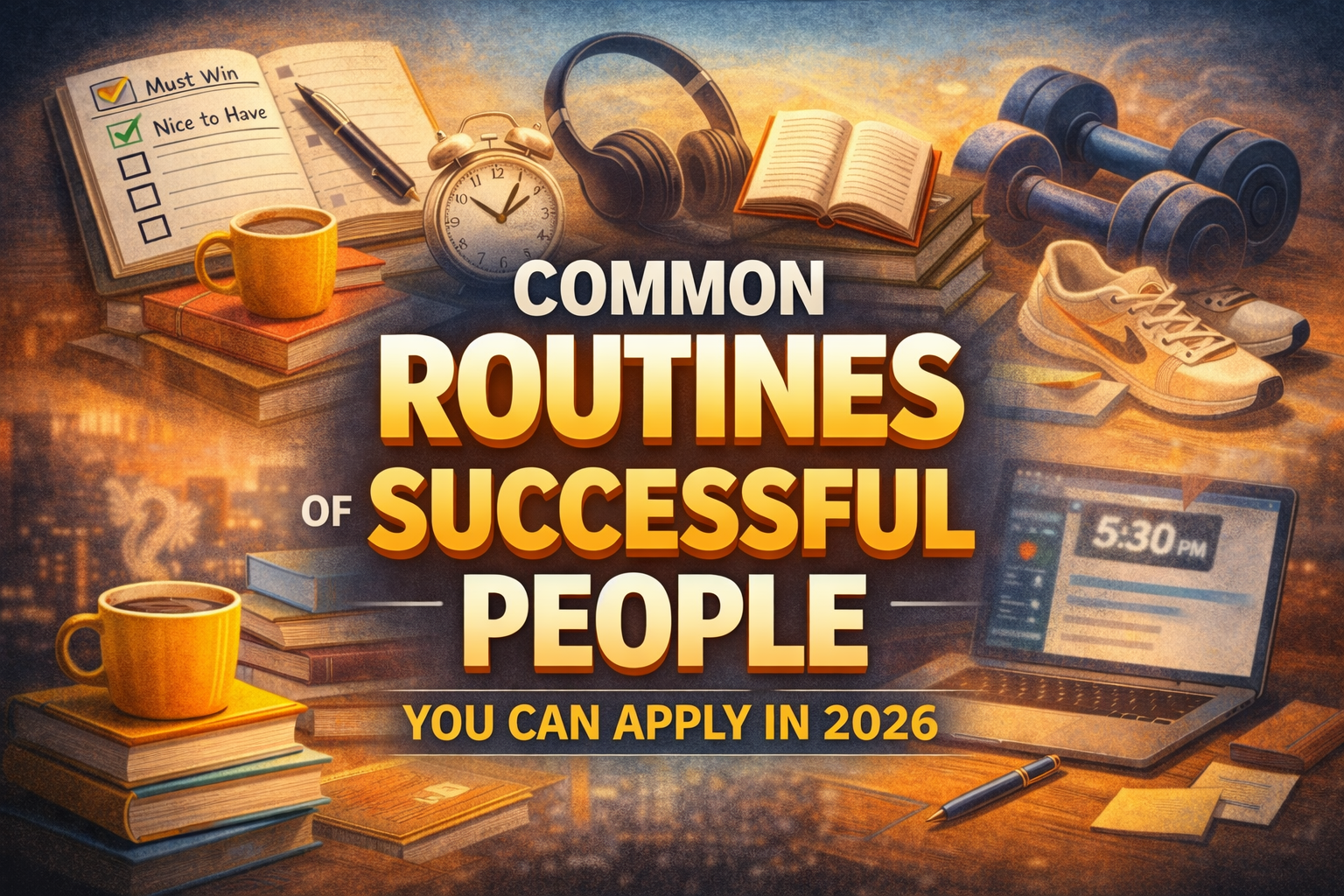
Successful people don't win because they have perfect motivation.
They win because they repeat a few simple routines until the results compound.
The good news: most of these routines are not "celebrity lifestyle" stuff. They're basic behaviors that scale from normal life to extreme success.
Here are the most common routines high performers share—and how to apply them in a realistic way in 2026.
1) They start the day with intention, not reaction
A lot of people "begin the day" by opening:
- messages
- news
- social apps
That's not starting the day—that's surrendering it.
What successful people do instead:
- decide what today is for
- pick the 1 thing that makes the day a win
- do that first (or schedule it early)
Apply in 2026 (simple rule):
No notifications until your first priority is started.
2) They plan weekly, not just daily
Daily planning helps.
But weekly planning prevents drift.
Successful people do a weekly review because it answers:
- What did I do?
- What matters next?
- What should I stop doing?
Apply in 2026 (15 minutes):
Every Sunday (or Monday morning):
- choose 1–3 weekly outcomes
- schedule the hardest block first
- pre-decide what you'll ignore
3) They protect deep work like it's an asset
They don't "find time."
They block time.
Deep work is where the valuable output happens:
- building
- writing
- designing
- solving hard problems
- shipping
Apply in 2026:
Start with 2 × 60 minutes per week.
Then grow to 4 × 90 minutes.
Make it scheduled, not optional.
4) They use constraints to stay focused
Unlimited options create procrastination.
Constraints create shipping.
Common constraints:
- timeboxing ("90 minutes then stop")
- output goals ("publish 1 per week")
- limits ("3 priorities max")
Apply in 2026:
Use the rule: 1 Must-Win task/day
Everything else is optional.
5) They track a few key metrics (not everything)
High performers love clarity.
They track a small number of metrics that reflect progress.
Examples:
- workouts/week
- hours of deep work
- posts shipped
- sales calls
- trial → paid conversion
- churn / retention
- revenue
Apply in 2026:
Pick 3 metrics:
- output metric (what you ship)
- energy metric (sleep, workouts, steps)
- business/career metric (leads, sales, revenue, learning hours)
6) They build routines that reduce decision fatigue
They don't want to "decide" basics every day.
They automate the boring stuff:
- same breakfast
- same work start routine
- same planning template
- same shutdown routine
Apply in 2026:
Create a default day:
- Start ritual (5–10 min)
- Deep work block
- Admin block
- Shutdown ritual
When life gets chaotic, defaults keep you stable.
7) They do some form of daily learning
Reading, listening, reflecting, practicing.
Not "random scrolling."
Targeted learning:
- books
- courses
- high-signal podcasts
- skill reps
Apply in 2026:
30 minutes/day of deliberate learning
(or 3×/week if daily is too much)
8) They reflect and adjust instead of blindly grinding
A lot of people work hard… in the wrong direction.
Successful people check the map often.
Apply in 2026:
Do a "mini-review" every Friday:
- What moved forward?
- What didn't?
- What is the one fix for next week?
9) They protect health because it protects output
This is the one most people learn late.
Energy is the foundation for:
- focus
- patience
- creativity
- consistency
Apply in 2026:
Pick one health anchor:
- sleep schedule
- 4 workouts/week
- daily walks
- no caffeine after 2pm
- protein + water baseline
Do one well before adding more.
10) They end the day with a shutdown routine
This is underrated.
A shutdown routine prevents:
- mental carryover
- stress
- waking up with chaos
Apply in 2026 (5 minutes):
- write tomorrow's Must-Win
- clear quick notes (brain dump)
- stop work deliberately
The "2026 Routine Stack" (copy this)
If you want a simple routine set you can actually maintain:
Daily (20–60 min total)
- 1 Must-Win task
- 5-minute morning plan
- 5-minute shutdown plan
Weekly (15–30 min)
- weekly outcomes + schedule deep work blocks
- quick metrics check
Monthly (30–60 min)
- what worked / what didn't
- choose next month's focus
- stop 1 low-value commitment
The real takeaway
Most success is boring.
It's not dramatic bursts of motivation.
It's repeating small routines long enough for momentum to compound.
If you apply just 3 routines consistently in 2026:
- weekly planning
- deep work blocks
- daily Must-Win task
…you'll look back at the year and feel like you "found time."
You didn't.
You built it.

AI Powered Task Manager
Plan smarter, execute faster, achieve more
Create tasks in seconds, generate AI-powered plans, and review progress with intelligent summaries. Perfect for individuals and teams who want to stay organized without complexity.
Get started with your preferred account