How a Task/Project Manager Keeps You Accountable (And Helps You Reach Your 2026 Goals)
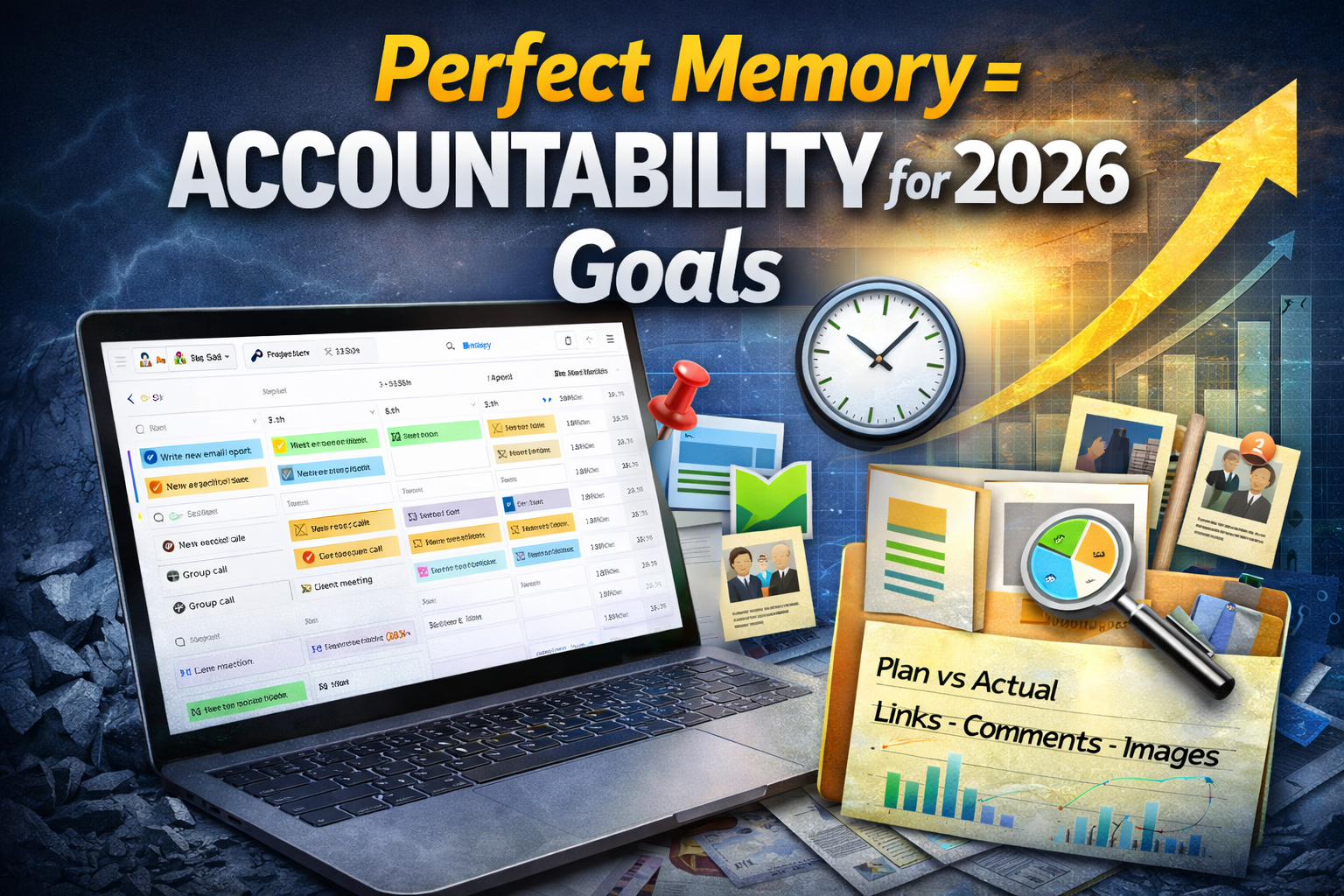
Introduction
If your 2026 goals are important, you don't just need motivation.
You need accountability.
And the most underrated form of accountability is not a coach or a friend.
It's a system that can answer, clearly and honestly:
- What did I plan to do?
- What did I actually do?
- Where did my time go?
- What decisions did I make?
- What patterns keep repeating?
- What led to the outcomes I'm getting?
A good task/project management app does this because it has something humans don't:
Perfect memory.
Not emotional memory. Not "I think I worked hard."
Actual history.
And that's what makes it a powerful tool for reaching your 2026 goals.
Why most people fail 2026 goals (even when they work hard)
Goals usually fail because of:
- losing track of priorities
- weeks disappearing into "urgent" tasks
- forgetting what was tried last month
- repeating the same mistakes
- not reviewing progress accurately
- making decisions without data
In other words: drift.
A serious task/project manager reduces drift by turning your year into a visible timeline.
The core idea: accountability = visible reality
A task manager keeps you accountable when it provides:
1) A time-based plan (so your goals become scheduled)
A random to-do list is easy to ignore.
A time-based system forces the real question:
"When exactly will this happen?"
When tasks are attached to days/weeks/months, your goal becomes operational.
That's the bridge from "I want this in 2026" → "here's what I'm doing this week."
2) A record of decisions and progress (perfect memory)
Your brain forgets:
- why you chose that strategy
- what caused a project to stall
- when momentum dropped
- what worked during your best weeks
A proper tool keeps history:
- tasks created and completed
- edits, notes, changes
- priorities and planning decisions
- what you did on specific dates
- attachments, links, images, comments
So your progress becomes traceable.
That's how you stop repeating the same cycle every year.
3) Time tracking and effort visibility (where your year actually went)
Most people are shocked when they see their real time distribution.
A task/project manager makes time visible:
- time spent per project
- deep work vs admin
- planned vs actual
- recurring tasks eating the week
That data creates accountability without guilt.
It just shows reality.
And reality is how you improve.
4) A single place for context (links, comments, images)
Accountability isn't only "did I do it."
It's also:
"Did I think it through? Did I learn? Can I reuse this?"
When you store context next to the task/project:
- links
- screenshots
- notes
- decisions
- meeting outcomes
- feedback
…you create a personal knowledge base.
This reduces friction and increases execution speed.
Because you're not constantly rebuilding context from scratch.
5) Accurate reviews (so you can steer, not drift)
Most people "review" with feelings.
A good system lets you review with facts:
- what you planned vs what got done
- what moved the goal forward
- what distracted you
- what patterns repeat
- what bottleneck is limiting progress
This is where 2026 goals are won.
Because goals don't fail in one day.
They fail through months of uncorrected drift.
Reviews correct drift.
Why this is NOT "just a to-do list for groceries"
A grocery list is:
- temporary
- low context
- not connected to outcomes
- disposable
A serious task/project manager is:
- time-based
- structured
- history-preserving
- decision-aware
- reviewable
- progress-tracking
It's the difference between:
"What should I do today?"
and
"What am I building in 2026, and what is my actual progress week by week?"
How to use a task/project manager to hit your 2026 goals (simple system)
Step 1: Turn your 2026 goal into projects + milestones
Example:
Goal: "Grow my business"
- Project: lead generation
- Project: conversion improvements
- Project: retention/quality delivery
- Milestones: monthly targets
Goal: "Get in shape"
- Project: training plan
- Project: sleep routine
- Project: nutrition baseline
- Milestones: weekly sessions + monthly measures
Step 2: Plan in time blocks (not in wishful lists)
Put tasks where they belong:
- this week
- next week
- this month
If a task has no date, it becomes "someday."
Someday is where goals go to die.
Step 3: Track effort and attach context
For important tasks/projects, store:
- links
- notes
- screenshots
- decisions ("why we chose this")
This creates your "perfect memory" system.
Step 4: Run weekly and monthly reviews using real data
Weekly review (10–15 minutes):
- What did I plan?
- What happened?
- What moved my 2026 goal forward?
- What stole time?
- What's the Must-Win next week?
Monthly review (30 minutes):
- What trends do I see?
- What should I stop doing?
- What is the bottleneck?
- What is the next milestone?
The real payoff: you don't just do tasks—you learn your own patterns
When your system stores history, you can finally answer:
- "What causes my best weeks?"
- "What causes my worst weeks?"
- "Which projects actually compound?"
- "What decisions lead to good outcomes?"
- "Where do I consistently underestimate time?"
That level of clarity is rare.
And it makes future decisions easier.
Because you're not relying on mood or memory.
You're relying on evidence.
Final takeaway
If you want to reach your 2026 goals, you need more than a checklist.
You need a system that:
- keeps you accountable with visible reality
- tracks time and effort
- stores context (links, comments, images)
- preserves your decision history
- enables accurate reviews
- shows progress over time
That's what a real task/project manager does.
It becomes your "perfect memory" and your steering wheel—so you don't drift through 2026 and wonder where the year went.

AI Powered Task Manager
Plan smarter, execute faster, achieve more
Create tasks in seconds, generate AI-powered plans, and review progress with intelligent summaries. Perfect for individuals and teams who want to stay organized without complexity.
Get started with your preferred account