Emotional Fitness = Better Productivity: How to Think Clearly, Avoid Impulses, and Make Long-Term Decisions
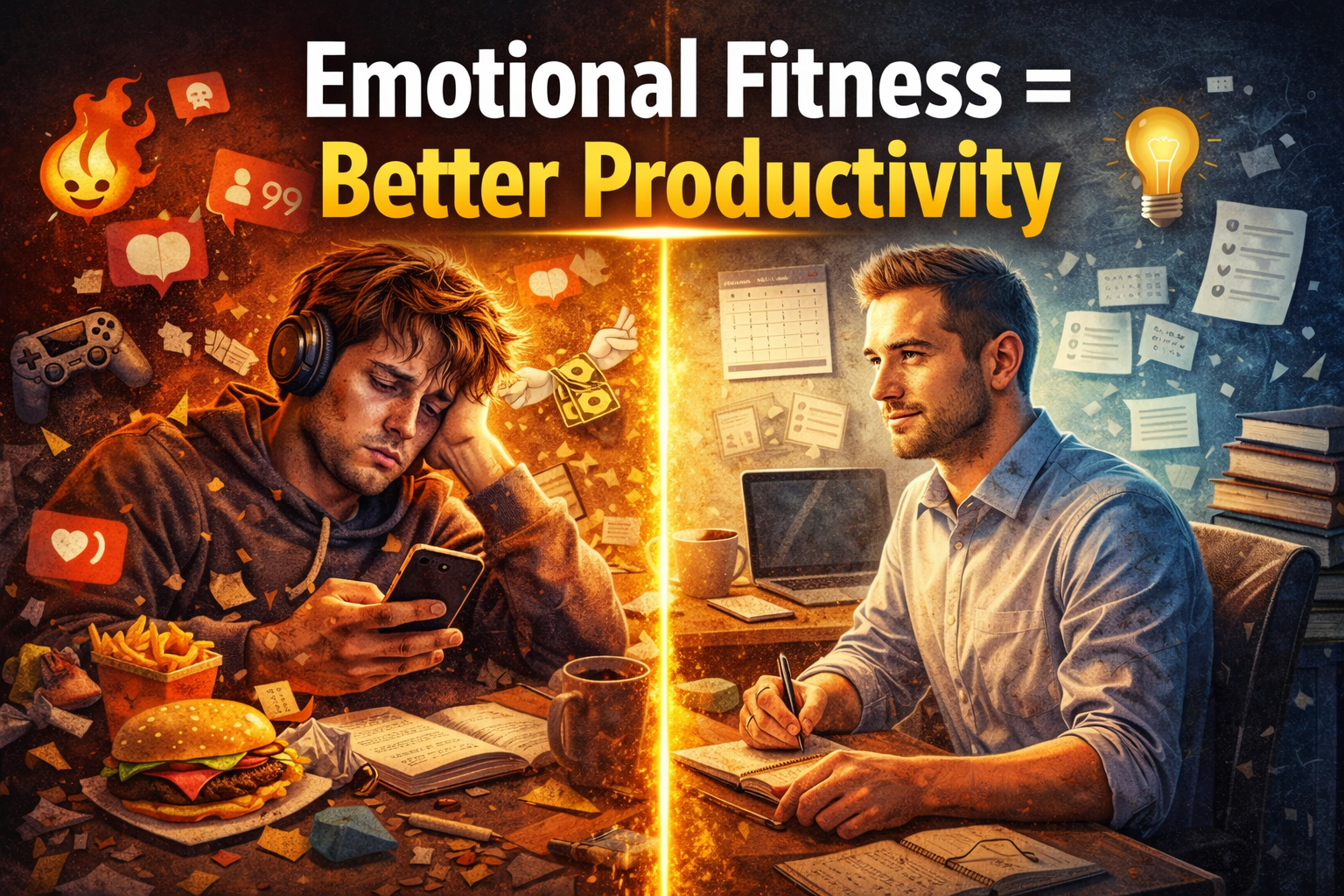
Most people try to fix productivity with tactics:
- better to-do lists
- new apps
- stricter routines
- "more discipline"
But productivity collapses for a simpler reason:
emotions drive behavior.
When your emotions are unstable, you don't "choose" your day.
You react to it.
And reacting creates:
- impulsive decisions
- dopamine chasing
- procrastination disguised as "research"
- conflict
- quitting too early
- short-term comfort over long-term progress
So if you want better productivity, you don't just need planning.
You need emotional education: the skill of noticing, managing, and upgrading your internal state.
Not to be emotionless — but to be stable enough to think straight.
Why emotions control productivity more than people admit
Your brain has two modes:
- reactive mode (fast, emotional, impulsive)
- deliberate mode (slow, logical, long-term)
When you're stressed, hungry, tired, anxious, angry, or overstimulated, the brain defaults to reactive mode.
In reactive mode, you:
- choose the easy thing
- avoid discomfort
- seek quick relief
- scroll, snack, buy, argue, quit, delay
- "do something" instead of doing the right thing
That's why emotional regulation isn't a "self-help luxury."
It's a core productivity skill.
The modern productivity trap: short-term dopamine
A lot of modern life is designed to hijack your attention with quick rewards:
- social media
- notifications
- junk entertainment
- online debates
- sugar and fast food
- "busy work" that feels productive but isn't
These create tiny dopamine hits.
The problem?
You train your brain to prefer:
easy reward now > bigger reward later
That mindset destroys long-term goals.
Because long-term goals require:
- patience
- discomfort tolerance
- delayed gratification
- consistency even when it's boring
Emotional fitness is what keeps you stable while you do that.
Emotional education: what it actually means
"Emotional education" is not:
- pretending you're always positive
- suppressing feelings
- becoming a robot
It's the ability to:
- notice what you feel
- understand why it's happening
- not let it hijack your behavior
- choose actions that match your values and goals
It's basically:
feel it, name it, manage it, move forward.
The productivity benefits of emotional control
When your emotional state is steady, you get:
1) Less impulsive decision-making
You stop sabotaging yourself with "in the moment" choices.
2) Clearer thinking
Your brain isn't overloaded by stress and noise.
3) Better consistency
You don't need motivation every day because you can handle "meh days."
4) Stronger relationships (which improves work)
Less reactivity = fewer conflicts and better collaboration.
5) Long-term behavior wins
You do the important things even when short-term dopamine calls you.
A simple model: Pause → Label → Choose
This is one of the most useful mental tools for productivity.
1) Pause
Before you react (scroll, eat, quit, argue), pause for 3 seconds.
2) Label
Name the emotion:
- "I'm anxious."
- "I'm bored."
- "I'm frustrated."
- "I'm overwhelmed."
- "I'm tired."
Labeling creates distance.
It turns "I am the emotion" into "I'm experiencing the emotion."
3) Choose
Now choose a response that helps future-you.
Not perfect. Just better.
This tiny sequence breaks the impulse loop.
The most common emotional triggers that destroy productivity
Overwhelm
When too many tasks feel heavy, the brain escapes.
Fix: reduce the next step to something stupidly small:
- "Open the doc"
- "Write the first paragraph"
- "Do 5 minutes"
Anxiety
Anxiety creates avoidance.
Fix: write down the fear and the next action:
- "What am I afraid will happen?"
- "What is one action that reduces uncertainty?"
Boredom
Boredom makes you chase stimulation.
Fix: time-box focus:
- "I'll do this for 20 minutes, then take a real break."
Frustration / anger
Anger makes you reactive and careless.
Fix: walk, breathe, delay the response.
A delayed response is a smarter response.
Fatigue
Fatigue makes you impulsive because your brain wants relief.
Fix: sleep, food, water, sunlight, short rest.
You can't "discipline" your way through chronic fatigue.
How to train emotional stability (practically)
This isn't about becoming perfect.
It's about getting 10–20% better — which changes your results massively.
1) Reduce emotional volatility with basics
This is boring but real:
- sleep
- movement
- protein + stable meals
- hydration
- sunlight
- less late-night doom scrolling
A lot of "lack of discipline" is just nervous system chaos.
2) Build a "calm reset" habit
Pick one:
- 5-minute walk
- 10 slow breaths
- short stretch
- quick journal dump: "What's on my mind?"
Your goal is to return to deliberate mode.
3) Replace "escape breaks" with "recovery breaks"
Escape breaks:
- scrolling
- random videos
- junk snacks
Recovery breaks:
- walk
- water
- breathing
- music
- short nap
- quick tidy
Recovery breaks give you energy back.
Escape breaks usually take it.
4) Practice delayed gratification daily
Do a tiny discomfort every day:
- start the hard task first
- don't check your phone for 30 minutes after waking up
- finish a task before opening a new tab
- wait 10 minutes before eating a craving
You're teaching your brain:
"I'm in control, not the impulse."
"Think long-term" is an emotional skill
People assume long-term thinking is purely logical.
It's not.
Long-term thinking is the ability to tolerate:
- boredom
- slow progress
- uncertainty
- lack of immediate reward
- discomfort
That tolerance is emotional, not intellectual.
This is why two smart people can have different outcomes:
- one follows short-term comfort
- one stays calm and consistent
A quick exercise: Future-you decision filter
When you feel an impulse, ask:
"Would future-me thank me for this?"
Examples:
- scrolling for 30 minutes
- writing the first page of the article
- replying emotionally to a message
- doing a 10-minute walk
- eating junk because you're stressed
This question interrupts the dopamine loop and brings you back to long-term reality.
How Self-Manager.net can help you make better decisions
Emotions hit hard in the moment.
So you need a system that:
- captures thoughts without acting on them
- turns decisions into visible plans
- helps you review patterns over time
With Self-Manager.net, you can:
- write a quick note on today like "Feeling anxious - tempted to procrastinate"
- create a small next action (5–10 minutes) to regain control
- track triggers and patterns across days (your system remembers what you forget)
- use weekly/monthly reviews to see what emotions lead to wasted time and what habits stabilize you
- plan long-term goals and break them down so you don't rely on mood
Your emotions shouldn't run your life.
A good system helps you act like the person you want to become — even on messy days.
Final thought: the best productivity upgrade is emotional clarity
The goal isn't to never feel bad.
The goal is to stop letting emotions decide your actions automatically.
If you can:
- pause instead of react
- choose long-term instead of short-term
- recover instead of escape
- think straight instead of impulsive
…your productivity becomes calmer, smarter, and more consistent.
And that's the real win: not "doing more," but building a life where your decisions compound in the right direction.

AI Powered Task Manager
Plan smarter, execute faster, achieve more
Create tasks in seconds, generate AI-powered plans, and review progress with intelligent summaries. Perfect for individuals and teams who want to stay organized without complexity.
Get started with your preferred account