Digital Organization Matters: How Clean Information Makes Your Thinking Sharper
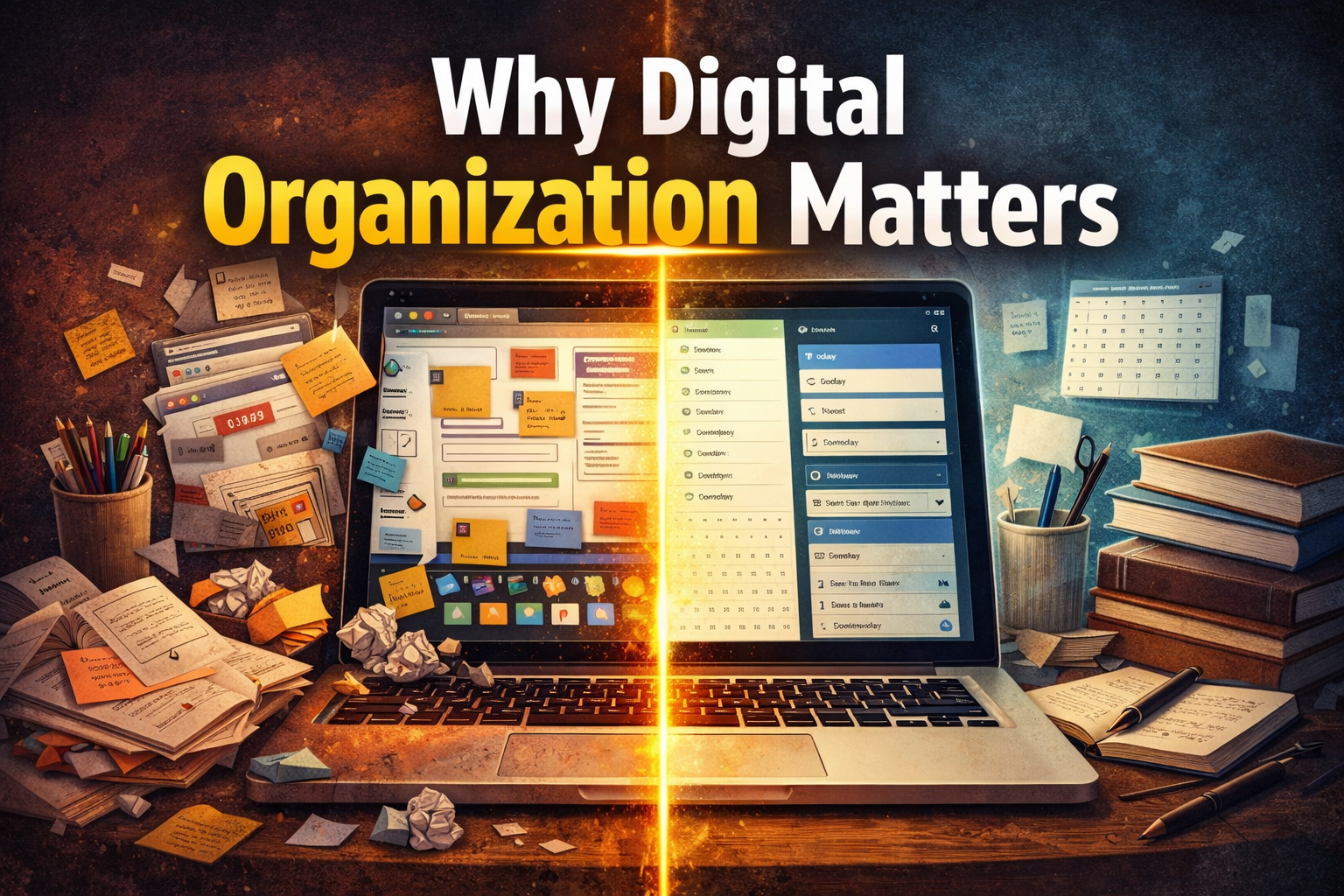
When people hear "organization," they often imagine the physical world:
- a clean desk
- labeled folders
- tidy shelves
- everything in its place
That helps. But for knowledge work in 2026, your real workspace is digital.
It's your:
- notes
- tasks
- bookmarks
- files
- screenshots
- ideas
- links
- drafts
- calendars
- "I'll come back to this later" pile
And here's the truth:
If your digital world is messy, your thinking becomes messy.
Not because you're lazy — but because your brain is constantly paying a hidden tax.
The hidden cost of digital chaos
Digital mess doesn't feel as obvious as physical mess.
A messy room is visible.
A messy information life is silent — but it leaks time and mental energy all day.
Common symptoms:
- you can't find things when you need them
- you save the same link 3 times
- you rewrite notes you already wrote
- you forget decisions and repeat debates
- you open 20 tabs and feel overwhelmed
- you start projects… then lose the thread
- you avoid planning because planning feels like digging through clutter
This isn't just "being disorganized."
It's friction in thinking.
Organization improves thinking (not just productivity)
A lot of productivity advice focuses on doing more.
But digital organization is deeper than that:
It makes the thinking process better.
1) Clear structure reduces cognitive load
Your brain has limited working memory.
When your system holds the information, your brain can focus on:
- reasoning
- creativity
- decision-making
- execution
Instead of "Where did I put that?" or "What did I decide last week?"
2) Clarity creates faster decisions
When information is organized, decisions become easier because:
- you can see context
- you can see history
- you can see priorities
- you can see the next step
Messy information = indecision.
3) Good organization protects your attention
The digital world is an attention battlefield.
If your notes and tasks are scattered across:
- random apps
- old docs
- unread messages
- browser tabs
- screenshots
…your attention gets pulled in 10 directions.
Organization gives you a single place to return to.
That alone improves focus.
Digital organization is really "information design"
Think of it like designing a workspace for your mind.
A good information system answers quickly:
- What am I doing today?
- What matters this week?
- What am I trying to achieve this month?
- What did I decide last time?
- Where is the relevant info?
- What is the next action?
If your system can answer those questions fast, your mind stays calm.
If it can't, you live in mental fog.
The modern problem: too much input, too little structure
Most people today collect information like this:
- save posts
- bookmark articles
- screenshot ideas
- watch videos
- read threads
- take notes
But they don't convert input into a usable system.
So the result is a digital garage full of boxes:
- "someday"
- "useful"
- "important"
- "I should read this"
- "great idea"
And later, when you need it… you can't find it.
Or you find it with stress.
What "organized" looks like in the information world
Digital organization isn't "perfect folders."
It's a simple structure that matches how you think.
Here's what works for most people:
1) A reliable capture system
A place where you quickly dump:
- tasks
- ideas
- links
- notes
Without losing them.
2) A way to connect tasks to time
The mind thinks in time:
- today
- tomorrow
- next week
- next month
When tasks aren't connected to dates, they become abstract and heavy.
3) A "single source of truth"
One place where you check:
- what you're doing
- what's next
- what you decided
- what matters
If you have 5 places, you're never fully confident.
Confidence comes from one clear system.
4) A review habit
Organization without review becomes storage.
Review turns storage into strategy.
Even 10 minutes weekly changes everything.
Practical tips to reduce digital chaos (without over-complicating)
Keep fewer "buckets"
Most people create too many categories, then stop using them.
Keep it simple:
- Now
- Next
- Someday
- Reference
Or:
- Personal
- Work
- Learning
Simple systems get used.
Convert content into action
If you save something, add a note:
- "Why did I save this?"
- "What will I do with it?"
If there's no answer, delete it.
Don't hoard tabs
Tabs are not a system.
Tabs are a symptom of unclear thinking.
Close aggressively.
Save intentionally.
Convert important things into notes/tasks.
Write decisions down
Half of mental clutter is repeating decisions:
- "Should I do this?"
- "How did I do that last time?"
- "What did I decide?"
Write decisions down once. Use them for months.
Why this makes you calmer
Digital organization isn't about being "neat."
It's about reducing anxiety.
Because anxiety often comes from:
- too many open loops
- unclear priorities
- missing context
- feeling behind
A good system closes loops.
It tells your brain:
"You don't need to remember everything. It's handled."
That frees your mind to think clearly.
How Self-Manager.net fits this approach
If you want organization that improves thinking, you need structure that matches real life:
- time-based planning
- context attached to dates
- quick capture
- easy review
Self-Manager.net is built around that idea:
- You can connect tasks and notes to specific days (so nothing floats in chaos)
- You can store ideas where they belong in time (today/week/month)
- You can review past days and see what happened (your system has memory)
- You can keep "tables" for topics like Learning, Ideas, Content, Business, Fitness, etc.
- You can turn information into action, not just storage
The goal isn't to have more information.
It's to have better thinking because your information is organized.
Final thought: organize your information, upgrade your mind
In the physical world, organization makes your space nicer.
In the digital world, organization makes your mind nicer.
Cleaner inputs.
Clearer priorities.
Fewer open loops.
Better decisions.
Less stress.
More execution.
You don't need a complex system.
You need a system you trust.
Because when your information world is clean, your thinking becomes clean — and everything you do gets easier.

AI Powered Task Manager
Plan smarter, execute faster, achieve more
Create tasks in seconds, generate AI-powered plans, and review progress with intelligent summaries. Perfect for individuals and teams who want to stay organized without complexity.
Get started with your preferred account