Why a Strong Attention Span Is a Productivity Superpower
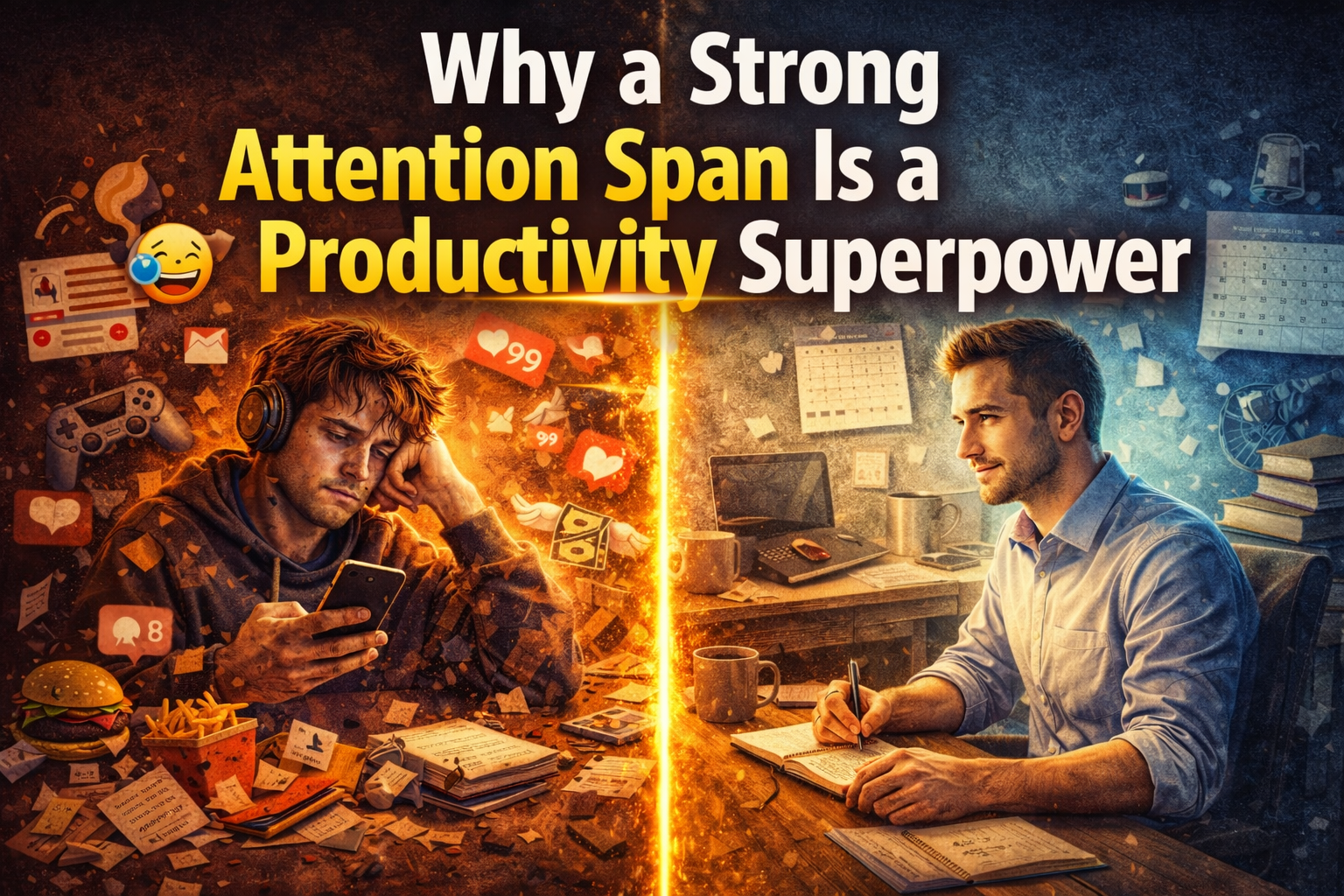
Productivity isn't only about working hard.
It's about being able to hold your attention on the right thing long enough to:
- understand it
- make good decisions
- execute it
- finish it
If your attention breaks every 2 minutes, your day becomes:
- started tasks
- half-finished work
- constant context switching
- "busy" feeling with little output
A good attention span is not a "nice to have."
It's one of the highest-leverage skills for modern work.
Attention is the foundation of everything else
Most productivity skills depend on attention:
- planning requires attention
- prioritizing requires attention
- learning requires attention
- deep work requires attention
- creative thinking requires attention
- quality requires attention
Even discipline needs attention, because discipline is basically:
"stay with the plan instead of chasing impulses."
So when your attention span improves, many other productivity problems shrink automatically.
The real cost of a short attention span
A short attention span doesn't just waste time.
It damages the quality of your thinking.
1) Context switching is expensive
Every time you switch:
- task → notification → task
- writing → email → writing
- coding → Slack → coding
…your brain pays a "reload cost."
You don't return instantly at full speed.
You return slowly, with less clarity.
2) Shallow attention creates shallow work
If you can't sit with complexity, you default to:
- easy tasks
- quick wins
- busywork
- "research" loops
- optimization instead of execution
You feel productive, but you're not building anything substantial.
3) You become easier to manipulate
If your attention is fragile, algorithms and notifications basically run your day.
Your calendar becomes less important than your feed.
Attention span = ability to delay dopamine
A strong attention span is not just "focus."
It's the ability to tolerate:
- boredom
- slow progress
- uncertainty
- discomfort
- delayed reward
Because meaningful work is often not instantly rewarding.
If you can only work when it feels exciting, you'll be inconsistent.
If you can work when it feels boring, you become unstoppable.
Why attention span matters even more in 2026
We live in an environment built to fragment attention:
- short-form video
- infinite scroll
- constant notifications
- multi-tab browsing
- multitasking culture
So attention span has become a competitive advantage.
Two people with equal talent:
- one can focus deeply
- one can't
The one who can focus will learn faster, build faster, and produce higher-quality work.
What good attention span gives you
Better decisions
You can think through problems instead of reacting instantly.
Faster learning
You can stay with hard material long enough to understand it.
Higher-quality output
You notice details. You catch mistakes. You refine.
More finished projects
Most people don't fail because they're stupid.
They fail because they can't stay with one thing long enough to finish.
More calm
A mind that can focus feels less chaotic.
Common signs your attention span is weak
You don't need a test. You'll notice it:
- you check your phone without thinking
- you open a tab and forget why
- you can't read more than a page without drifting
- you jump between tasks all day
- silence feels uncomfortable
- you avoid hard tasks and default to easy ones
- you keep "preparing" but don't execute
If that's you sometimes — it's normal.
But it's also trainable.
How to rebuild attention span (practical and realistic)
Think of attention like a muscle.
Train it gradually.
1) Reduce distraction at the source
If your environment is noisy, your attention will be noisy.
- silence notifications (especially during work blocks)
- keep phone out of reach
- close tabs you don't need
- use full-screen mode when working
You're not trying to be "stronger than distraction."
You're trying to make distraction less present.
2) Use timed focus blocks
Start small:
- 15 minutes focus
- 5 minutes break
Then increase:
- 25 / 5
- 45 / 10
- 60 / 10
The goal is not perfection.
The goal is to regularly practice "stay with one thing."
3) Do one thing until a clear stopping point
A powerful rule:
Don't switch tasks until you hit a checkpoint.
Examples:
- finish the paragraph
- fix the bug
- send the email
- complete the section
- write the outline
No checkpoint = endless switching.
4) Replace "escape breaks" with real recovery
If your break is scrolling, you're training fragmented attention.
Better breaks:
- walk
- water
- stretch
- breathe
- look outside
- short snack
This keeps your mind calm instead of overstimulated.
5) Read daily (even 10 minutes)
Reading is focus training.
It forces sustained attention in a way that fast content doesn't.
If you read 10–20 minutes a day consistently, your attention improves over time.
Attention span and long-term success
A lot of long-term success is boring in the moment:
- building a business
- learning a skill
- getting fit
- writing consistently
- shipping products
- improving craft
Attention span is what makes consistency possible.
It's what helps you choose:
long-term compounding over short-term dopamine.
How Self-Manager.net can help you protect attention
Attention isn't only an internal skill — it's also a system problem.
You lose attention when:
- tasks are unclear
- priorities are messy
- open loops keep nagging you
- your day has no structure
With Self-Manager.net, you can:
- plan your day with clear "what matters today"
- break big work into small next actions (less overwhelm = less distraction)
- time-block deep work sessions (and see them in context of the week)
- capture distractions quickly (write it down, don't follow it)
- review what derailed you weekly, so you improve your environment
A good tool doesn't magically give you focus.
But it reduces the chaos that steals it.
Final thought: your attention is your life
Whatever holds your attention, shapes your:
- skills
- relationships
- career
- health
- identity
So productivity isn't just about managing tasks.
It's about managing attention.
Because if you control your attention, you control your output.
And if you control your output consistently, you control your future.
AI Powered Task Manager
Plan smarter, execute faster, achieve more
Create tasks in seconds, generate AI-powered plans, and review progress with intelligent summaries. Perfect for individuals and teams who want to stay organized without complexity.
Get started with your preferred account