Why a Winner's Mindset in 2026 Helps You Achieve Your Yearly Goals (With Real Examples)
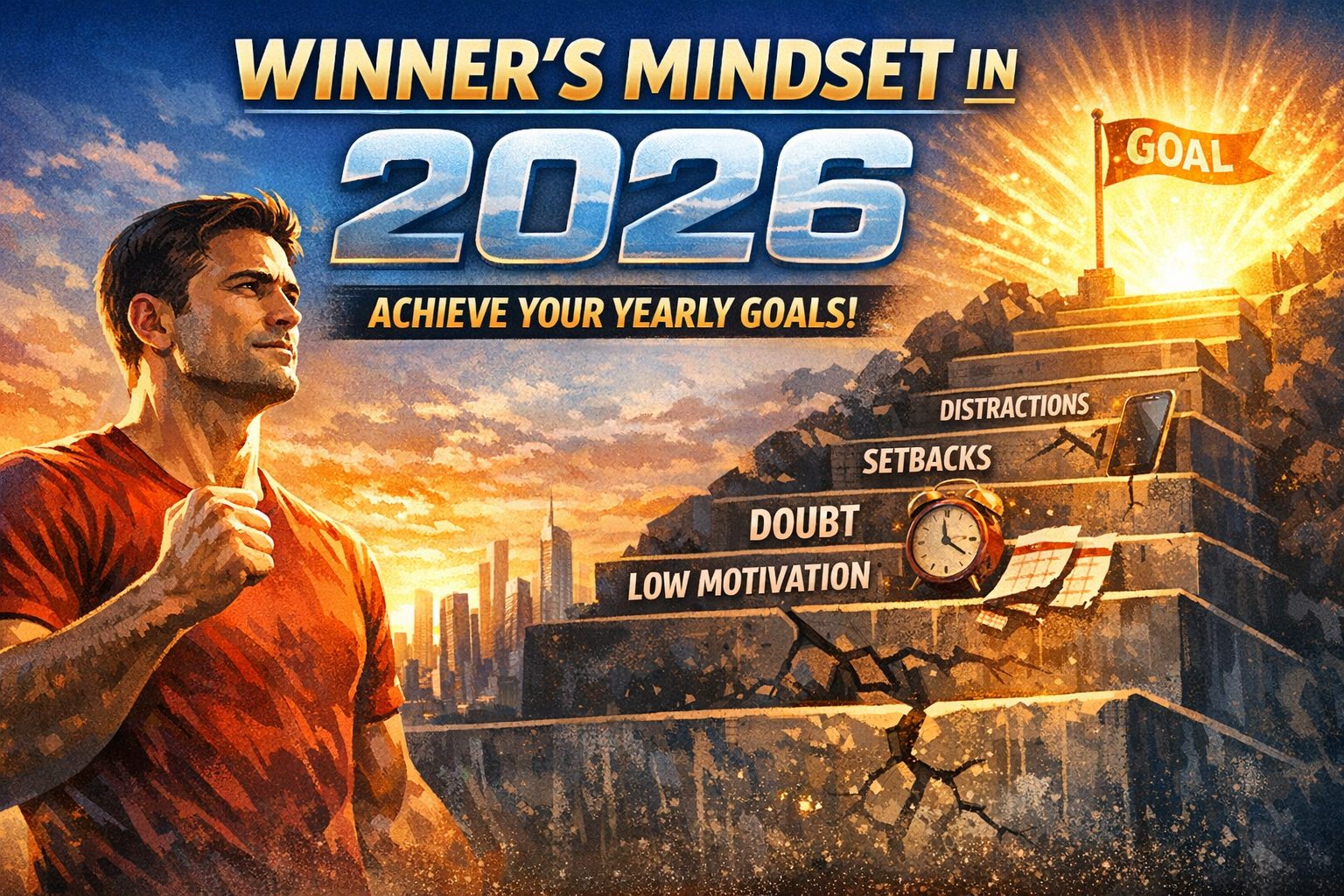
Most people think yearly goals are about strategy, tools, or discipline.
Those matter—but they don't come first.
What comes first is how you think when things get hard.
Because every goal eventually hits the same wall:
- motivation drops
- progress slows
- life interrupts
- you miss days
- you start doubting the plan
A winner's mindset doesn't mean being loud, arrogant, or "always positive."
It means having the mental habits that keep you moving after the easy phase ends.
Below are concrete examples of successful people whose mindset patterns helped them push through—and how you can apply the same patterns in 2026.
What a "winner's mindset" actually is
A winner's mindset is:
staying committed to the process even when outcomes are delayed.
Winners don't win because everything works.
They win because they keep going when it doesn't.
Examples of successful people whose mindset made the difference
1) Michael Jordan: turning rejection into fuel
Jordan is famously associated with getting cut early in his basketball journey (the story is often told as a turning point). Whether you focus on the exact details or the principle, the mindset is the key:
Mindset pattern: "This setback is feedback."
What he did: doubled down on practice, not excuses.
Lesson for 2026: when you get rejected (client, job, launch, content flop), don't spiral—upgrade reps.
Steal this line:
"Failure isn't a stop sign. It's data."
2) J.K. Rowling: persistence through long uncertainty
Rowling's early years with Harry Potter involved major personal difficulty and multiple rejections before success.
Mindset pattern: "Keep submitting. Keep building."
What she did: continued writing and pitching despite rejection.
Lesson for 2026: most goals have a long "silent period" where progress isn't visible. Winners expect that phase.
Steal this rule:
"No quitting during the boring middle."
3) Thomas Edison: reframing failure as iteration
Edison is associated with the "many attempts" story around the lightbulb.
Mindset pattern: "I'm not failing. I'm iterating."
What he did: treated each attempt as a step in the process.
Lesson for 2026: if you're building a product, learning a skill, or growing an audience—your first versions are supposed to be imperfect.
Steal this approach:
"Ship → learn → adjust → repeat."
4) Kobe Bryant: obsession with process (not motivation)
Kobe's "Mamba Mentality" is basically extreme commitment to practice, consistency, and improvement.
Mindset pattern: "I don't negotiate with my routine."
What he did: showed up regardless of mood.
Lesson for 2026: if you rely on motivation, you'll be inconsistent. If you rely on routine, you'll be unstoppable.
Steal this rule:
"On bad days, do the smallest version."
5) Serena Williams: resilience under pressure and criticism
Top athletes don't just train physically—they train mentally to perform while being watched, judged, and pressured.
Mindset pattern: "I can handle discomfort."
What she did: continued to compete at elite levels despite intense scrutiny and setbacks.
Lesson for 2026: you'll feel discomfort when you:
- raise your prices
- ship publicly
- post content consistently
- ask for sales
- take feedback
Winners don't avoid discomfort. They normalize it.
Steal this sentence:
"Pressure is part of the price."
6) Jeff Bezos: long-term thinking over short-term emotions
Bezos is strongly associated with long-term bets and delayed gratification.
Mindset pattern: "Short-term noise doesn't decide my direction."
What he did: stayed focused on long-term compounding rather than short-term optics.
Lesson for 2026: don't change goals every week. Keep the direction stable, adjust tactics.
Steal this principle:
"Consistency beats constant reinvention."
7) Oprah Winfrey: using setbacks as redirection, not identity
Oprah's career includes early setbacks and criticism, yet she built momentum by leaning into strengths and purpose.
Mindset pattern: "This is feedback, not my identity."
What she did: stayed focused on growth and alignment, not proving people wrong.
Lesson for 2026: your self-talk matters. If you label yourself "not disciplined," you'll act that way. Winners label setbacks as temporary.
Steal this shift:
"I'm not behind. I'm building."
The 5 winner mindset traits that make yearly goals inevitable
1) Process over mood
Winners execute even when they don't "feel like it."
2026 rule: 1 Must-Win task per day.
2) Consistency over intensity
They avoid heroic sprints that lead to burnout.
2026 rule: minimum viable progress on bad days.
3) Fast restart after failure
They don't waste a week because they missed a day.
2026 rule: "Next rep." Restart today.
4) Patience with delayed results
They expect the slow middle.
2026 rule: track input metrics (hours, sessions, outputs).
5) Ownership
They focus on what they control.
2026 rule: replace "I didn't have time" with "I didn't prioritize it."
Turn mindset into action: a simple winner system for 2026
Step 1: Pick one main goal
Not ten. One main win for the year.
Step 2: Define the weekly process
Examples:
- 4 workouts/week
- 2 articles/week
- 10 outreach messages/week
- 3 deep work blocks/week
Step 3: Define your daily Must-Win
One task that moves the goal forward.
Step 4: Weekly review (15 minutes)
Ask:
- What worked?
- What didn't?
- What's the one adjustment for next week?
This review is what prevents drift.
Final takeaway
A winner's mindset isn't about being "better" than other people.
It's about being consistent with yourself.
The common thread across Jordan, Rowling, Edison, Kobe, Serena, Bezos, Oprah isn't luck.
It's this:
they kept showing up while the outcome was still uncertain.
That's the mindset that makes 2026 goals real.

AI Powered Task Manager
Plan smarter, execute faster, achieve more
Create tasks in seconds, generate AI-powered plans, and review progress with intelligent summaries. Perfect for individuals and teams who want to stay organized without complexity.
Get started with your preferred account