Why Tech CEOs Talk About “Hard Work” (But What They Really Mean Is Leverage + Systems)
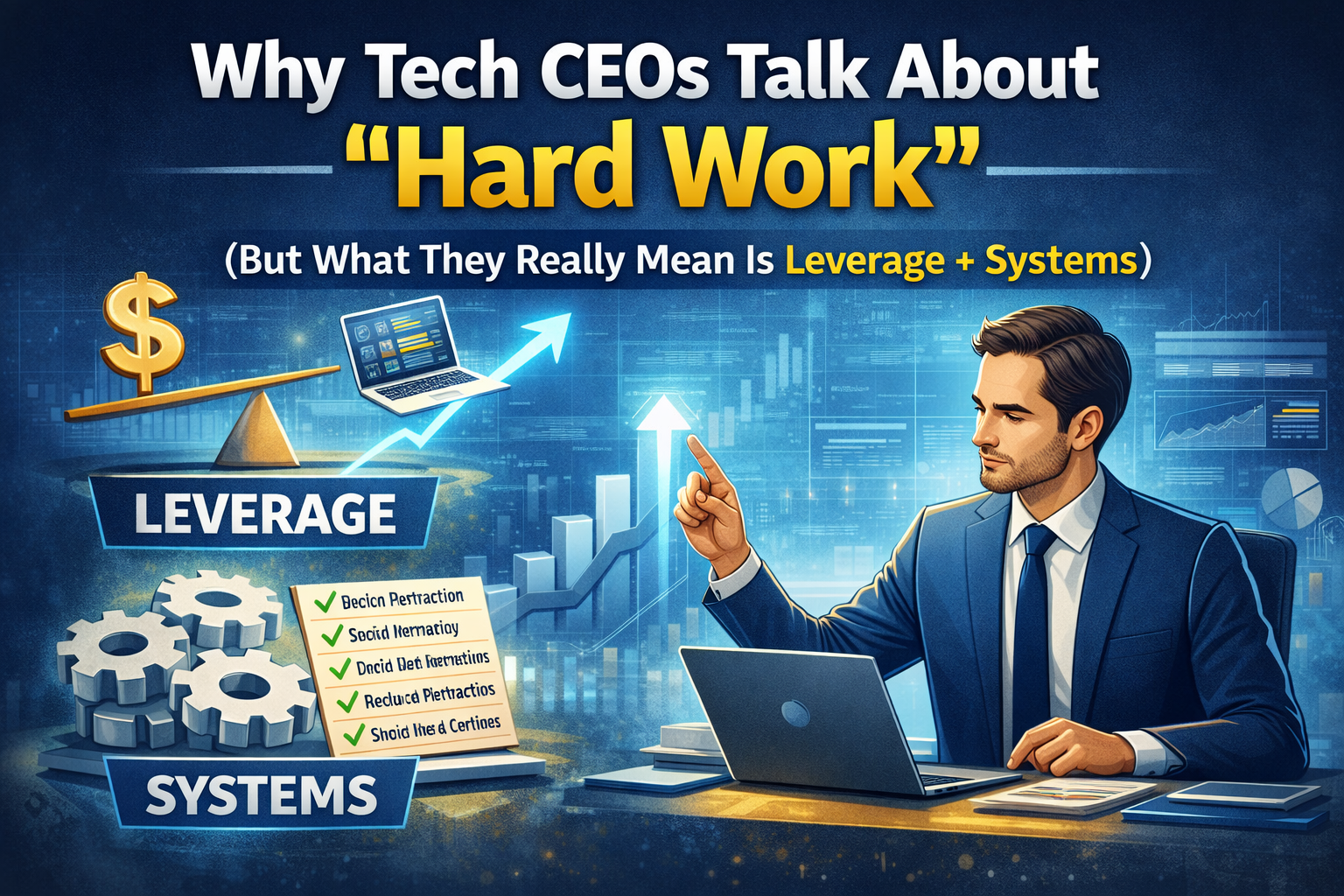
You’ll hear a lot of top U.S. tech CEOs mention hard work.
Elon Musk talks about extreme hours. Jensen Huang is famous for intensity and high standards. Many others repeat the same theme: outwork, outlearn, out-execute.
But if you copy only the “work harder” part, you miss the real point.
They’re not just doing more work.
They’re doing more of the right work, with systems that keep them focused on leverage.
Hard work is the fuel.
Systems decide where the fuel goes.
1) “Hard work” is the headline. “Working on leverage” is the strategy.
Most people work hard on low-leverage tasks:
- polishing details that don’t matter
- reacting all day
- busywork that looks productive
- fixing the same problems repeatedly
High-performing CEOs work hard too—but they aim that effort at:
- decisions that change outcomes
- execution systems that compound
- products/platforms that scale
- teams and processes that multiply results
They’re not obsessed with effort.
They’re obsessed with impact per hour.
2) Why “hard work” is emphasized publicly
Hard work is easy to understand and easy to repeat.
It also communicates:
- seriousness
- hunger
- willingness to sacrifice
- high standards
But internally, leadership is more about:
- what gets worked on
- who works on it
- how it gets executed repeatedly
- how fast the feedback loop runs
That’s a system problem, not a motivation problem.
3) The hidden truth: consistency beats intensity
Most people can do “CEO mode” for a week.
Then they burn out.
What separates long-run operators is not intensity—it’s repeatability:
- the same execution rhythm every week
- reviews that keep priorities sharp
- a pipeline that turns strategy into tasks
- fast learning from mistakes
Intensity is occasional.
Systems are daily.
4) The Leverage Stack (what high-output leaders actually build)
If you look at what serious operators optimize, it’s usually this stack:
Layer 1: Personal clarity (what matters)
They keep a tight list of priorities.
They say no aggressively.
They don’t let their calendar become a junk drawer.
Layer 2: Execution loops (daily/weekly review)
They run a cadence:
- daily: plan → execute → short review
- weekly: review metrics → adjust priorities
- monthly/quarterly: strategy refresh
The loop prevents drift.
Layer 3: Delegation systems (who does what)
They don’t delegate randomly.
They delegate with:
- clear outcomes
- feedback checkpoints
- ownership
The goal is to move the CEO away from low-leverage tasks permanently.
Layer 4: Product and platform leverage (scale)
In tech, the ultimate leverage is:
- code
- distribution
- networks
- automation
- compounding product improvements
Hard work here compounds.
Hard work on busywork doesn’t.
5) The CEO “hard work” formula is really this
When a CEO says “work hard,” it often means:
- Pick the smallest set of priorities that drive outcomes
- Allocate time like a weapon
- Create an execution system so it repeats
- Measure results and tighten feedback loops
- Remove distractions and low-leverage commitments
- Build leverage (product/platform/team)
Hard work is the energy.
The system is the multiplier.
6) How to copy the useful part (without needing 100-hour weeks)
You can borrow the same principle at a normal human level.
Step 1: Define 1–3 leverage goals
Examples:
- grow audience
- ship product improvements weekly
- close more sales
- build a repeatable marketing engine
Step 2: Turn goals into weekly outcomes
Not “work on marketing.”
But:
- publish 2 posts
- ship one feature
- contact 10 leads
- record 3 short videos
Step 3: Protect a daily leverage block (60–120 minutes)
A protected daily block is where your compounding happens.
No admin.
No messages.
No “quick checks.”
Step 4: Run a review loop (this is the real cheat code)
Daily (2 minutes):
- what mattered today?
- what’s the next best action?
Weekly (15–30 minutes):
- what moved outcomes?
- what was noise?
- what do I stop doing?
This is how you keep working hard on the right things.
7) Why “systems” beat motivation (especially in tech)
Tech work is mentally expensive:
- deep focus
- long feedback loops
- complex decisions
- heavy context
If you rely on motivation, you’ll:
- switch tasks too often
- restart constantly
- waste cognitive energy
- ship slower
Systems reduce cognitive load:
- the next action is clear
- priorities are visible
- context is stored
- review catches drift early
That’s why high-output leaders don’t just grind.
They design.
8) Where Self-Manager.net fits in this philosophy
A leverage-based system requires:
- a place to plan what matters (daily)
- a place to store context (notes, decisions, links)
- a place to review patterns (weekly/monthly/quarterly)
That’s exactly the “CEO operating system” approach:
plan → execute → review → adjust
Self-Manager.net fits this because it’s date-based:
- your actions live on the day they happened
- your decisions don’t get lost
- review becomes easy because history is organized naturally
It turns “hard work” into something that compounds.
Closing idea: hard work is common. leverage is rare.
Hard work alone can get you far.
But the real advantage is:
hard work pointed at leverage, repeated by a system.
That’s what most top tech leaders are actually doing—whether they say it explicitly or not.

AI Powered Task Manager
Plan smarter, execute faster, achieve more
Create tasks in seconds, generate AI-powered plans, and review progress with intelligent summaries. Perfect for individuals and teams who want to stay organized without complexity.
Get started with your preferred account