Why Daily Planning Is So Important for Productivity (And Yearly Goals)
Introduction
Daily planning isn't about controlling every minute.
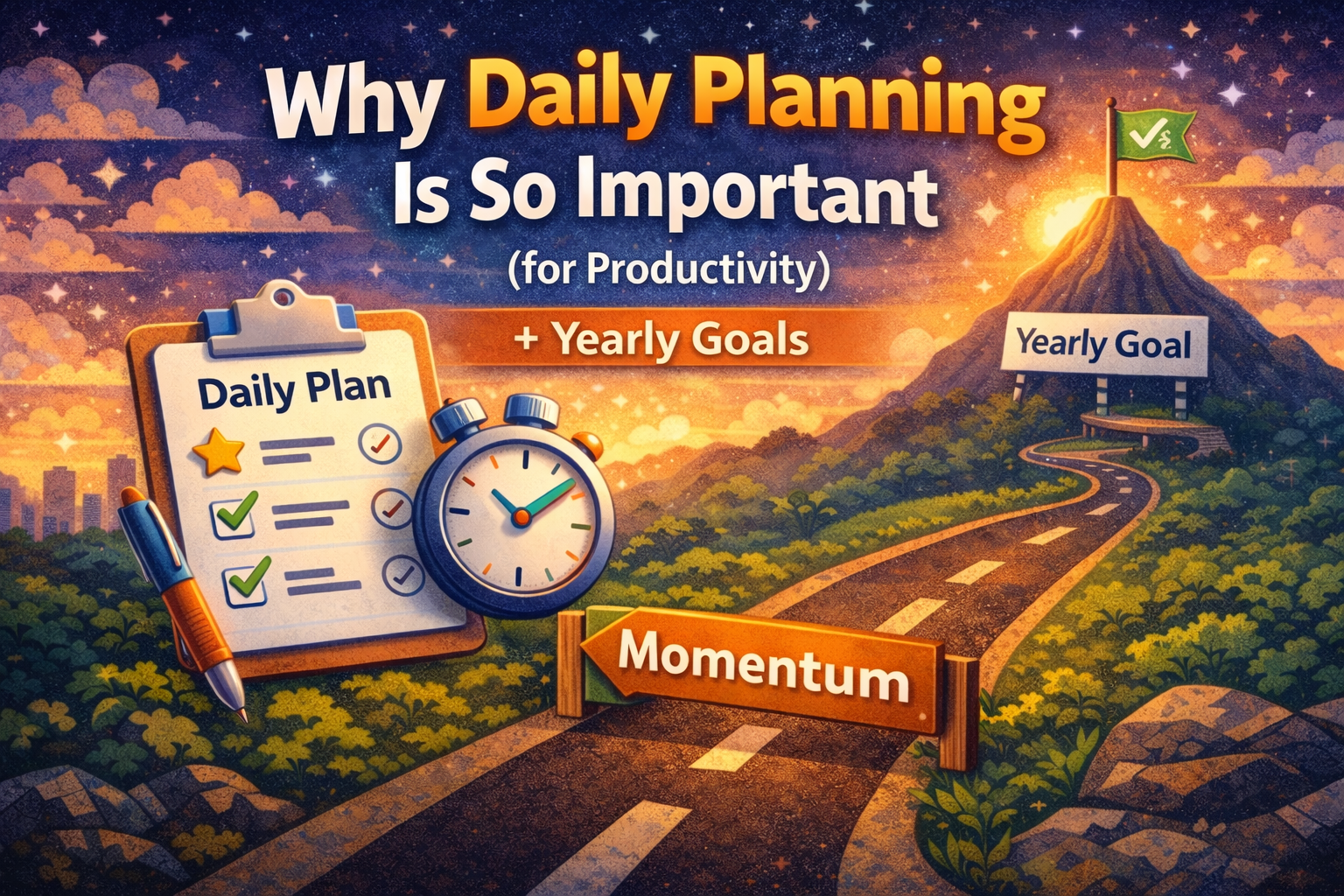
It's about building momentum, staying realistic, and making sure your long-term goals actually turn into daily actions.
Most people don't fail because they're lazy.
They fail because their days are unstructured — so the day gets "spent" instead of "used."
Daily planning creates momentum (the real secret)
Momentum is the most underrated productivity force.
When you plan your day, you remove the hardest part of work:
figuring out what to do next.
That decision friction is what causes:
- procrastination
- random task hopping
- "I'll start later"
- wasted high-energy hours
A simple daily plan turns your day into a sequence of next actions instead of a guessing game.
Daily planning shows what's realistically possible in one day
Without daily planning, people consistently do one of two things:
- Overestimate what can be done → feel behind → lose motivation
- Underestimate what can be done → drift → waste time
Planning forces a reality check:
- How many deep-work tasks can you actually do?
- What meetings/admin will steal time?
- What's the one thing that must happen today?
Over time, you build an accurate "internal calendar."
That accuracy is what makes you consistent.
Daily planning makes improvement measurable through review
A daily plan is only half the system.
The other half is the end-of-day review:
- What did I actually finish?
- What took longer than expected?
- What blocked me?
- What was noise?
- What should I change tomorrow?
Without review, you repeat the same mistakes and think "productivity doesn't work."
With review, you get compounding improvements.
This is how a week becomes better than the last week.
Daily planning + time tracking reveals where your time really goes
Most people don't know where their time goes.
They feel busy, but they can't explain the day.
Light time tracking (even rough estimates) shows:
- where you're leaking time
- which tasks expand
- what drains energy
- what produces real outcomes
That data turns daily planning from a "hope" into a strategy.
You stop guessing.
You start optimizing.
Daily planning is how yearly goals become real
Yearly goals don't get achieved in December.
They get achieved by:
- hundreds of normal days
- small repeatable actions
- consistent execution
Daily planning is the bridge between:
"This is my goal for the year"
and
"This is what I do today."
No daily bridge = the year becomes wishes + stress.
The simplest daily planning structure (that works)
If you want a practical system:
- Pick 1 "must win" (the one thing that moves a goal)
- Pick 2 supporting tasks (important but smaller)
- Time-block the must win (protect it early if possible)
- Batch admin (don't let admin fragment the day)
- End-of-day review (5 minutes):
- what worked
- what didn't
- what to do tomorrow
That's it.
Simple enough to run daily.
Strong enough to change a year.
Final thoughts
Daily planning isn't overhead.
It's the difference between:
- having goals and achieving goals
- feeling busy and making progress
- repeating days and compounding days
If you want 2026 to be different, don't start with more motivation.
Start with a better daily system.

AI Powered Task Manager
Plan smarter, execute faster, achieve more
Create tasks in seconds, generate AI-powered plans, and review progress with intelligent summaries. Perfect for individuals and teams who want to stay organized without complexity.
Get started with your preferred account