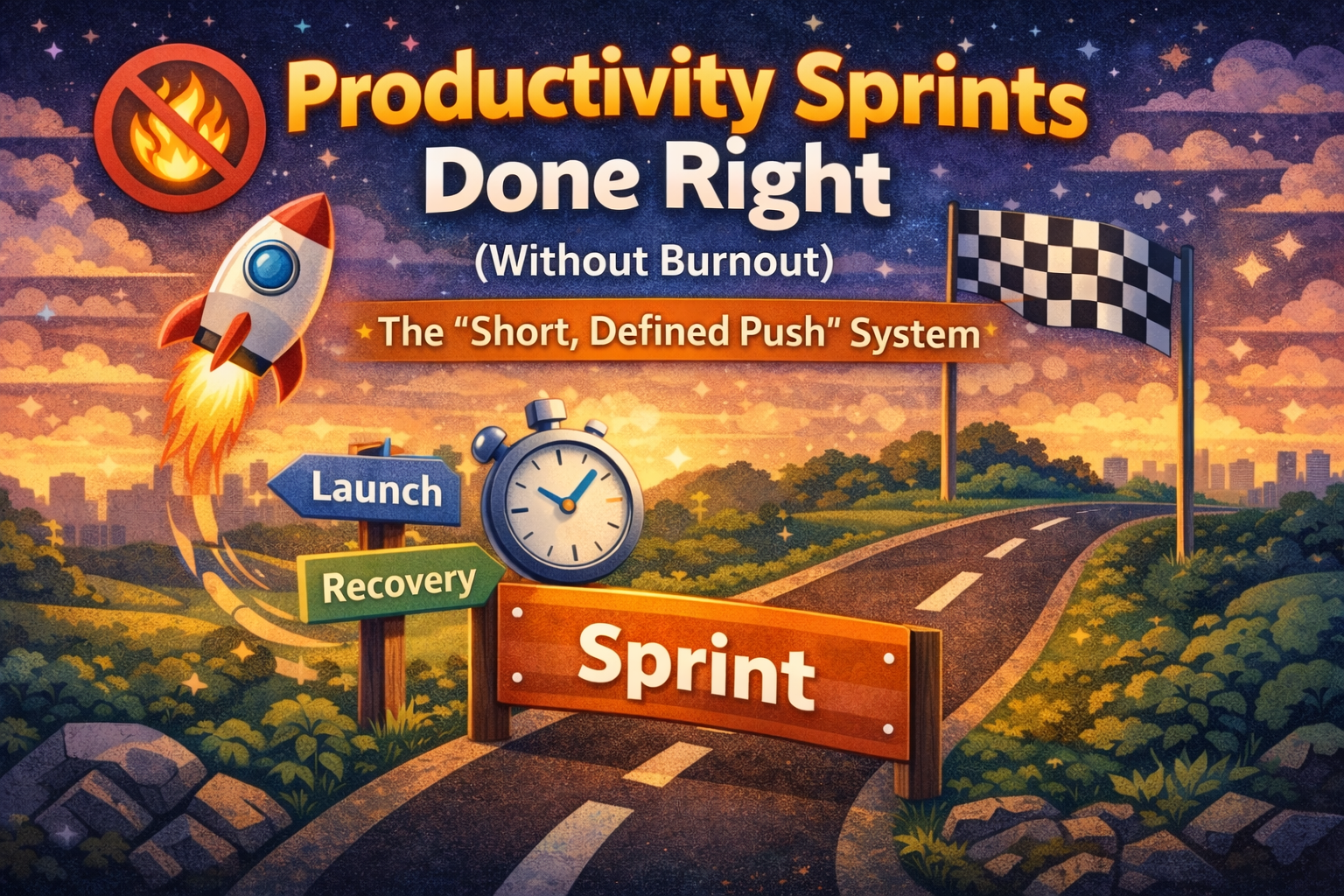
Productivity Sprints Done Right (Without Burnout): The "Short, Defined Push" System
Introduction
A productivity sprint is a short, focused burst of execution where you temporarily narrow your priorities to finish something that's already well-defined.
Not "work harder forever."
Not "hustle mode."
A sprint is a controlled push with a clear finish line.
Used correctly, sprints are one of the fastest ways to:
- ship meaningful work
- break through procrastination
- recover momentum
- finish the "almost done" projects that drain your mind
Used incorrectly, sprints become burnout.
This article is the ruleset for doing them right.
What a sprint really is (in plain English)
A sprint is:
A short time window (1–10 days) where your main goal is completing a defined deliverable, not juggling everything.
The key word is defined.
If you can't describe the outcome clearly, you're not sprinting — you're just stressing.
Why sprints work so well
1) They remove ambiguity (the #1 productivity killer)
Most "lack of motivation" is actually:
- unclear next steps
- unclear definition of done
- too many possible directions
A sprint forces:
- a single target
- a visible plan
- fewer decisions
2) They create psychological momentum
Once you enter "finish mode," your brain stops reopening old tabs.
You stop negotiating with yourself every hour.
3) They shrink the time window (which increases execution)
Long time horizons invite delay.
Short windows create urgency without panic — if the scope is correct.
The non-negotiable rule: only sprint when the work is well-defined
You sprint only when:
- you know what "done" looks like
- the steps are mostly known
- you can estimate effort reasonably
If the work is still research-heavy or unclear, you need discovery, not a sprint.
"Sprint-ready" checklist
A sprint is ready when you can answer:
- What is the deliverable?
- What does "done" mean?
- What are the 5–20 tasks that complete it?
- What can be postponed for a week?
- What will you stop doing during the sprint?
If you can't answer these quickly, don't sprint yet.
The biggest mistake: sprinting too long
A sprint is not a lifestyle.
Recommended sprint lengths (in 2026 reality)
- Solo work: 1–5 days is ideal
- Small team: 3–10 days is common
- If it needs 3+ weeks: it's a project, not a sprint
Long sprints fail because:
- intensity can't be maintained
- "temporary sacrifice" becomes permanent
- sleep and exercise drop first
- quality drops next
- motivation collapses last
If you need a month, break it into 4 micro-sprints with recovery gaps.
The "Sprint Without Burnout" Framework
Step 1: Pick one outcome (not ten tasks)
Examples of good sprint outcomes:
- "Publish the new landing page"
- "Ship the onboarding flow"
- "Finalize the client proposal + send it"
- "Complete the week 1 version of the feature"
Bad outcomes:
- "Work on marketing"
- "Fix the app"
- "Improve productivity"
(too vague)
Step 2: Define "done" brutally
Write 3–7 bullet points that make "done" objective.
Example:
Done means:
- page is live on production
- mobile tested
- copy finalized
- analytics event tracked
- 1 screenshot for social is created
Step 3: Scope it to fit the timebox
The timebox is the boss.
If you only have 3 days, the sprint must be shaped for 3 days.
Do not keep scope and extend time.
Instead:
- keep time
- reduce scope
Step 4: Sprint in time blocks (not in chaos)
Most people "sprint" by staying available all day.
That's not a sprint. That's interruption.
A sprint needs protected blocks:
- 1–3 deep blocks per day (60–120 minutes each)
- shallow/admin tasks batched later
Step 5: Daily micro-review (5 minutes)
Every sprint day ends with:
- What is the next action for tomorrow?
- What is blocked?
- What is no longer necessary?
This prevents mid-sprint drift.
Step 6: Recovery day / recovery evening
If you sprint hard, recovery must be planned:
- lighter day after
- or at least a protected evening with no "catch-up"
Recovery is what keeps sprinting sustainable.
How to avoid burnout while sprinting
Burnout is not just "too much work."
It's usually a mix of:
- too much ambiguity
- no finish line
- no recovery
- guilt-driven pacing
- sprinting while still doing everything else
Burnout prevention rules
- Sprint only on defined work
- Keep it short (1–10 days)
- Reduce commitments during sprint
- Schedule recovery
- Stop at "done" (don't keep adding "bonus")
The "Sprint vs Routine" distinction
Use sprints for:
- launches
- deadlines
- shipping features
- finishing backlog items
- pushing through resistance
Use routine for:
- health
- relationships
- learning
- long-term content
- maintaining systems
A good life is mostly routine.
Sprints are a tool you use when needed — then you return to baseline.
A simple sprint template you can copy
Sprint name:
Start date → End date:
Outcome:
Definition of done (3–7 bullets):
Sprint task list (5–20 tasks):
What I will pause during sprint:
Daily deep work blocks:
Daily micro-review time:
Recovery plan (day/evening):
Final thoughts
Sprints work.
But only when:
- The work is defined
- The timeline is short
- Recovery is planned
Without those three pieces, you're not sprinting.
You're just burning out slowly.

AI Powered Task Manager
Plan smarter, execute faster, achieve more
Create tasks in seconds, generate AI-powered plans, and review progress with intelligent summaries. Perfect for individuals and teams who want to stay organized without complexity.
Get started with your preferred account