Top Productivity App Categories People Use for Personal Life (2026 Stack Guide)
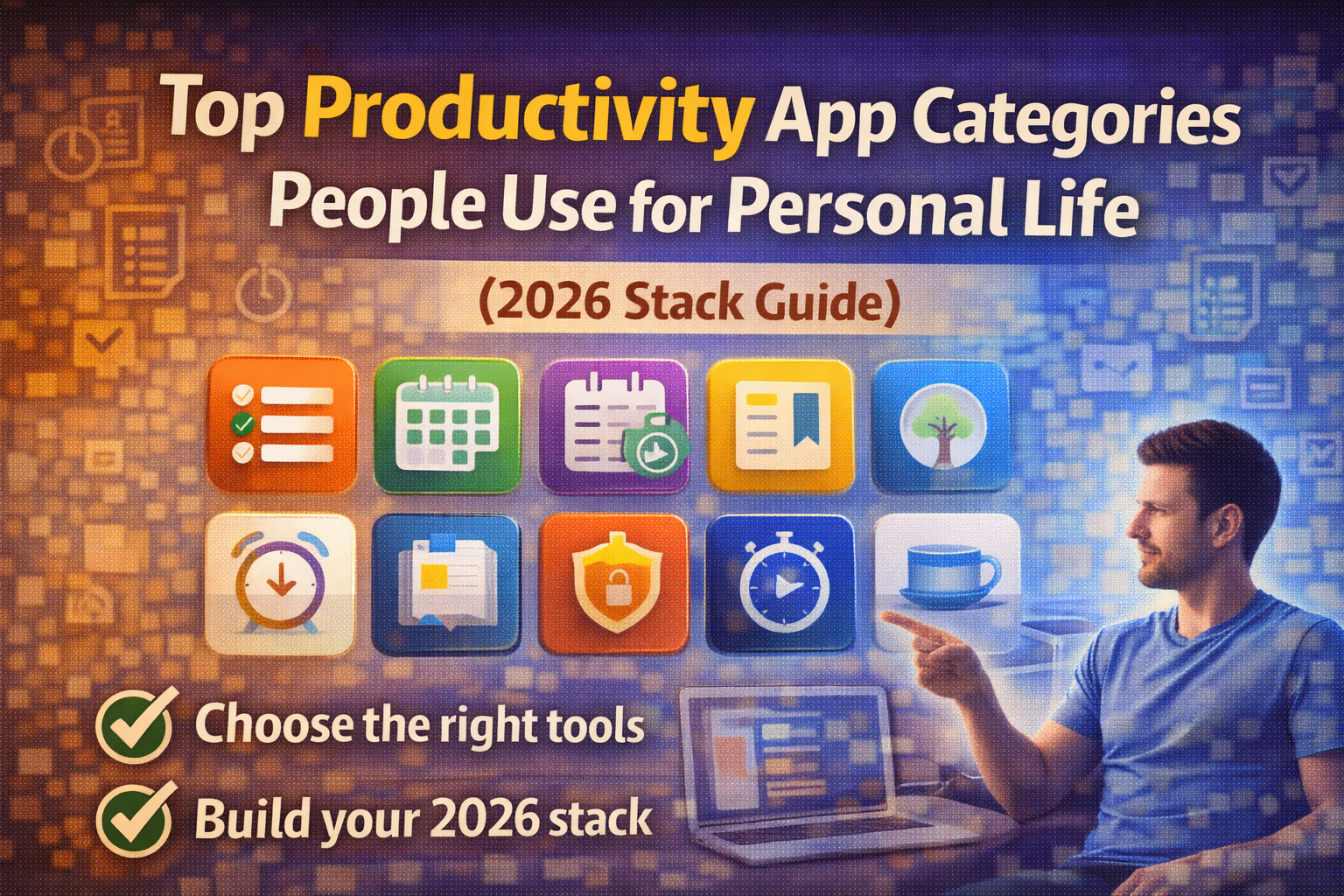
Introduction
Most people don't use "one productivity app."
They use a small stack — usually 3 to 6 tools — each handling a different job: capture tasks, plan time, store notes, stay focused, and review progress.
Below are the most common categories people use for personal productivity (with popular app examples), plus a simple way to choose your own stack without app overload.
1) Home base (tasks + projects + daily/weekly system in one place)
This is where your life "lives" — your plans, projects, and reviews.
Popular picks:
- Self-Manager.net (date-based daily/weekly/monthly workflow + deep AI integration)
- Notion (notes + databases + tasks, positioned as an AI workspace)
- ClickUp / Asana / Trello (often used even for personal projects because they're structured)
Best for: people who want one place to plan and review (not just list tasks).
2) To-do list apps (fast capture + daily execution)
These are the "get it out of your head" tools — quick, lightweight, reliable.
Popular picks (commonly recommended):
- Todoist, TickTick, Microsoft To Do, Apple Reminders, Google Tasks
Note: even simpler apps keep evolving (example: Google Tasks adding a deadline feature).
Best for: daily execution and quick capture.
3) Calendar apps (your reality engine)
If it isn't on the calendar, life will try to overwrite it.
Popular picks:
- Google Calendar / Apple Calendar / Samsung Calendar (calendar apps consistently sit at the top of "productivity" rankings on mobile).
Best for: appointments, time constraints, and "non-negotiables."
4) Daily planners + auto-scheduling (calendar-first productivity)
These tools are for people who want the app to build a realistic day plan automatically.
Popular picks:
- Motion (AI prioritizes tasks and time-blocks them on your calendar)
- Reclaim (AI auto-schedules tasks/habits/focus time around your calendar)
- Sunsama (daily planner with AI estimates and planning support)
Best for: people whose biggest problem is "my day explodes, I need a plan that adapts."
5) Notes and "second brain" apps (knowledge + ideas + personal wiki)
People use these to store thinking, notes, learning, and reference material.
Common picks:
- Notion (notes + databases)
- Evernote (still widely used as a note organizer)
Best for: keeping important info searchable so you don't rely on memory.
6) Habit trackers (consistency engine)
When the goal is "do it daily," habits tools help you keep streaks and reduce friction.
Examples you'll see commonly recommended:
- habit trackers vary a lot by taste; many people pair them with calendar + to-do apps rather than replacing them.
Best for: workouts, language practice, routines, sleep habits.
7) Focus timers + distraction blockers (protect attention)
These help when the real enemy is notifications + doomscrolling + task switching.
Popular pick:
- Forest (gamified focus timer designed to keep you off your phone)
A newer trend: playful "focus companion" apps that gamify staying off your phone.
Best for: anyone who struggles to start, or who loses focus mid-task.
8) Time tracking (where did the week go?)
Not everyone needs this — but if you're self-employed or building a product, it can be a clarity superpower.
People often pair time tracking with project tools.
Best for: freelancers, founders, and anyone trying to reduce "invisible time leaks."
9) Journaling + reflection (stress down, clarity up)
A surprising number of "productive" people use journaling to:
- reduce mental load
- think clearly
- track patterns (what works, what doesn't)
Best for: staying calm, improving decisions, learning from your weeks.
The simplest "personal productivity stack" that works for most people
If you want a clean setup (without app overload):
- One home base (projects + reviews)
- One calendar (time reality)
- One capture/to-do tool (fast tasks)
- One focus tool (protect attention)
Everything else is optional.
Self-Manager.net fits best in the "home base" slot because it's built around real dates (day → week → month) and AI that works inside your actual work timeline.
Quick choose-your-category question
What's your main bottleneck right now?
- "I forget / feel overwhelmed" → to-do + capture (Todoist/TickTick)
- "My schedule is chaos" → calendar-first AI planner (Motion/Reclaim)
- "I can't stay focused" → focus timer/blocker (Forest / Focus Friend style)
- "I need one place to run my life" → home base (Self-Manager/Notion)
AI Powered Task Manager
Plan smarter, execute faster, achieve more
Create tasks in seconds, generate AI-powered plans, and review progress with intelligent summaries. Perfect for individuals and teams who want to stay organized without complexity.
Get started with your preferred account