The 1–3–5 Rule for Tasks (And How to Make It Actually Stick)
If your daily plan keeps collapsing, it’s usually not because you’re unmotivated.
It’s because you’re planning like your day has unlimited capacity.
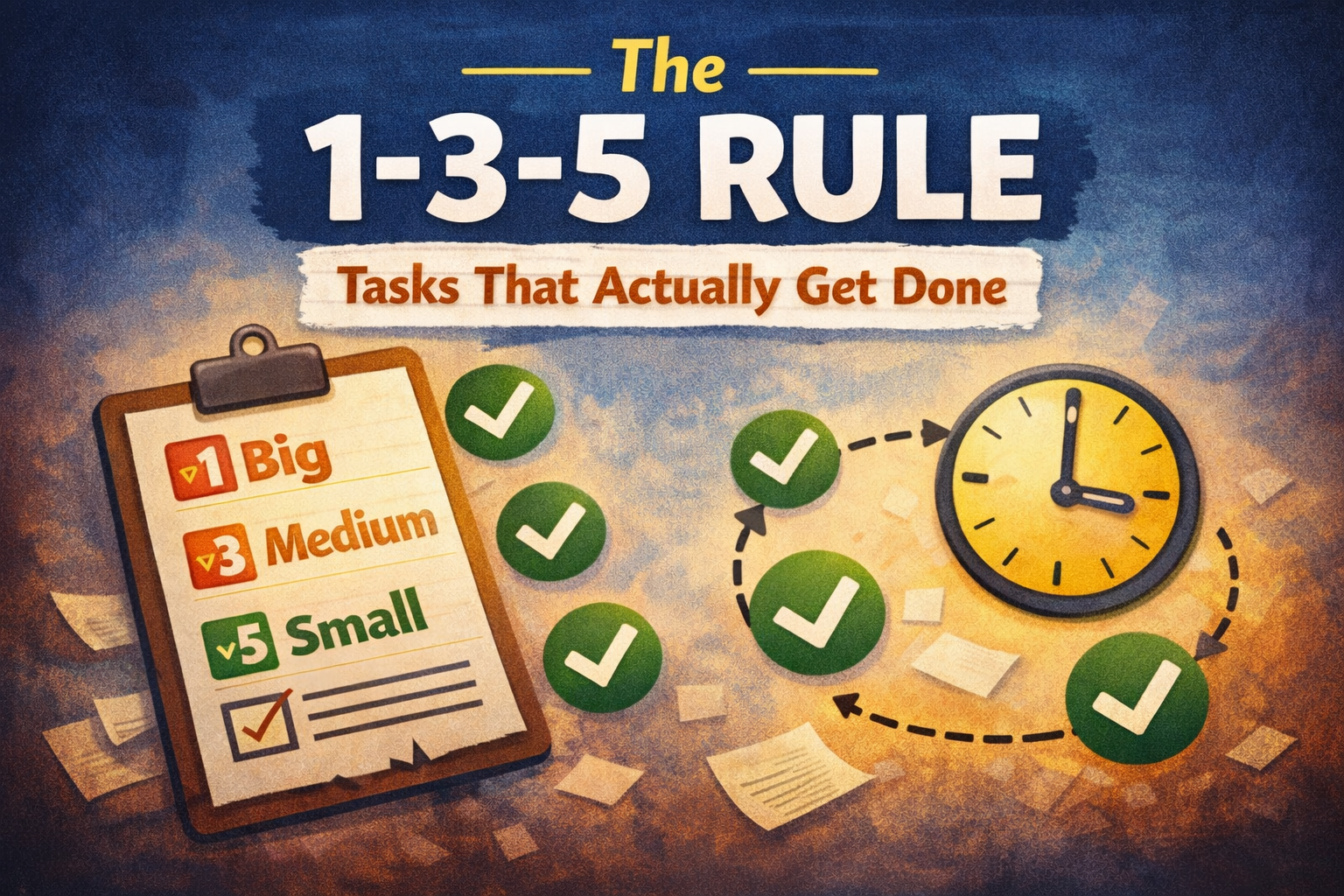
The 1–3–5 Rule is a simple way to make your day realistic:
- 1 big task
- 3 medium tasks
- 5 small tasks
That’s it.
It’s not a productivity hack. It’s a constraint. And constraints are what make execution possible.
Why the 1–3–5 Rule works (when to-do lists fail)
A regular to-do list is infinite.
It makes you feel behind before you even start.
The 1–3–5 rule works because it:
- forces trade-offs (you can’t pick 25 “important” things)
- stops fantasy planning
- gives your day structure
- creates a clear “win” definition
- reduces switching and decision fatigue
Your brain performs better when “done” is reachable.
Step 1: Define what “big / medium / small” means
Most people break the rule because they classify tasks wrong.
Use time as the definition:
Big task (1)
- 60–180 minutes
- requires focus
- moves something important forward
Examples:
- write a sales page draft
- build a feature
- film a video
- do deep client work
Medium tasks (3)
- 20–60 minutes
- meaningful, but manageable
Examples:
- edit a section of an article
- clean up a dashboard
- implement one small feature
- write 5 outreach messages
Small tasks (5)
- 2–15 minutes
- quick wins, admin, maintenance
Examples:
- reply to emails
- pay an invoice
- update a doc
- book an appointment
- fix one UI detail
Rule: if a “small task” takes 45 minutes, your list will fail.
Step 2: Convert projects into next actions (the real secret)
The 1–3–5 rule only works if your tasks are executable.
These are not tasks:
- “Work on marketing”
- “Improve website”
- “Get fit”
- “Grow business”
They’re projects.
A task must be something you can do in one sitting.
Rewrite:
- “Work on marketing” → “Write 10 headline hooks (20 minutes)”
- “Improve website” → “Fix mobile hero spacing (15 minutes)”
- “Grow business” → “Draft 1 LinkedIn post (25 minutes)”
If you can’t start immediately, it’s still too vague.
Step 3: Place the 1 big task first (or it won’t happen)
Most people do this backwards.
They start with small tasks because it feels easier.
Then the day fills up, energy drops, and the big task never happens.
If your big task matters, it must happen:
- first thing
- or inside a protected block
Rule: “big task before inbox.”
Even 45 minutes before you check messages changes your week.
Step 4: Make the rule stick with a “Minimum Viable Day”
You will have low-energy days.
If your system requires a perfect day, you won’t be consistent.
So you need two modes:
Normal day
- 1 big
- 3 medium
- 5 small
Bad day (minimum viable day)
Pick just:
- 1 medium
- 3 small
Or even:
- 1 small (just keep the chain alive)
The goal on bad days isn’t performance.
It’s continuity.
Step 5: Add a “carry-over limit” (the anti-shame rule)
The fastest way to destroy any planning system is moving 20 unfinished tasks to tomorrow.
So set a carry-over cap.
Example:
- you can only roll over 2 tasks
- everything else gets rescheduled properly (or deleted)
This prevents the “doom list” effect.
Rule: tomorrow doesn’t inherit today’s fantasy.
Step 6: Use the 1–3–5 rule as a daily review tool
This is where it becomes powerful.
At the end of the day, check:
- Did I complete the big task?
- If not, why?
- too big?
- wrong time?
- unclear first step?
- distractions?
Then you improve the system.
Over time, you learn:
- how much you can actually do
- what tasks take longer than you think
- when you are best at deep work
- what you should stop committing to
That’s how productivity compounds.
A complete example (copy-paste)
1 Big (90 min)
- Draft homepage hero + first section
3 Medium (30–45 min each)
- Implement mobile nav fix
- Write 10 tweet hooks
- Edit 1 minute of a short video (tight cut)
5 Small (5–10 min each)
- Reply to 3 emails
- Pay one invoice
- Add 3 notes to tomorrow’s tasks
- Book appointment
- Update one analytics report screenshot
This is a “real” day.
And real days get done.
Common mistakes that stop it from sticking
Mistake 1: Your big task is actually a project
Fix: define the first milestone.
“Build landing page” → “Write hero copy + CTA only.”
Mistake 2: You plan 1–3–5… and then add 20 extras
Fix: keep an “optional” list separate.
Optional tasks are not commitments.
Mistake 3: You don’t protect time for the big task
Fix: schedule it or tie it to a trigger (coffee → big task).
Mistake 4: You never review
Fix: 2-minute review:
“What worked, what didn’t, what changes tomorrow?”
Where Self-Manager.net fits
The 1–3–5 rule sticks best when your system:
- lets you plan tasks by date (so today is separate from tomorrow)
- keeps context (notes, links, comments) attached to tasks
- makes review easy (daily/weekly/monthly history)
That’s exactly what Self-Manager.net is designed for:
a date-based home base where planning and review match real life.
7-day challenge
For the next 7 days:
- Plan 1–3–5 in the morning
- Do the “1 big” before checking messages
- End the day with a 2-minute review
- Roll over max 2 tasks
In a week, you’ll notice something:
you don’t just do more — you trust your plan again.

AI Powered Task Manager
Plan smarter, execute faster, achieve more
Create tasks in seconds, generate AI-powered plans, and review progress with intelligent summaries. Perfect for individuals and teams who want to stay organized without complexity.
Get started with your preferred account