Slow Down to Speed Up: Why Seeing the Big Picture Is a Productivity Superpower (2026)
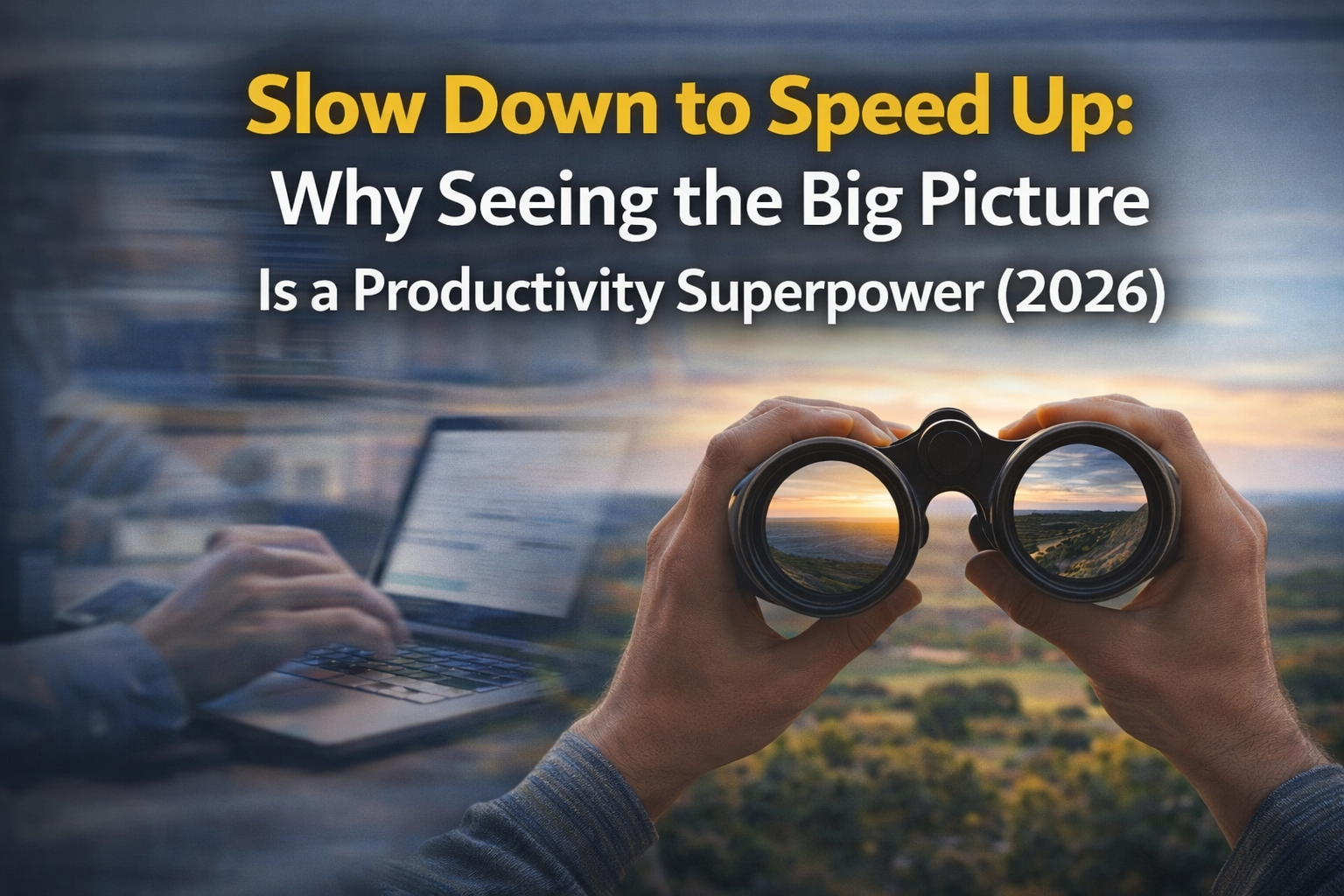
Most people think productivity is about moving faster.
More tasks.
More hustle.
More intensity.
But the highest-leverage productivity move is often the opposite:
slowing down long enough to see the big picture.
Because when you never zoom out, you don't just get tired — you get misaligned.
And misalignment is the most expensive form of "busy."
The hidden productivity problem: motion without direction
If you stay in execution mode 24/7, you start living like this:
- reacting to the next message
- doing the next urgent task
- finishing small things all day
- feeling busy… but not progressing
That's not a motivation problem.
That's a perspective problem.
You're too close to the work to see where it's going.
Zooming out fixes that.
Why slowing down makes you more productive
1) It prevents "doing the wrong thing efficiently"
One of the worst productivity outcomes is:
high effort + wrong direction.
Slowing down lets you ask:
- What am I actually trying to achieve this month?
- What is the one thing that would make everything else easier?
- What am I doing that doesn't matter anymore?
If you don't ask those questions, your task list becomes a museum of old priorities.
2) It reduces mental noise (and decision fatigue)
A tired brain isn't just slower.
It makes worse decisions.
When you slow down, you reduce the constant decision stream:
- what to do next
- what to ignore
- what to reschedule
- what to respond to
Less noise = better judgment.
Better judgment = better productivity.
3) It gives your brain recovery time (so tomorrow isn't ruined)
A lot of people "win" Monday and lose the week.
They push so hard that their brain is fried for the next days.
But productivity isn't about one good day.
It's about repeatable output.
Slowing down is how you protect tomorrow's performance.
The big picture is not a motivational speech — it's a control panel
When you zoom out, you should be looking at 3 simple things:
1) Your direction
- What matters this month?
- What matters this week?
- What matters today?
2) Your constraints
- What's eating your time?
- What's draining your energy?
- What's creating stress?
3) Your tradeoffs
- What are you saying no to?
- What are you postponing on purpose?
- What are you overcommitted to?
That's the big picture.
Not inspiration — control.
What "slowing down" actually looks like (practical, not vague)
Here are simple ways people build "zoom out" time without turning it into a philosophy hobby.
1) Daily reset (2 minutes)
At the end of the day, ask:
- What did I actually do today?
- What's the real next step tomorrow?
- What should I stop carrying mentally?
This is how you end the day with a clear brain.
2) Weekly big-picture review (10–15 minutes)
Once per week, ask:
- What moved forward?
- What drifted?
- What is the 1–3 priorities for next week?
- What should be deleted?
This is where you prevent weeks from disappearing.
3) Monthly zoom out (20 minutes)
Once per month, ask:
- What are the main themes of this month?
- What worked and why?
- What didn't work and why?
- What's the next focus?
This gives you calm direction instead of constant pressure.
Why this is an "important step" in productivity (not a nice-to-have)
If you never zoom out, these things happen automatically:
- your calendar fills with other people's priorities
- your tasks become "someday"
- your brain never fully rests
- you lose the feeling of progress
- you start relying on willpower
Zooming out isn't extra work.
It's maintenance for your direction and your mind.
The brain angle: rest is not laziness, it's performance protection
A rested brain has:
- better attention
- better memory
- better creativity
- better decision-making
- lower stress response
A tired brain has:
- shallow thinking
- procrastination
- emotional reactions
- low patience
- "everything feels hard"
So "slowing down" isn't only psychological.
It's biological.
You're protecting the machine that produces the work.
A simple system that keeps you fresh for the next days
If you want a minimal routine that works in real life:
Every day (2 minutes)
- choose tomorrow's "one priority"
- clear mental leftovers (write them down)
Every week (10 minutes)
- pick 3 outcomes that matter
- remove or postpone the rest
Every month (20 minutes)
- decide one theme
- set one measurable target
That's it.
No complicated dashboards.
Just a rhythm that keeps your brain clear and your goals visible.
Final thought: speed without clarity is drift
Most people don't fail because they're lazy.
They fail because they run too fast in the wrong direction — until they burn out.
In 2026, the most productive people aren't the ones who sprint nonstop.
They're the ones who:
- slow down
- see the big picture
- choose the right work
- and protect their brain so they can show up tomorrow
That's how productivity becomes sustainable — and how progress becomes inevitable.

AI Powered Task Manager
Plan smarter, execute faster, achieve more
Create tasks in seconds, generate AI-powered plans, and review progress with intelligent summaries. Perfect for individuals and teams who want to stay organized without complexity.
Get started with your preferred account