How to Use a Task Manager for Personal Growth (2026 Guide)
Most people use a task manager for one thing:
getting more done.
But the real power is bigger.
A task manager can become your personal growth engine
Personal growth isn’t a motivational quote.
It’s small actions repeated over weeks — and a way to review what’s actually changing.
If you build the right system, your task manager becomes:
- your habit builder
- your accountability partner
- your progress tracker
- and your “life dashboard” (without needing a spreadsheet)
The mindset shift: from “tasks” to “training”
Personal growth is basically training:
- training your health
- training your skills
- training your discipline
- training your relationships
- training your finances
- training your mental clarity
A task manager turns that training into something you can plan and repeat.
The 10 best ways to use a task manager for personal growth
1) Turn goals into weekly actions (goals fail when they stay abstract)
Bad goal:
- “Get fit.”
Good weekly actions:
- 3 workouts
- 2 long walks
- hit protein target 5 days
A task manager helps you convert a dream into a weekly plan.
2) Track your “keystone habits” (the few habits that upgrade everything)
Not all habits matter equally.
Keystone habits often include:
- sleep routine
- exercise
- journaling
- reading
- deep work block
- weekly review
Put these habits as recurring tasks, and keep them visible.
3) Use “themes” to reduce overwhelm
Instead of tracking 20 goals at once, run your life in themes.
Examples:
- January: Health foundation
- February: Skill building
- March: Business systems
Your task manager becomes a seasonal strategy tool.
4) Build a daily “identity” checklist (small actions that prove who you are)
Personal growth is identity.
A simple list like:
- “I am a healthy person” → workout/walk
- “I am a focused person” → one deep work block
- “I am a disciplined person” → plan tomorrow
These tasks are tiny, but they compound.
5) Create a “skill ladder” for learning (instead of random courses)
Most people learn randomly and quit.
Instead:
- pick one skill
- break it into levels
- schedule practice tasks
Example: “Public speaking”
- week 1: write 3 short scripts
- week 2: record 3 takes
- week 3: publish 1 video
- week 4: live session
A task manager makes learning structured.
6) Make reflection part of the system (growth requires review)
Without review, you don’t grow — you just repeat.
Add recurring tasks:
- Weekly reflection (15 min)
- Monthly reflection (30 min)
- Quarterly review (60 min)
Reflection turns activity into improvement.
7) Track your “wins” (progress needs proof)
One reason people lose motivation is: they don’t see progress.
Create a weekly habit:
- list 5 wins
- list 1 lesson
- list 1 focus for next week
This builds confidence and momentum.
8) Use “friction removal tasks” (upgrade your environment)
Personal growth isn’t only effort — it’s design.
Examples:
- remove junk food from the house
- set up your gym bag
- clean your workspace
- install website blockers
- unsubscribe from distractions
These tasks reduce friction so habits become easier.
9) Use “life areas” like a balanced scorecard
Instead of only work tasks, build categories:
- Health
- Wealth
- Skills
- Relationships
- Mindset
- Home
- Fun/Recovery
Even a few tasks per week in each area keeps your life balanced.
10) Build a “personal operating system” (not just a task list)
The highest level is when your task manager holds:
- your plans
- your routines
- your reviews
- your progress history
At that point, you stop starting over.
You just keep refining.
Why Self-Manager.net is a strong fit for personal growth
Personal growth is all about time:
- daily actions
- weekly consistency
- monthly momentum
- quarterly direction
That’s why Self-Manager.net’s date-centric structure works so well:
- plan by day/week/month/quarter
- review what happened (not what you hoped would happen)
- use AI summaries to reflect faster
It’s less about “doing more” and more about:
building a life you can actually sustain.
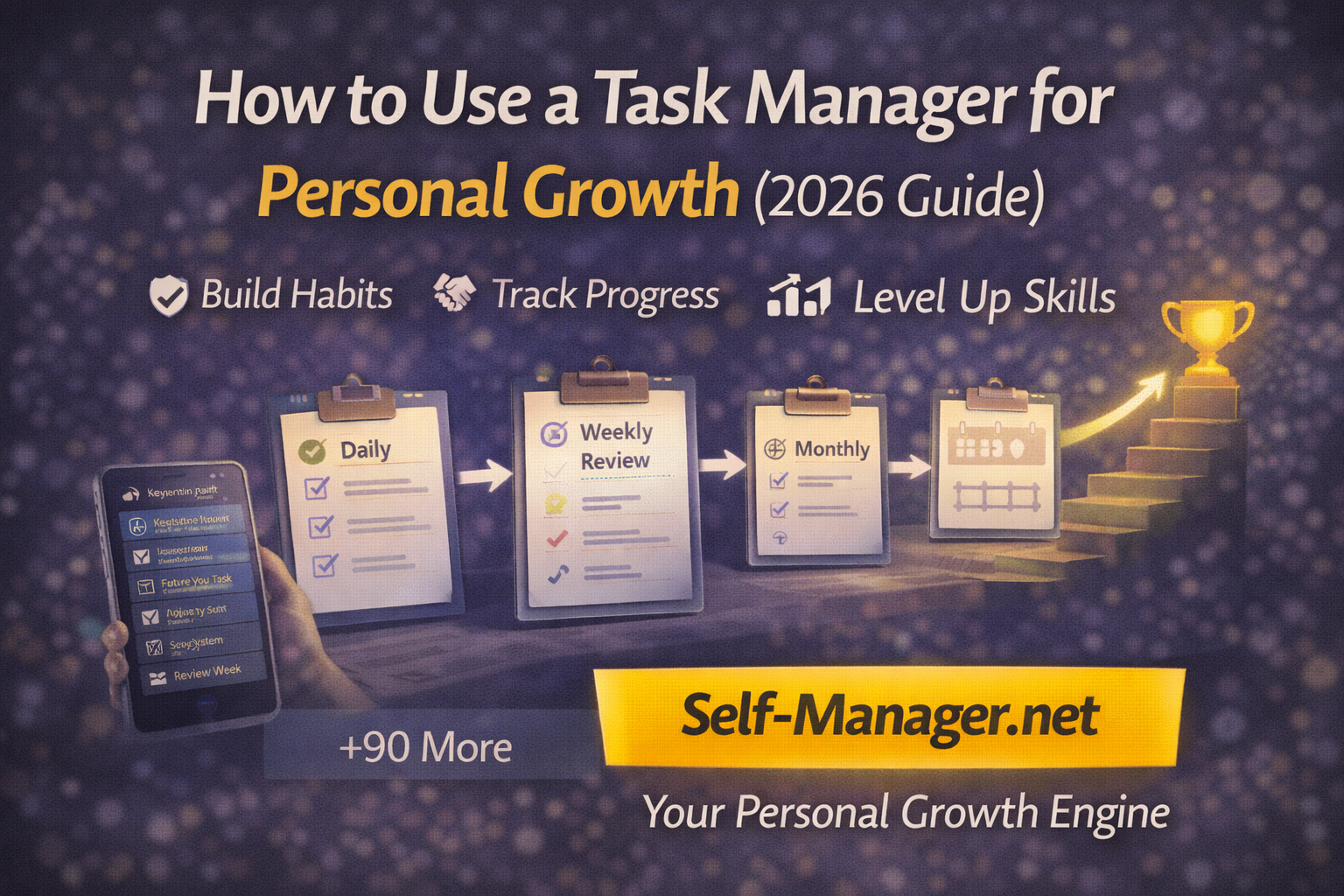
A simple “Personal Growth Setup” you can copy
Daily
- Top 3 tasks
- 1 keystone habit
- 1 “future you” task (health/skill/finance)
Weekly
- plan week (10 min)
- review week (15 min)
- choose one focus theme
Monthly
- recap wins
- identify what’s slipping
- adjust your system
That’s enough to create real progress.
If you want personal growth, don’t rely on motivation.
Rely on:
- small actions
- time-based planning
- consistent reviews
Use a task manager as your growth engine.
And if you want a system built for day/week/month/quarter planning and reviews, try Self-Manager.net.

AI Powered Task Manager
Plan smarter, execute faster, achieve more
Create tasks in seconds, generate AI-powered plans, and review progress with intelligent summaries. Perfect for individuals and teams who want to stay organized without complexity.
Get started with your preferred account