Why "Productivity" Is Bullshit
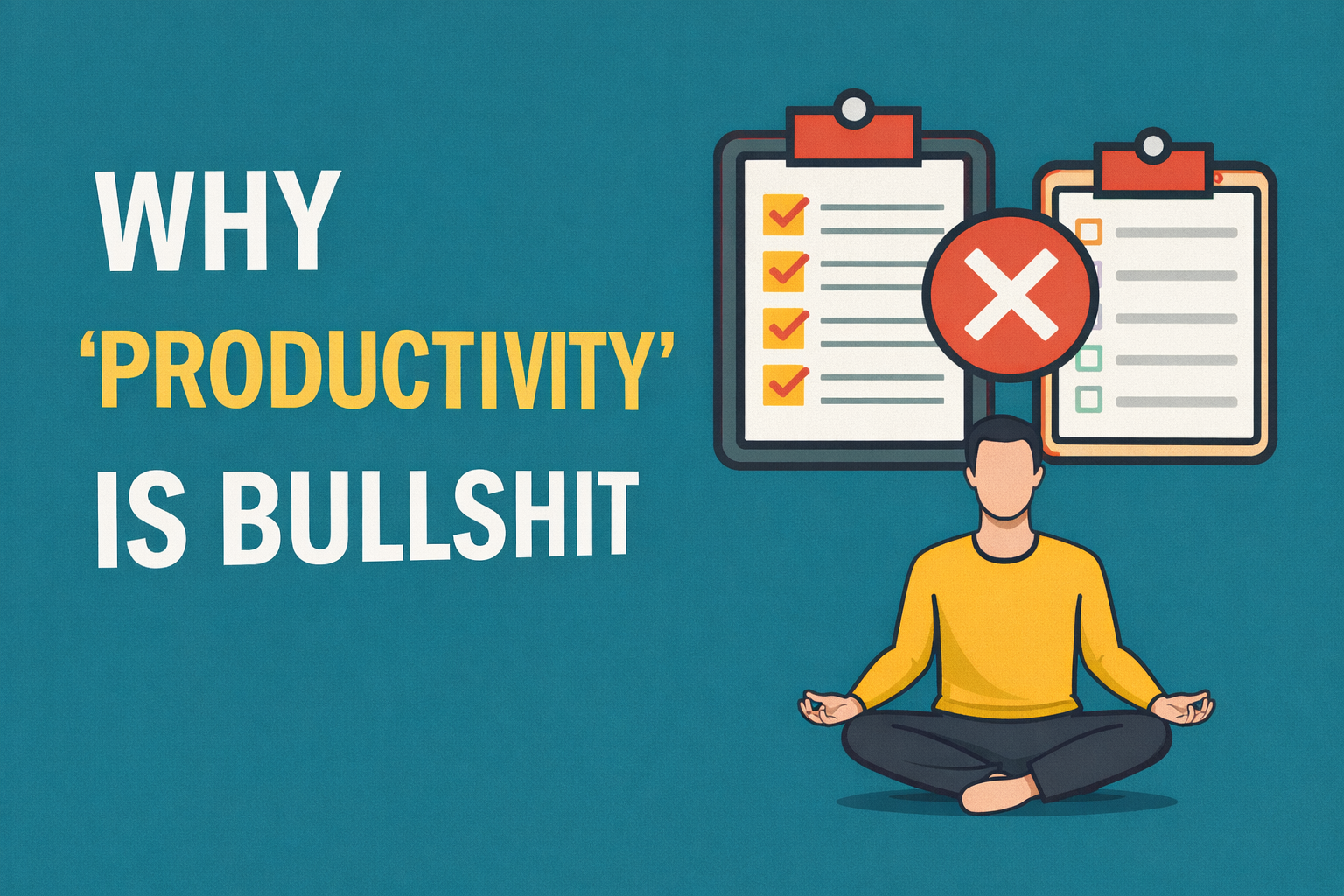
Sam Ovens' "do less" idea, translated into a real-life system you can actually use
A lot of "productivity advice" is really just a socially acceptable form of procrastination.
It feels like progress because you're reading, planning, optimizing, and setting up tools… but nothing meaningful is actually getting done.
In Sam Ovens' video "Why Productivity Is Bullshit! The Secret Is To Do Less Not More," he argues that most people define productivity the wrong way. They try to cram more into their days, build huge to-do lists, and obsess over optimization. His point is simple: the secret isn't doing more. It's doing less, removing distractions, and focusing your energy on fewer things.
This article takes the core ideas from the video and turns them into a practical system you can apply with a date-based tool like Self-Manager.
The "productivity trap": doing more makes you do less
Sam describes a pattern that's extremely common:
- You add more tasks
- Your day becomes fragmented
- You spend more time switching, organizing, and deciding
- The actual work shrinks
He even calls out the "meta work" people do: reading productivity books, attending webinars, and stacking tools on top of tools, which can become its own form of avoidance.
The deeper problem isn't effort. It's attention.
When your attention is divided across 15 different things, you make slow progress on everything.
The energy idea: your progress is limited by focus, not time
Sam frames it like this: you have a fixed amount of energy/time, and you can distribute it across many things (small progress everywhere) or concentrate it on one thing (big progress in one direction).
That's why some people look "unstoppable." They aren't necessarily working more hours than everyone else. They're wasting less energy switching contexts.
He uses Michael Phelps as an example of extreme focus: removing most distractions and channeling energy into one goal.
You don't need to live like an Olympic athlete, but the principle holds: focus multiplies progress.
Doing less doesn't mean doing nothing
It means doing fewer things that matter more.
Here's the simple filter:
If a task does not meaningfully move your main goal forward, it's either:
- removed
- delegated
- delayed
- batched
The opposite of this is what most people do:
- they treat everything as equally important
- they keep everything in their head
- they react all day
- they end the week exhausted, with little progress
Where most time is actually wasted (and it's not in business)
One surprising point Sam makes: a lot of wasted time comes from personal-life overhead, not "work tasks."
He talks about errands and life maintenance: food decisions, groceries, cooking, cleaning, laundry, and similar recurring tasks. His high-end solution is outsourcing (chef, trainer), but the underlying principle matters even if you don't outsource:
Reduce recurring decision-making.
He also suggests batching: doing groceries once, cooking in bulk, and removing repeated daily "what should I eat?" cycles.
The routine argument: structure creates freedom
Sam's other big point is routine and discipline: when you don't have a consistent wake/sleep schedule and a repeatable daily protocol, planning becomes unstable and you drift.
He emphasizes sleep as foundational to performance and self-control (his framing is opinionated, but the takeaway is solid: when sleep is bad, everything else becomes harder).
A practical "do less" system you can apply this week
Here's a simple workflow that matches the spirit of the video without requiring a total lifestyle redesign.
Step 1: Pick one main outcome for the next 7 days
Not ten goals. One primary outcome.
Examples:
- ship one feature
- deliver one client milestone
- publish one article
- fix one bottleneck that keeps repeating
Everything else becomes secondary.
Step 2: Create the smallest list that can still win
Take the outcome and break it into 5–12 small tasks.
If your list has 40 items, you're back in the "productivity trap."
Step 3: Capture every small task you normally keep in your head
This is the hidden productivity killer.
Follow-ups, quick replies, "remember this later," tiny fixes, small errands. Individually small. Collectively exhausting.
Your brain is not a reliable storage device. It's a decision engine.
How Self-Manager fits this philosophy
Sam's message is "do less." But the real-world challenge is: life still produces a lot of small tasks, and if you don't capture them, they leak into mental stress.
Self-Manager helps because it's built around chronological reality: day by day.
1) Create work on daily pages (real life happens on days)
In Self-Manager, the daily pages are where you create tasks, notes, and the "small stuff" you'd otherwise forget.
This supports "do less" because you stop wasting mental energy remembering.
2) Use Week Page to see reality, not to create more
Your Week Page isn't for adding more work. It's for seeing what's already on each day.
That matters because most people don't fail from laziness. They fail from overload they didn't notice until Wednesday.
3) Use Month Page to catch patterns you keep repeating
Month view isn't about planning a fantasy month. It's about noticing patterns:
- overloaded weeks
- inconsistent routines
- recurring bottlenecks
When you can see it, you can remove it.
4) Use Overview to reduce self-deception
Some weeks feel like "I did nothing," even when you were busy all week.
Overview gives you a clean, honest view of what happened and what keeps draining time.
5) Use AI Period Summary to review faster (and learn quicker)
If "do less" is the goal, reviews should be lightweight.
AI Period Summary helps you reflect on a week or month based on what you already captured, so you can adjust without spending an hour writing a manual report.
The real secret isn't productivity. It's subtraction.
If you take one thing from Sam Ovens' argument, it's this:
Most people try to win by adding.
Winners often win by removing.
Remove distractions.
Remove unnecessary tasks.
Remove repeated decisions.
Remove the need to keep everything in your head.
Then put your energy into fewer things that actually matter.

AI Powered Task Manager
Plan smarter, execute faster, achieve more
Create tasks in seconds, generate AI-powered plans, and review progress with intelligent summaries. Perfect for individuals and teams who want to stay organized without complexity.
Get started with your preferred account