What Task & Project Management Apps Are Productivity Influencers Using? (2026 Snapshot)
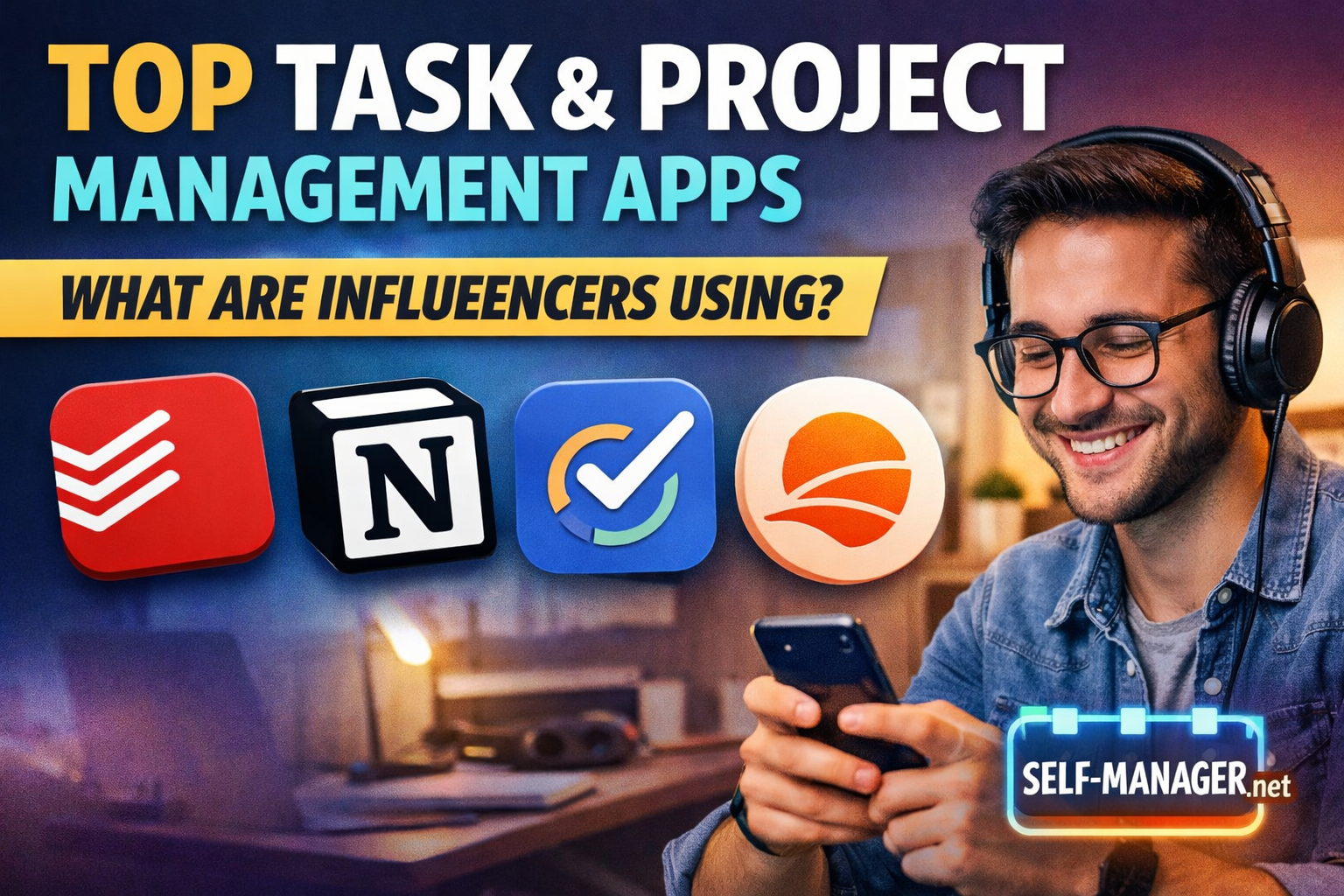
Productivity influencers love talking about systems… but behind almost every system there's an app stack.
And while creators experiment a lot (new tools, sponsorships, shiny updates), a few patterns show up again and again:
- A fast task manager for daily execution
- A flexible "workspace" for projects/notes (often Notion)
- A calendar-first daily planner for time-blocking (optional, but trending)
Below is a practical roundup of the apps you'll see most often in public "tool tours" and "my productivity system" breakdowns.
The most common influencer stacks (what they're optimizing for)
1) "Tasks in Todoist, projects in Notion"
This is the classic split: Todoist = action, Notion = planning + context.
- Ali Abdaal has publicly listed Todoist as his task manager and Notion for team projects.
Why influencers like this:
- Todoist stays lightweight (capture → schedule → do)
- Notion holds the "why" (project plans, meeting notes, resources)
2) "Everything in Notion" (the all-in-one workspace approach)
A huge portion of productivity creators build a Notion-based task + project system and then sell / share templates.
Examples:
- Thomas Frank publishes a dedicated task + project management template for Notion (positioned as a replacement for tools like Todoist/Asana for many users).
- Marie Poulin describes a Notion "Today" dashboard where she spends the majority of her time.
- Jeff Su shows a Notion "Command Center" style setup for managing work + content + life.
- August Bradley's "PPV / Life OS" content is explicitly built around Notion.
- Tiago Forte has shared "Notion as a Second Brain" material and PARA is widely implemented via Notion templates.
Why influencers like this:
- It's infinitely customizable
- It looks great on camera
- It can combine tasks + projects + notes + databases
The tradeoff:
- Notion systems can become "too flexible," turning into maintenance work if you don't keep them simple.
3) "TickTick for daily life" (tasks + habits + calendar in one app)
Some creators prefer a single app that feels more like "Todoist + habits + calendar" out of the box.
Example:
- Matt Ragland has shared a hybrid approach using TickTick as part of his workflow.
Why influencers like this:
- Habit tracking + tasks in one place
- Quick daily planning without building a complicated workspace
4) "Daily planner overlays" (Sunsama-style calm planning)
This category is growing: apps designed around daily planning rituals and time-blocking.
Example:
- Sunsama markets itself as a task manager + calendar + daily planner focused on calmer workdays, and it's frequently reviewed in productivity content.
Why influencers like this:
- It forces realistic planning
- It encourages finishing, not hoarding tasks
Influencer-to-app mapping (real examples you'll see repeatedly)
| Influencer (public system content) | App(s) they highlight | What they use it for |
|---|---|---|
| Ali Abdaal | Todoist + Notion | Tasks in Todoist; team/projects in Notion |
| Carl Pullein | Todoist | Task execution + structured workflow content around Todoist |
| Thomas Frank | Notion | Task/project management templates + systems in Notion |
| Marie Poulin | Notion | "Today" dashboard + daily execution inside Notion |
| Jeff Su | Notion | "Command Center" + project management workflows in Notion |
| August Bradley | Notion | PPV / Life OS (goals → projects → tasks) built on Notion |
| Matt Ragland | TickTick (plus analog habits) | Hybrid task planning style (digital + analog) |
| Tiago Forte | Notion (as second brain) | Knowledge + organization frameworks often applied in Notion |
| Sunsama-style creators | Sunsama | Daily planning + time-blocking workflows |
What this tells you (the "meta" lesson)
Most productivity influencers aren't looking for "the best app."
They're optimizing for one of these:
- Speed of capture (get tasks out of your head instantly)
- Clarity of the day (what matters today, not someday)
- Context for projects (notes, links, next actions, decisions)
- Review cycles (weekly/monthly planning so nothing drifts)
So the real decision is:
- Do you want a task list app you never have to maintain?
- Or a workspace you can customize endlessly?
- Or a calendar-first planner that forces realism?
Honorable mention: Self-Manager.net (an innovative take)
Most influencer setups are split between:
- a task app (execution), and
- a project workspace (context)
Self-Manager.net takes a different approach: it's date-centric by design.
Instead of burying work inside endless boards or disconnected projects, you can run your system around days/weeks/months:
- keep projects as tables that live on specific dates (so progress is time-aware)
- do weekly/monthly review tables you can pin and revisit
- use AI summaries to reduce "what happened again?" friction during reviews
- collaborate with your team without forcing a heavyweight corporate tool
If you like the influencer idea of "weekly review + daily execution," but you want it to feel more time-native, it's worth a look.
Simple recommendations (pick a lane)
- If you want fast daily execution → Todoist-style task managers (common among creators).
- If you want a customizable life/project OS → Notion-style systems (dominant in influencer culture).
- If you want tasks + habits + calendar in one app → TickTick-style workflows.
- If you want calm time-blocking rituals → Sunsama-style daily planners.
- If you want time-aware project management with review-friendly structure → Self-Manager.net (honorable mention).
AI Powered Task Manager
Plan smarter, execute faster, achieve more
Create tasks in seconds, generate AI-powered plans, and review progress with intelligent summaries. Perfect for individuals and teams who want to stay organized without complexity.
Get started with your preferred account