Top Productivity Lessons Learned From Jeff Bezos (That Still Work in 2026)
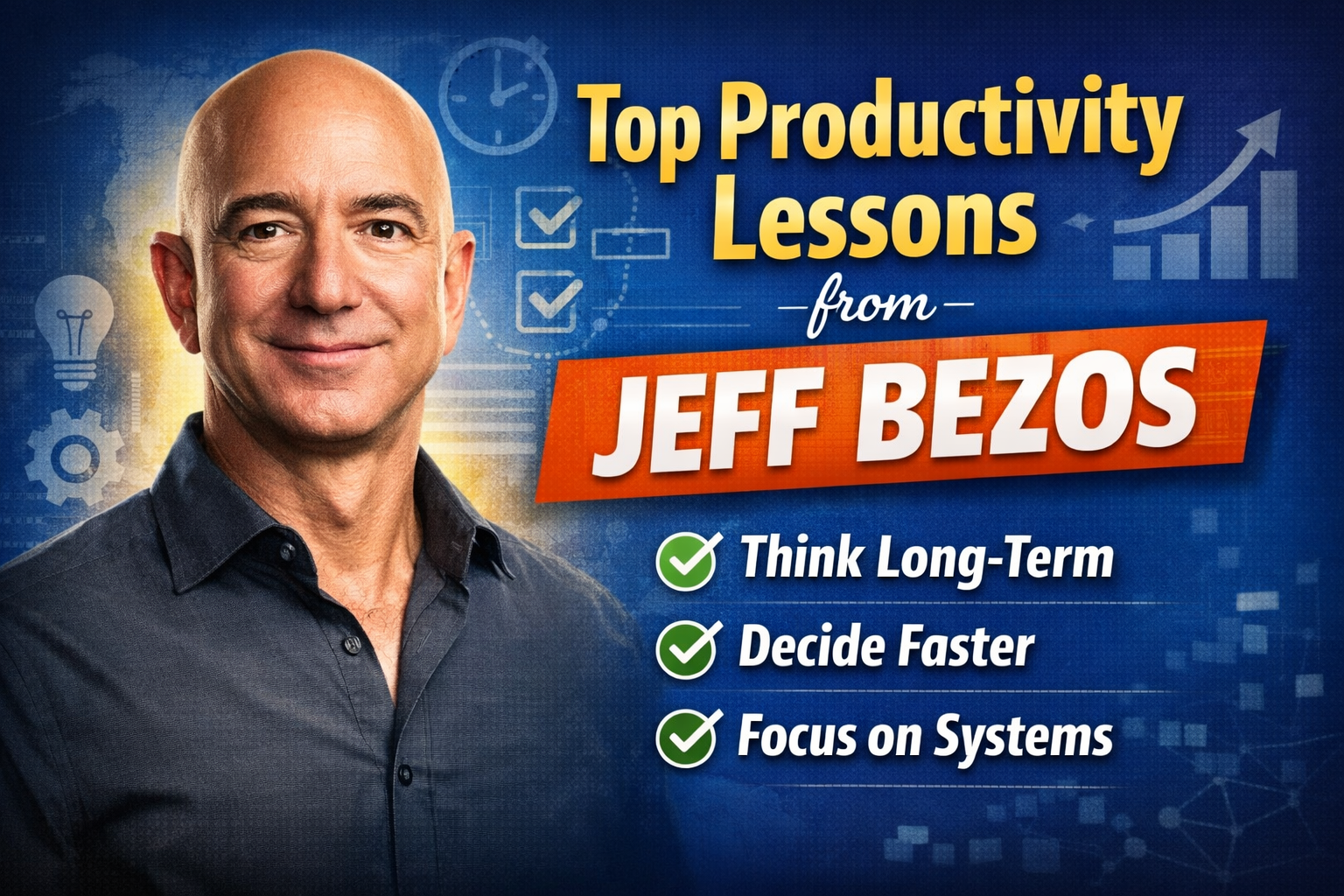
Jeff Bezos is often discussed in terms of Amazon's scale, ambition, and long-term bets. But underneath that story is a pretty consistent set of productivity principles: how to make decisions, how to structure time, how to create focus, and how to avoid "busy work" that looks important but changes nothing.
This article is not about copying a billionaire's lifestyle. It's about extracting a few practical lessons you can apply whether you run a team, build a product, or just want your days to feel more intentional.
Below are the most useful productivity lessons you can learn from Bezos - translated into habits you can actually use.
1) Protect your high-IQ hours (do hard work when your brain is sharp)
Bezos has mentioned that he likes to schedule important meetings earlier in the day and avoid heavy decisions late in the afternoon.
The lesson:
- Identify your 2-4 best "thinking hours" and treat them as premium time.
- Put your most important work there: planning, writing, strategy, problem solving.
- Move shallow tasks (email, admin, small fixes) later.
Practical habit:
- Make a daily rule: "One deep task before noon."
2) Make fewer, better decisions (and avoid decision fatigue)
Productivity isn't only about speed. It's about choosing the right things consistently.
Bezos is known for prioritizing fewer high-quality decisions rather than thousands of small ones. That's why the first part of the day matters - it's when decision quality tends to be higher.
Practical habit:
- Don't start the day in your inbox.
- Start the day by deciding the 1-3 outcomes that matter most.
3) Focus on the inputs you control, not the outcomes you hope for
Amazon became Amazon because of input-focused thinking:
- Build systems
- Improve customer experience
- Reduce friction
- Iterate faster
For personal productivity, this becomes:
- Control your process, not your mood.
- Build repeatable routines that produce results even on low-energy days.
Practical habit:
Convert goals into controllable inputs:
- Goal: "Lose weight" → Input: "Walk 8k steps daily"
- Goal: "Grow a business" → Input: "Publish 2 useful posts weekly"
- Goal: "Ship product faster" → Input: "Reduce WIP, weekly release"
4) Use "disagree and commit" to stop endless loops
In teams, a huge productivity killer is "discussion that never ends." Bezos popularized the idea that sometimes you disagree, but once a decision is made, everyone commits to execution.
Even solo, you can apply this mindset:
- Make a decision.
- Commit to it for a fixed time window.
- Review later with data.
Practical habit:
- "Commit for 2 weeks, then review." This stops you from re-deciding the same thing daily.
5) Choose speed when the decision is reversible
Bezos has described decisions as "Type 1" (hard to reverse) and "Type 2" (easy to reverse). Many people treat everything like it's permanent - and that slows them down.
Productivity lesson:
- Most decisions are reversible.
- If it's reversible, decide fast and move.
Practical habit:
- Ask: "Can I undo this in a week?" If yes, decide quickly and execute.
6) Write to think (clarity is a productivity superpower)
Bezos is famous for using written narratives instead of slide decks for important meetings.
Even if you never run a big meeting, the principle is gold:
- Writing forces clarity.
- Clarity reduces wasted effort.
- Wasted effort is the biggest productivity cost.
Practical habit:
Before starting a big task, write a short "narrative":
- What problem am I solving?
- What does "done" look like?
- What is the smallest version worth shipping?
7) Work backwards from the customer (or from your future self)
Amazon's "work backwards" approach starts with the customer experience and then builds the plan.
For personal productivity:
- Work backwards from your future self.
- What would make the next 30 days feel successful?
- What would your future self thank you for doing this week?
Practical habit:
Weekly "work backwards" check:
- If next week goes perfectly, what will be true by Sunday?
8) Reduce friction ruthlessly (friction is invisible procrastination)
Amazon obsessed over friction: fewer clicks, faster delivery, easier returns.
Your productivity system should do the same:
- If it's hard to capture tasks, you won't.
- If planning takes too long, you'll stop.
- If review is messy, you'll avoid it.
Practical habit:
- Make task capture instant.
- Keep planning lightweight.
- Make review feel rewarding (because it shows progress).
9) Build systems, not hero days
People love "one crazy productive day." Systems are what compound.
Bezos's long-term approach is basically a compounding mindset:
- Small improvements repeated over years become massive.
- One-off effort spikes fade quickly.
Practical habit:
Stop chasing motivation. Build one system per month:
- Better weekly review
- Better daily planning
- Better prioritization
- Better follow-up habits
10) Keep a long-term direction, but operate with short cycles
Amazon's strategy is long-term. Execution is iterative.
That's a powerful combination:
- Long-term vision keeps you from drifting.
- Short cycles keep you from dreaming forever.
Practical habit:
- Have a simple 12-month theme (direction).
- Plan in quarters.
- Execute weekly.
- Adjust daily.
11) Make meetings and communication earn their place
Bezos is known for not filling his calendar with endless meetings, and for structuring the ones that exist to be high-signal.
Whether you're a team or solo:
- Too much communication creates motion, not progress.
- High-quality communication creates alignment and speed.
Practical habit:
Create a personal rule:
- No meeting without an agenda.
- No call unless the outcome is clear.
- No long chat threads when a 3-line decision note would do.
12) Use data, but don't become slow because you want perfect certainty
Bezos is data-driven, but he's also known for acting with incomplete information when needed.
Personal productivity lesson:
- You'll never have full certainty.
- Waiting for perfect clarity is a form of procrastination.
Practical habit:
- Decide when you have "enough" information (not all information).
- Ship the next step.
A Simple Bezos-Inspired Productivity Framework
If you want to turn the lessons above into something usable daily, use this framework:
Daily
- Choose 1 deep task for your best hours
- Decide 1-3 outcomes for today
- Capture tasks instantly (don't hold them in your head)
Weekly
- Work backwards from Sunday: what should be true by then?
- Commit to a plan for 7 days (don't re-plan daily)
- Review what worked and what created friction
Quarterly
- Pick a direction and a single theme
- Keep execution weekly and measurable
How to Apply This With Self-Manager.net
If you like the "calendar-first" approach (everything belongs to dates), Self-Manager.net fits these principles naturally:
- High-IQ hours planning: put your deep work tasks on the day with a clear priority.
- Type 1 vs Type 2 decisions: create a quick decision note on a table and commit for a time window.
- Work backwards: plan from week/month outcomes down to daily actions.
- Reduce friction: keep all tasks, notes, and progress tied to specific days so review is fast and accurate.
- Systems over hero days: use a consistent weekly review and let the history of your days guide improvements.
A good productivity system isn't the one with the most features. It's the one you'll still use after the excitement wears off - because it makes the next day easier.

AI Powered Task Manager
Plan smarter, execute faster, achieve more
Create tasks in seconds, generate AI-powered plans, and review progress with intelligent summaries. Perfect for individuals and teams who want to stay organized without complexity.
Get started with your preferred account