Top Productivity Lessons Learned From Carl Icahn (That Still Work in 2026)
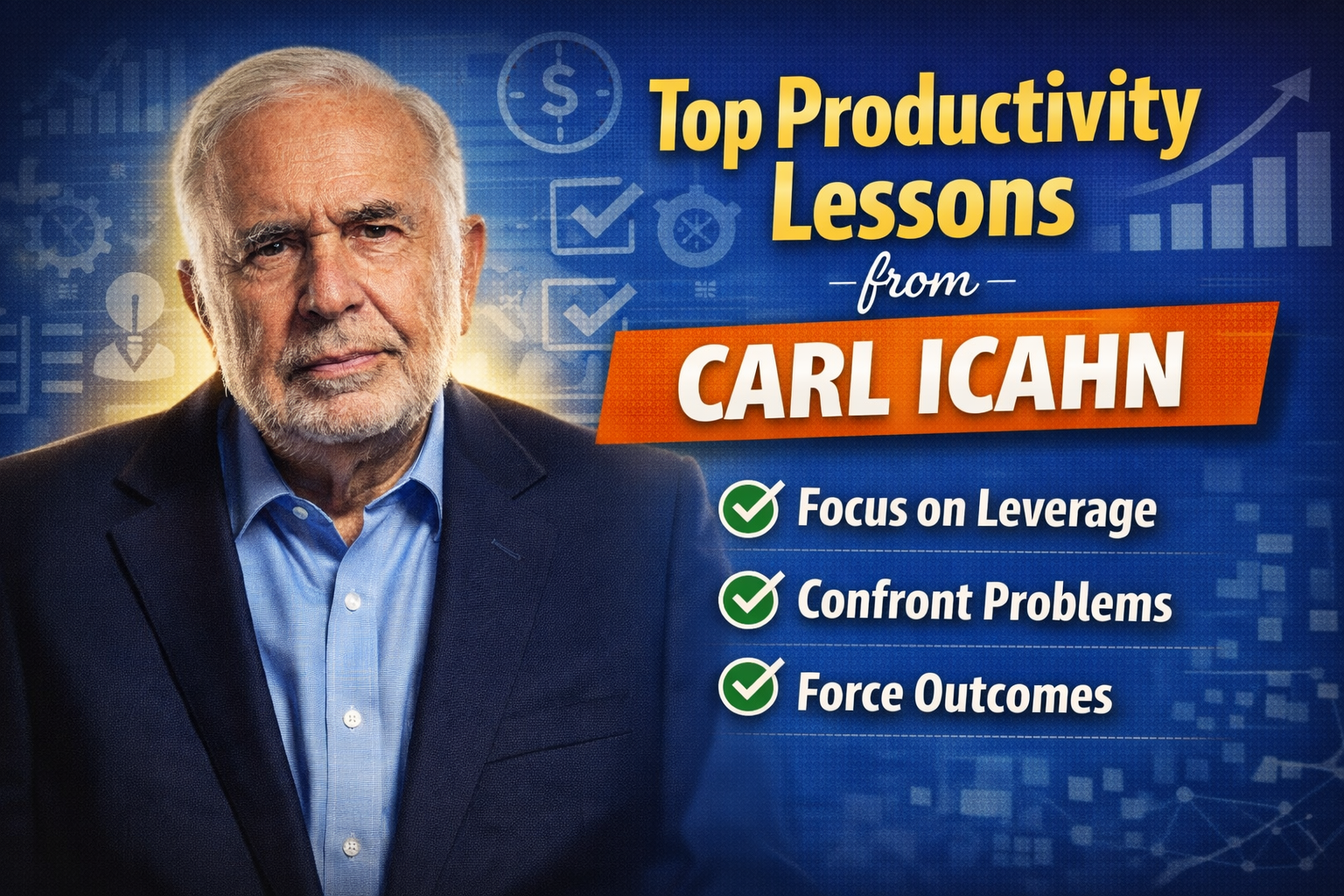
Carl Icahn is famous for activism, tough negotiations, and going directly at problems other people avoid. Whether you love or hate his style, there are useful productivity lessons in how he thinks: focus on leverage, cut the fluff, confront reality fast, and push for outcomes.
This isn't about "being aggressive." It's about being direct, high-signal, and execution-oriented - especially if you're building a business, managing a team, or trying to move projects forward without getting stuck in endless planning.
1. Be obsessed with leverage (don't do low-impact work)
Icahn's whole approach is finding the few actions that create outsized results. That's a productivity superpower.
In normal work, it translates to:
- Don't optimize tiny details while the big lever is untouched
- Don't polish a page while the offer is unclear
- Don't refactor before you validated the feature
Practical habit:
- Each morning ask: "What's the highest-leverage move I can make today?"
- Do that first.
2. Don't avoid the uncomfortable work (the "hard conversation" is often the bottleneck)
A lot of delays come from avoidance:
- unclear expectations
- vague responsibilities
- bad partnerships
- weak priorities
- fear of upsetting someone
Icahn's style is to confront reality quickly.
Practical habit:
If something is stuck for more than 7 days, force clarity:
- Who owns it?
- What is the next action?
- What does success look like?
- By when?
This alone can remove weeks of wasted effort.
3. Reduce problems to first principles: "What is true, right now?"
When there's noise, Icahn looks at fundamentals. In productivity terms, fundamentals are:
- time
- cash
- priorities
- constraints
- outcomes
Practical habit:
Write a 5-line "truth list" when you feel overwhelmed:
- What I'm responsible for
- What's actually due soon
- What's blocked and why
- What matters most this week
- What I'm ignoring
Clarity creates momentum.
4. Put everything in writing (so people can't hide behind vagueness)
Negotiators love written clarity because it removes ambiguity. Productivity systems benefit from the same thing.
Practical habit:
Replace "we should" with:
- "I will do X by Tuesday"
- "You will do Y by Thursday"
- "We will review on Friday"
If it isn't written, it's not real.
5. Use deadlines as tools, not as stress
Icahn is deadline-driven because deadlines force decisions. Without deadlines:
- projects sprawl
- priorities melt
- meetings repeat
Practical habit:
Give every project a "next deadline," even if it's internal:
- "First version by Friday"
- "Decision by Monday"
- "Launch experiment by next week"
A deadline doesn't have to be perfect. It just needs to exist.
6. Don't accept "busy" as an excuse for no progress
Icahn cares about outcomes. A lot of teams get trapped in activity without movement.
Practical habit:
Weekly check:
- "What shipped?"
- "What got measurably better?"
- "What decision was made?"
- "What is still stuck?"
If nothing changed, your system needs adjustment.
7. Don't overtrust consensus (consensus often protects mediocrity)
In many teams, consensus is a slow way of saying "nobody wants responsibility."
The productivity lesson isn't "ignore everyone." It's:
- get input quickly
- decide clearly
- commit
- revisit with data
Practical habit:
Use a decision rule:
- "I'll take input for 24 hours. Then I decide."
8. Keep your attention on incentives (why people actually behave the way they do)
Icahn looks at incentives because they explain reality better than intentions.
Productivity lesson:
- If someone repeatedly drops work, the incentive isn't aligned.
- If you keep procrastinating a project, the reward is unclear or too delayed.
Practical habit:
For any recurring problem ask:
- "What incentive is driving this behavior?"
- "How do I change the environment so the right action is easier?"
9. Track the work like an operator, not like a dreamer
Operators track:
- what's done
- what's next
- what's blocked
- what matters
Dreamers track:
- ideas
- plans
- possibilities
Both are useful, but execution requires operator tracking.
Practical habit:
Keep a weekly "operator view":
- Top 3 outcomes
- Top blockers
- Next actions
10. Make your system confront reality weekly
A good productivity system shows you the truth:
- what you actually did
- what you avoided
- what keeps recurring
- what creates results
This is why weekly reviews are powerful: they force honesty.
Practical habit:
Do a weekly review with 3 questions:
- What moved the needle?
- What wasted time?
- What will I do differently next week?
The "Icahn-Style" Productivity Framework (Simple and Effective)
If you want a practical version of these lessons:
Daily
- Choose the highest-leverage action first
- Do one uncomfortable task you've been avoiding
- Write down next actions clearly (no vague tasks)
Weekly
- Review outcomes, not activity
- Kill one low-impact commitment
- Set one decision deadline
Monthly
- Identify the biggest bottleneck
- Fix incentives or remove friction
- Repeat
How to Apply This With Self-Manager.net
If you want a productivity system that supports this style of execution, a calendar-first approach helps because it keeps everything tied to time and reality:
- Put your highest-leverage work on specific days (so it doesn't float forever)
- Use tables for outcomes (projects) and tasks as next actions
- Add quick notes like "blocked by X" so problems don't hide
- Run a weekly review to see patterns (what truly moved vs what repeated)
Icahn's productivity lesson is simple: focus on leverage, don't avoid the hard part, and force clarity fast.

AI Powered Task Manager
Plan smarter, execute faster, achieve more
Create tasks in seconds, generate AI-powered plans, and review progress with intelligent summaries. Perfect for individuals and teams who want to stay organized without complexity.
Get started with your preferred account