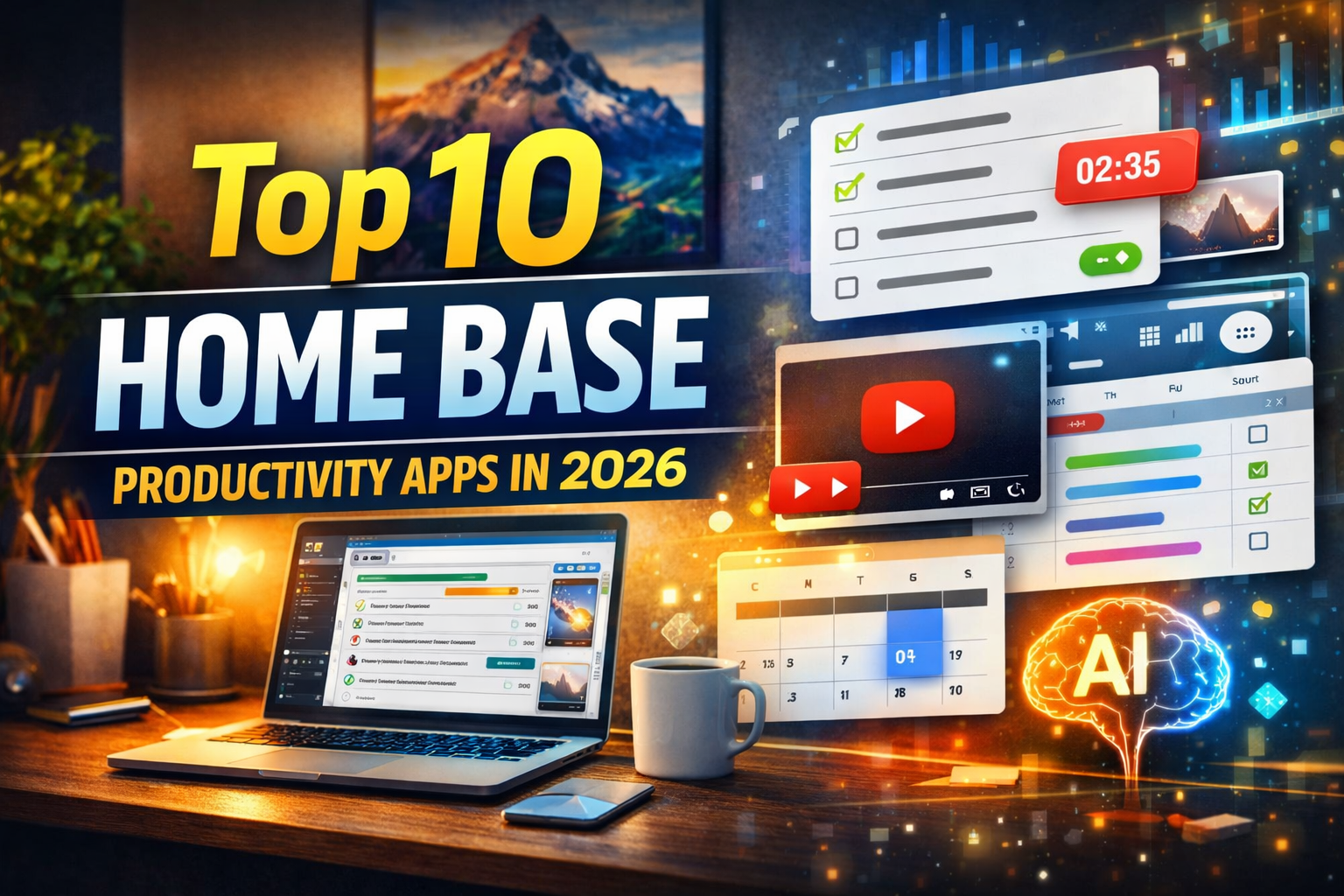
Top 10 Home Base Productivity Apps in 2026
Introduction
A "home base" productivity app is the one place you return to every day to run your life/work: capture tasks, keep notes/context, plan realistically, and review what happened. It's the hub that reduces "app-hopping" by holding the source of truth (projects + next actions + decisions + progress), while other tools (calendar, files, email) plug into it.
That's why "home base" apps usually share 4 traits:
- Everything lands in one system (tasks + notes + context, not scattered)
- Time reality (dates, planning, time-blocking, or time tracking)
- Reviews (weekly/monthly reflection so you don't drift)
- Low friction (fast capture + easy retrieval)
1) Self-Manager.net (date-based home base + reviews + AI)
Self-Manager is built around a simple idea: dates and tables. Each date represents your workday, and tables hold your tasks/notes/progress—so everything stays tied to when it happened, which makes reviews and planning much clearer.
The core "home base" features
- Tasks + time tracking in the same place (per-task tracking, totals, and trend-friendly data)
- Notes in the same place (notes attached where the work lives, not in a separate app)
- Comments in the same place (so decisions/conversations stay with the table/project)
- YouTube integration for links (drop YouTube videos you want to watch in the comments and play them inside the app)
- Personalize your home base
- custom sidebar background image
- hero image per table or a global hero image across tables
- Self Message (per-date): add a personal note that appears at the top of that day (or hide it)
The "home base" advantage: context + review loop
Because everything belongs to a table, and every table belongs to a date, you get built-in context for:
- planning (today/week/month)
- tracking (what actually happened)
- reviewing (learning from reality, not memory)
10 AI features (Gemini-powered)
Self-Manager's AI is integrated into your actual tables (tasks, time tracking, comments, logs) — not just a chatbot bolted onto a to-do list.
It runs on Gemini 3 models, with "Fast" and "Thinking" modes for different depth/speed needs.
2) Notion (docs + databases + AI "agent" workflows)
Notion is still the most flexible "workspace as a home base" option: pages + databases let you build your own operating system. In 2026, its AI direction is increasingly "agentic"—AI that can take actions inside your workspace.
Best for: people who want maximum flexibility (and are willing to maintain a system).
3) ClickUp (all-in-one work hub for tasks + docs + goals + AI)
ClickUp positions itself as one workspace for tasks, docs, goals, and collaboration, with AI features layered across the system.
Best for: power users/teams who want a "command center" with lots of structure options.
4) Akiflow (tasks + calendar + time-blocking in one cockpit)
Akiflow is designed as a daily execution hub that combines tasks and calendars with time-blocking and planning routines.
Best for: founders/operators who live in a calendar and want a single daily planning cockpit.
5) Sunsama (guided daily planning + pulls tasks + email + calendar)
Sunsama focuses on calm, realistic daily planning: it pulls in tasks from other tools and pairs them with your calendar, with guided daily planning rituals.
Best for: people who want a daily planner home base (especially if email drives tasks).
6) Motion (AI auto-schedules your day)
Motion prioritizes your tasks and time-blocks them automatically on your calendar, re-optimizing as things change.
Best for: people who want the system to "drive the schedule" instead of manually planning.
7) Reclaim.ai (AI calendar that defends focus time + auto-schedules tasks/habits)
Reclaim runs on top of Google/Outlook Calendar and automatically schedules tasks, habits, breaks, and focus time around meetings.
Best for: calendar-heavy weeks where protecting focus time is the main battle.
8) TickTick (tasks + calendar views + pomodoro + habits)
TickTick is a strong personal "home base lite" because it combines tasks with calendar views and built-in focus/habit modules.
Best for: individuals who want one app for tasks + schedule + focus timers + habits.
9) Todoist (fast task system with calendar integration)
Todoist is still a top pick for fast capture and clean task management, and it supports showing calendar events alongside tasks + syncing time-blocked tasks to calendars.
Best for: people who want a simple, reliable task home base (especially with calendar pairing).
10) Asana (project + goals hub that links strategy to execution)
Asana is a strong "home base" for structured projects: tasks, multiple project views (list/board/calendar/timeline), and goals that can link directly to work so progress updates roll up.
Best for: teams (or serious personal projects) where "who's doing what by when" matters.
A simple "choose your home base" rule
Pick the one that matches your bottleneck:
- "I need reviews + true timeline memory" → Self-Manager.net
- "I need docs + knowledge + custom dashboards" → Notion / ClickUp
- "My schedule is chaos; I need auto-planning" → Motion / Reclaim
- "I want a calm daily cockpit" → Sunsama / Akiflow
AI Powered Task Manager
Plan smarter, execute faster, achieve more
Create tasks in seconds, generate AI-powered plans, and review progress with intelligent summaries. Perfect for individuals and teams who want to stay organized without complexity.
Get started with your preferred account