Top 10 Habits of Successful People in 2026
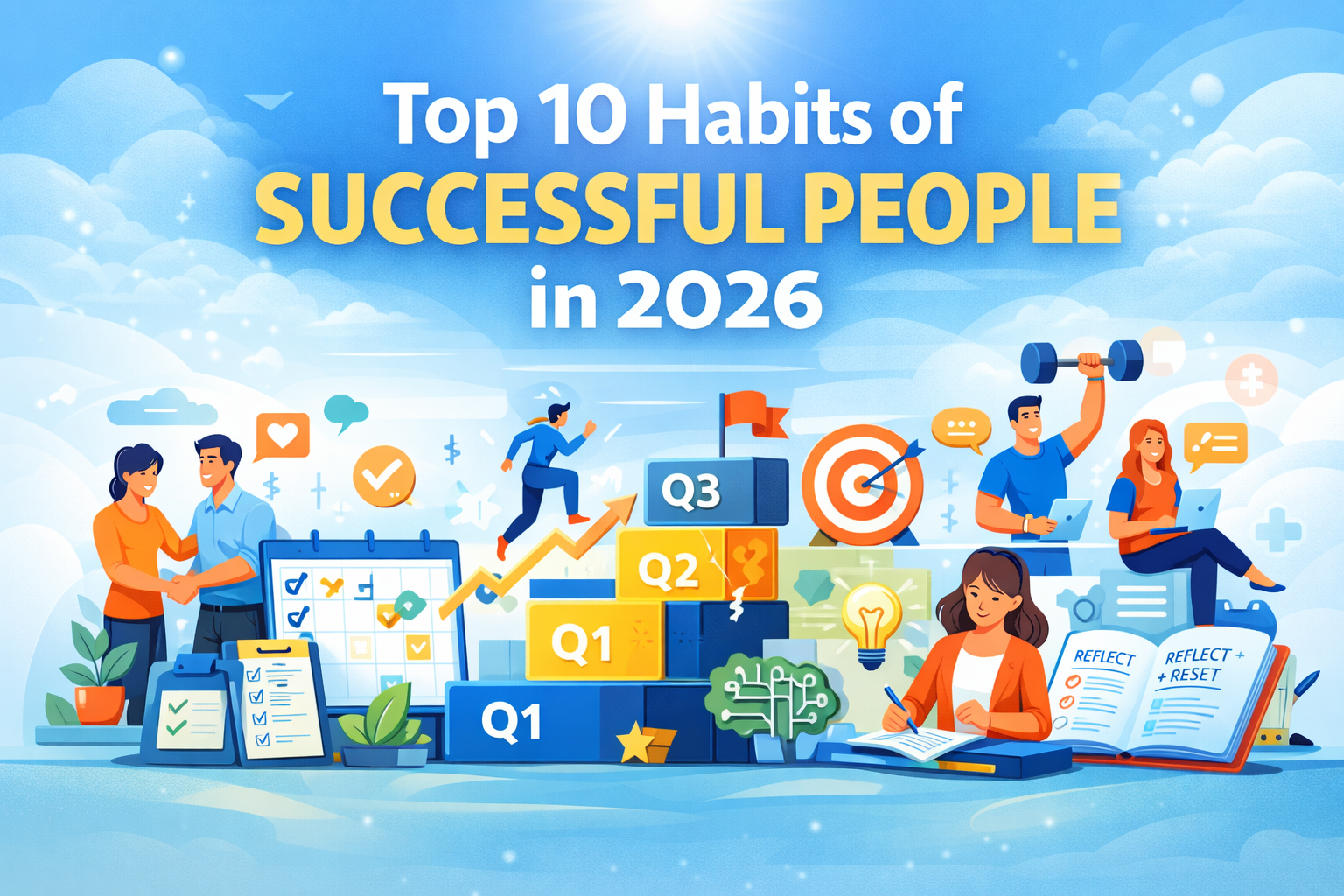
Practical habits that compound over time (and how to implement them)
"Successful people" aren't one type of person. But high performers across industries tend to rely on repeatable habits—because habits scale better than motivation.
Below are 10 habits that show up again and again, and that also line up with what research suggests improves performance, follow-through, wellbeing, and long-term consistency. (Not every habit is mandatory—pick 2–3 to start.)
1) They set clear yearly goals (not vague wishes)
Successful people don't just "want a better year." They define what "better" means.
Research from goal-setting theory consistently finds specific, challenging goals outperform "do your best" style goals.
Try this (10 minutes):
- Pick 1–3 outcomes for the year (max).
- For each, define:
- Outcome metric (what you'll measure)
- Lead actions (what you'll do weekly)
2) They run quarterly "sprints" instead of trying to do everything at once
A year is too long to stay focused. Quarters create urgency and reset points.
Simple quarterly cadence:
- Choose the 1–3 priorities that matter most for the next 12–13 weeks.
- Define weekly lead actions.
- Review and adjust at the end.
(Quarterly focus also makes progress monitoring easier, which is associated with better goal attainment.)
3) They plan their week (and keep a scoreboard)
Weekly planning is where strategy becomes real time and real calendar space.
Time management research (meta-analysis) finds time management is moderately related to performance and wellbeing and negatively related to distress.
Weekly scoreboard example:
- Workouts: 0/3
- Deep work: 0/4
- Learning: 0/2
- Outreach: 0/10
4) They plan their day around priorities, not long to-do lists
High performers usually don't try to "do 12 things." They pick a few priorities that move the week forward.
Daily habit (2 minutes):
- Choose 1–3 priorities
- One small maintenance task (optional)
- End-of-day: "Did I move the week forward?"
5) They use if–then rules to make execution automatic
This is one of the most underrated habits.
Implementation intentions ("If situation X happens, then I will do Y") have a medium-to-large positive effect on goal attainment in meta-analytic research.
Examples:
- If it's Monday 09:00 → I do a 20-minute weekly plan
- If I feel resistance → I do 10 minutes only
- If I miss a day → I restart tomorrow with the smallest version
6) They protect focus (they reduce context switching)
Successful people treat attention like a scarce resource.
Research on "attention residue" shows that switching tasks can leave part of your mind stuck on the previous task, reducing performance on the next one.
Try this:
- 60–90 minute focus block
- Notifications off
- One task only
- 5-minute shutdown note at the end ("next step is…")
7) They prioritize sleep (because it upgrades everything else)
Sleep isn't "nice to have" if you care about consistency and decision quality.
Meta-analytic work links short and long sleep duration (especially in older adults) with poorer cognitive outcomes.
Simple sleep rules:
- Consistent sleep/wake window (even weekends, as much as possible)
- No bright screens right before bed (or use strict limits)
- Caffeine cutoff time
8) They move their body regularly
Exercise is one of the highest ROI habits because it supports energy, mood, and cognition.
Large-scale reviews/meta-analyses report exercise benefits for cognition, memory, and executive function across populations.
Minimum viable plan:
- 3× per week, 20–45 minutes
- If busy: 10 minutes counts (consistency beats intensity)
9) They invest in relationships (because support multiplies resilience)
This is the "invisible habit" behind a lot of long-term success.
A major meta-analysis found stronger social relationships are associated with higher likelihood of survival (often summarized as ~50% increased likelihood).
Weekly relationship habit:
- One meaningful check-in (call, coffee, long message)
- One "give value" action (intro, feedback, help)
10) They reflect and reset (journaling, gratitude, lessons learned)
Reflection turns experience into learning. It also helps you course-correct fast.
Gratitude interventions show small increases in wellbeing in large meta-analytic work.
Writing-based interventions (including expressive/positive writing) show benefits for mood/wellbeing in systematic reviews/meta-analyses (effects vary by method and population).
5-minute reflection prompts:
- What worked today?
- What didn't?
- What's the next tiny adjustment?
- 3 good things (or 1, if you're busy)
A simple way to implement all 10 without overcomplicating it
Daily (2–5 min): priorities + quick check
Weekly (15–25 min): plan + scoreboard + review
Monthly (20–30 min): milestone check + adjust
Quarterly (30–45 min): reset priorities + lead actions
This keeps progress monitoring frequent, which is strongly associated with better goal outcomes.
How Self-Manager fits this (date-based planning + pinned tables)
If you want this system to feel natural (not like another dashboard you forget):
- Create a Weekly Plan table at the start of each week (commitments + scoreboard)
- Create a Monthly Plan table on day 1 (milestones)
- Create a Quarter Plan table at the quarter start (priorities + lead actions)
- Pin those tables so your plan stays visible while you work day-to-day
Because everything is tied to dates, you can also scroll back and see exactly what you planned, what happened, and what changed—without digging through old docs.

AI Powered Task Manager
Plan smarter, execute faster, achieve more
Create tasks in seconds, generate AI-powered plans, and review progress with intelligent summaries. Perfect for individuals and teams who want to stay organized without complexity.
Get started with your preferred account