The Weekly Review Scoreboard: 5 Metrics That Actually Improve Your Productivity in 2026
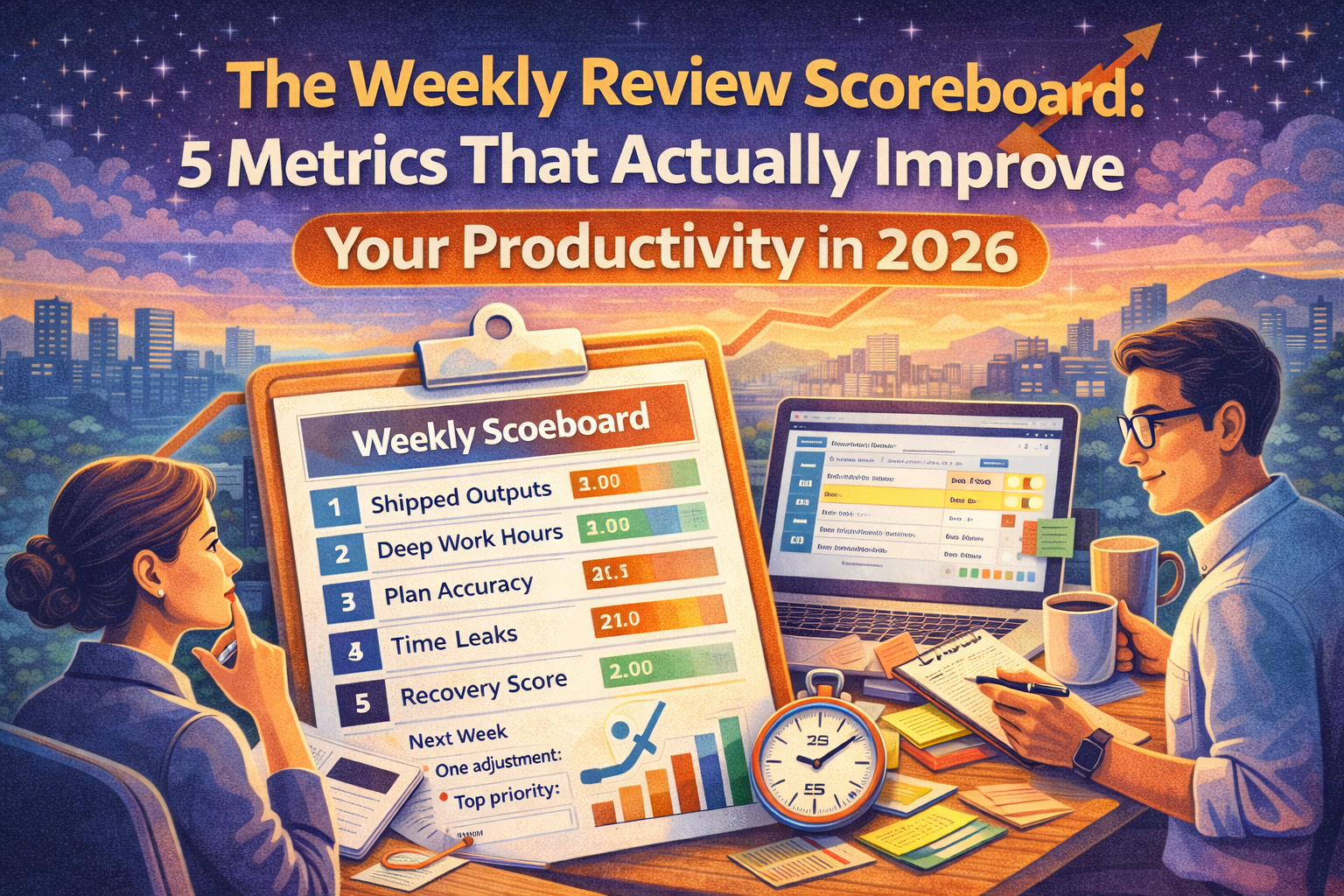
Introduction
Most productivity systems fail for one reason:
They don't have feedback.
People plan, work, get busy, repeat… and months disappear.
A weekly review fixes that — but only if you review the right things.
In 2026, you don't need 20 metrics.
You need 5 that create behavior change.
This article gives you a simple weekly scoreboard you can run in 10–15 minutes to get consistent improvement.
Why a weekly scoreboard works (the compounding effect)
A plan without measurement becomes fantasy.
A scoreboard does three things:
- shows what actually happened (truth)
- reveals patterns (what helps / what hurts)
- forces better decisions next week
The goal is not to judge yourself.
The goal is to adjust faster than life changes.
The 5 Metrics (and how to track them)
1) Shipped Outputs (the "results" metric)
This is the most important metric.
Count deliverables completed — not tasks.
Examples:
- shipped feature / released update
- published article / video
- sent proposals / closed client milestone
- finished onboarding flow
- launched landing page
Target: 1–5 per week (depending on workload)
Why it works: it prevents "busy weeks with no results."
Weekly review question:
"What did I finish that exists now?"
2) Deep Work Hours (the "focus" metric)
Track how many hours you spent in real focus.
Deep work means:
- no meetings
- no scrolling
- no multitasking
- one task, one direction
Target: 5–15 hours/week for most knowledge workers
Why it works: deep work is where the real progress happens.
Weekly review question:
"Did I protect focus time or did the week consume it?"
3) Plan Accuracy (the "reality" metric)
This is the "am I planning realistically?" metric.
Measure it as:
- Planned top tasks vs completed top tasks
Example: you planned 15 important tasks, completed 9 → accuracy 60%.
Or even simpler:
- how many days did you complete your Daily Top 1?
Target: 60–80% accuracy
Why it works: if your plan accuracy is always 30%, your planning is too optimistic.
Weekly review question:
"Was my plan realistic or imaginary?"
4) Time Leaks (the "waste" metric)
Pick the top 1–2 things that stole time.
Examples:
- "random admin"
- "doom scrolling"
- "reactive messages"
- "meetings with no output"
- "context switching"
Then estimate hours lost.
Target: reduce by 10–20% over time
Why it works: removing waste is often easier than adding effort.
Weekly review question:
"What stole my week — and how do I block it next week?"
5) Recovery Score (the "sustainability" metric)
Productivity collapses when recovery collapses.
Track simple indicators:
- average sleep quality (1–10)
- workouts completed
- number of evenings you truly unplugged
- stress level (1–10)
Target: stable, not perfect
Why it works: the best system is the one you can run for a year.
Weekly review question:
"Did I build momentum sustainably or did I burn fuel?"
How to run the weekly review (10–15 minutes)
- Write your numbers for the 5 metrics
- Circle the weakest metric
- Choose one adjustment for next week:
- protect 2 deep work blocks
- reduce meetings
- cut one commitment
- timebox admin
- plan fewer tasks
- Pick next week's #1 outcome
That's the loop.
The template (copy/paste)
Weekly Scoreboard (Week of ______):
- Shipped outputs: ____
- Deep work hours: ____
- Plan accuracy: ____% (or ____/7 Top-1 days)
- Time leaks: ____ hours (main leak: ______)
- Recovery score: ____/10 (sleep/workouts/unplug)
One change next week: ______
Next week's #1 outcome: ______
How to do this inside Self-Manager.net (clean workflow)
If you want this to become automatic:
- Create a Weekly Review table
- Add 5 rows (or sections) for the metrics
- Each week, fill in the numbers
- Use notes/comments for the "one change next week"
- Link the #1 outcome to your weekly plan tasks
Over time, you'll see patterns across weeks and make better decisions faster.
Final thought
This scoreboard is powerful because it forces the two things most people avoid:
- honesty
- adjustment
If you run it weekly, your productivity improves even if nothing else changes.

AI Powered Task Manager
Plan smarter, execute faster, achieve more
Create tasks in seconds, generate AI-powered plans, and review progress with intelligent summaries. Perfect for individuals and teams who want to stay organized without complexity.
Get started with your preferred account