The Hidden Cost of Not Doing Reviews (Weekly / Monthly / Quarterly)
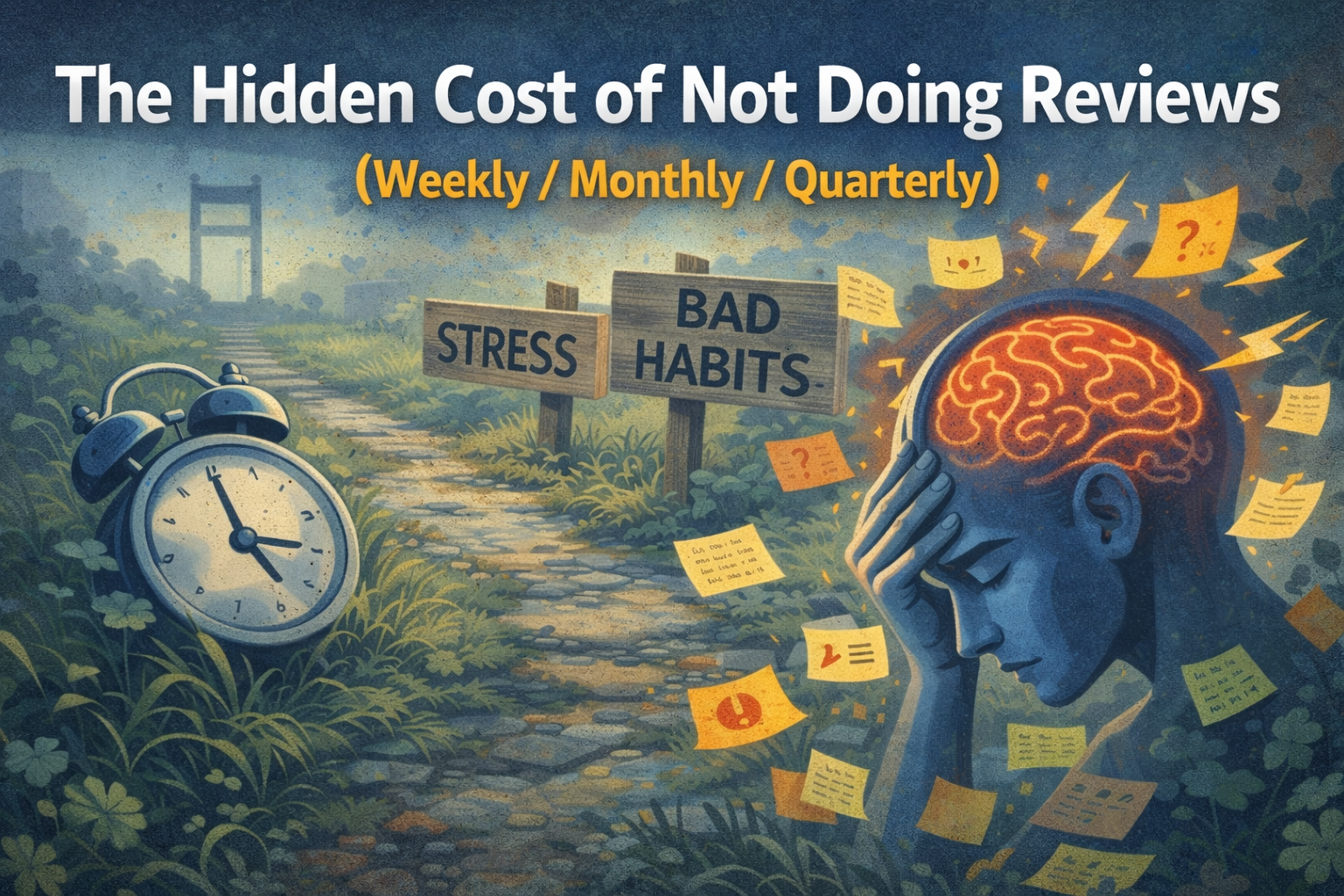
Most people don't avoid reviews because they're lazy. They avoid them because reviews feel like "extra work."
But here's the uncomfortable truth:
If you don't do reviews, you still pay the price — just in a different currency:
- stress
- rework
- missed opportunities
- slowly drifting away from goals
- and the feeling that you're always busy but never fully in control
Reflection and review aren't productivity theater. They're a practical way to improve performance and learning over time.
Reviews are not "planning." They are course correction.
Planning is what you wish will happen.
Reviews are what makes your system honest.
Agile teams formalized this idea with retrospectives: inspect what happened, then adapt how you work to become more effective.
A personal weekly/monthly/quarterly review is the same concept, just applied to your life and your projects.
The hidden costs you pay when you skip reviews
1) You lose the learning loop (so mistakes repeat)
Without reviews, you don't capture patterns:
- why tasks slip
- what consistently takes longer than expected
- what interrupts your focus
- which projects keep leaking time without producing results
Reflection turns experience into usable insight. That's the difference between "doing a lot" and "getting better."
2) Your weeks become reactive (the urgent slowly eats the important)
If you don't step back weekly, you default to:
- responding to messages
- handling small fires
- doing whatever feels easiest right now
Important projects don't die in one day. They die by being postponed 30 times.
3) You overcommit because of the planning fallacy
Humans systematically underestimate how long things take and overestimate what fits in a week.
Weekly and monthly reviews are how you fight that bias with reality:
- "What actually got done?"
- "What did I keep pushing?"
- "What always takes longer than I think?"
4) You carry open loops in your head (and it drains mental bandwidth)
Unreviewed tasks don't disappear. They sit in the background:
- "I should follow up…"
- "I forgot to…"
- "I need to remember…"
Reviews are how you close loops:
- either schedule it
- delegate it
- or delete it
That alone reduces stress because your brain stops acting like your task manager.
5) You waste time on rework and context switching
Without a weekly reset, you end up:
- starting things you won't finish
- revisiting the same decisions
- reopening half-done work and reloading context
A short review saves hours of scattered execution.
6) You miss wins (and motivation drops)
Quarterly reviews especially matter here.
If you don't track what improved, what shipped, what changed, your brain will "feel" behind even when you made progress. Reviews create proof of progress — which fuels consistency.
7) Your priorities silently drift
You can be productive and still drift.
Monthly and quarterly reviews reveal drift early:
- "Why did this goal vanish?"
- "Why did this project stall?"
- "Why am I spending time on things I don't care about?"
Without this, you wake up months later with the "how did I get here?" feeling.
What a good review actually looks like (simple and realistic)
Weekly review (20–40 minutes)
Goal: clean up the mess, regain control, plan the next 7 days.
Checklist:
- Capture loose thoughts (dump everything)
- Review what you completed
- Review what slipped and why
- Decide the top outcomes for next week
- Schedule or assign tasks to specific days
- Remove or pause projects that shouldn't be active
Monthly review (45–90 minutes)
Goal: make sure you're not drifting.
Questions:
- What moved forward this month?
- What did I avoid (and why)?
- Which projects should end, pause, or restart?
- What is one change that would make next month easier?
Quarterly review (1.5–3 hours)
Goal: zoom out, adjust goals, stop doing things that don't matter.
Questions:
- What were the biggest results of the quarter?
- What were the biggest mistakes (and what did they teach me)?
- What should I double down on next quarter?
- What should I stop completely?
- What are the 3 outcomes that would make the next quarter a win?
Where AI fits (without turning it into fluff)
AI becomes useful when it does two things:
- Summarizes the period (so you don't have to manually recount everything)
- Helps you turn that summary into decisions and next actions
A practical AI review flow:
- "Summarize what I completed this week and what slipped."
- "Group the slipped items by reason (time, dependencies, unclear scope, low priority)."
- "Propose a realistic plan for next week with 3 priorities."
- "Ask me the 5 questions that would make this plan more accurate."
The key is the follow-up conversation: the summary is just the starting point.
How Self-Manager fits this
Self-Manager is designed around a date-centric workflow, which makes reviews more honest because everything ties back to real days. It supports AI reviews for week, month, and quarter — and after the review you can continue the conversation, or start a chat first and use the review as validation.
That "review → follow-up chat → next actions" loop is the whole point: clarity, then execution.
Final takeaway
Skipping reviews feels like saving time.
But it usually creates:
- more stress
- more rework
- more drift
- and slower progress over months
A weekly review keeps you in control.
A monthly review keeps you aligned.
A quarterly review keeps you on the right path.

AI Powered Task Manager
Plan smarter, execute faster, achieve more
Create tasks in seconds, generate AI-powered plans, and review progress with intelligent summaries. Perfect for individuals and teams who want to stay organized without complexity.
Get started with your preferred account