Long-Term Thinking: The Calm Productivity Superpower That Prevents Burnout
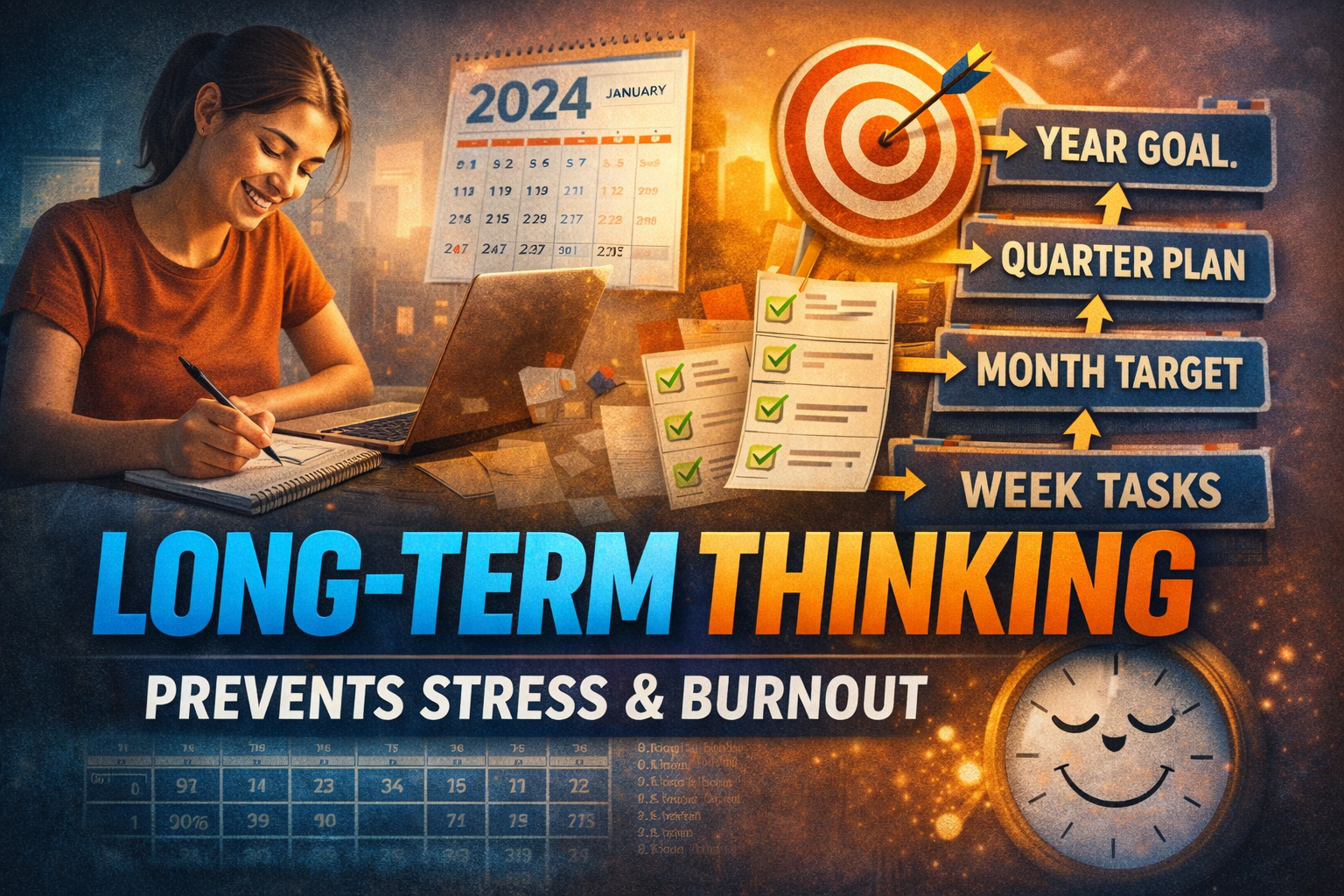
Short-term expectations + long-term goals = stress.
You want big results, fast. You plan as if everything will go perfectly. Then real life happens—delays, unexpected tasks, low-energy days, family, client requests, bugs, distractions.
Suddenly the plan feels “broken,” and the pressure turns into anxiety.
Long-term thinking fixes that. It replaces urgency with direction. It makes you productive without constantly feeling behind.
Why long-term thinking improves productivity
1) It turns chaos into a timeline
When you think long-term, you stop treating every day like it must “change your life.” Instead, you treat days as small bricks in a bigger structure. A slow day doesn’t destroy the plan. It’s just one day.
2) It protects your energy (which protects your consistency)
Burnout rarely comes from working hard once. It comes from overestimating what you can do in a week, then punishing yourself for not hitting an unrealistic plan, then repeating. Long-term thinking helps you plan in a way your nervous system can actually survive.
3) It changes your default decision-making
When your goals are clear for the year, your daily decisions get easier:
- “Does this move me toward my quarter goal?”
- “Is this urgent or just loud?”
- “Is this worth my focus today?”
The yearly goal framework that reduces stress
You don’t need a perfect system. You need a simple structure you can repeat.
Step 1: Set 3–5 yearly outcomes (not 25)
Yearly goals should be outcomes, not endless tasks.
Examples:
- Ship and monetize a product
- Improve health (consistent training + nutrition)
- Grow a channel to X subscribers
- Improve finances (save/invest X)
- Build a portfolio / reputation in a niche
If you set too many yearly goals, you create permanent guilt.
Step 2: Convert yearly outcomes into quarterly missions
A quarter is long enough to make real progress, short enough to stay focused.
Example (SaaS growth):
- Q1: Improve onboarding + activation
- Q2: Improve retention + reviews + referrals
- Q3: Increase acquisition (content, partnerships)
- Q4: Monetization optimization + offers
You’re not “doing everything all the time.” You’re doing the right thing at the right time.
Step 3: Break each quarter into monthly themes
Months are where reality shows up.
Example (Q1 onboarding):
- January: Fix the top 5 onboarding friction points
- February: Improve first-week user experience + email
- March: Add 1–2 high-impact features + measurement
Monthly themes prevent overwhelm because you always know the current focus.
Realistic expectations: the hidden burnout prevention tool
The most productive people aren’t the most intense—they’re the most realistic.
The truth about time
Almost everything takes longer than you want, especially:
- software development
- content creation
- marketing
- learning new skills
- building habits
- anything involving other people
Realistic expectations are not pessimism. They’re what keeps you calm enough to keep showing up.
Plan with “life tax” included
Every week includes:
- admin tasks
- messages
- unexpected interruptions
- chores and personal obligations
- low-energy days
If your plan assumes a perfect week, you will feel behind every week.
Instead, plan like this:
- 60–70% planned work
- 30–40% unplanned reality
That single change reduces anxiety dramatically.
A simple method: Year → Quarter → Month → Week → Day
Here’s a workflow that prevents both chaos and burnout:
Year
Pick your 3–5 outcomes.
Quarter
Choose one primary mission.
Month
Choose one theme.
Week
Pick 1–3 weekly outcomes:
- “Publish 1 article + 2 shorts”
- “Ship onboarding update”
- “Reach out to 10 partners”
- “Train 3 times + meal prep once”
Day
Choose one deep-work priority and 2–5 small supporting tasks.
This keeps you moving without feeling like every day must be “maximum output.”
How this avoids stress, anxiety, and burnout
Stress and anxiety often come from:
- vague goals
- too many goals
- unrealistic time expectations
- constant re-planning
- never feeling “done”
Long-term thinking solves all of these by creating:
- clarity
- pacing
- progress tracking
- realistic planning
- forgiveness for imperfect days
When forgiveness is built in, you don’t spiral after one bad day.
How Self-Manager supports long-term thinking
Long-term thinking needs a system that is easy to review, easy to plan forward, and grounded in daily life. Self-Manager’s date-centric workflow fits this naturally.
Use quarters/months/weeks as your planning spine
- Keep your yearly outcomes visible
- Define quarter missions
- Create monthly themes
- Plan weekly outcomes
- Execute daily priorities
Use weekly and monthly reviews to stay realistic
Instead of guessing, you can look back and ask:
- What did I actually complete?
- What patterns caused delays?
- Where did time leak?
- What keeps repeating?
Realistic expectations come from data, not hope.
Use AI summaries to reduce the review effort
Reviews shouldn’t become another big task. AI summaries can speed up reflection so you still get clarity without spending hours journaling.
A practical template you can copy
Yearly outcomes (3–5)
Quarter mission (pick 1 main mission)
This quarter I will focus on: __________
Monthly theme
This month I will prioritize: __________
Weekly outcomes (1–3)
Daily priority (1 deep-work target)
Today’s deep-work win: __________
Productivity isn’t pressure. It’s pacing.
If you want consistent output without burnout, you need long-term thinking, realistic expectations, a repeatable structure, and steady execution.
The goal isn’t to feel “busy.” The goal is to feel calm and effective — and to build progress you can sustain for years.
Happy productivity.

AI Powered Task Manager
Plan smarter, execute faster, achieve more
Create tasks in seconds, generate AI-powered plans, and review progress with intelligent summaries. Perfect for individuals and teams who want to stay organized without complexity.
Get started with your preferred account