The Importance of Periodical Reviews (Sam Ovens’ Quarterly Review Idea, Applied to Real Life)
Most people try to grow by doing more: more tasks, more tools, more hustle.
Sam Ovens makes a different point in his “Quarterly Reviews” idea: the biggest leaps often come from stepping out of the day-to-day and rethinking your approach from a higher level. Exponential growth doesn’t come from repeating what you’re already doing — it comes from changing your perspective.
That’s exactly why periodical reviews matter. They’re not “planning sessions.” They’re recalibration sessions.
The real purpose of a review: perspective, not pressure
When you’re in the weekly grind, you’re too close to everything:
- urgent messages feel important
- random tasks steal your best hours
- you keep “maintaining” instead of improving
- you can’t see patterns because you’re living inside them
A good review lifts you above the chaos so you can ask better questions. As Sam Ovens highlights with Jeff Bezos’ line, “Point of view is worth 80 IQ points.” The way you see the situation often matters more than trying harder inside the same viewpoint.
What periodical reviews actually give you
1) They stop you from drifting
You can be busy for months and still drift away from what matters. A review forces the question: “Are my actions still aligned with my goals?”
2) They reveal repeat problems
Reviews turn vague stress into specific patterns:
- Which tasks keep repeating?
- Where do I lose time every week?
- What always takes longer than expected?
- What causes the most mental load?
3) They create strategic simplification
A review is where you cut:
- goals that don’t matter anymore
- projects that are “almost good” but not worth it
- commitments that drain energy
- tasks that should be automated or eliminated
That reduction is often the real productivity upgrade.
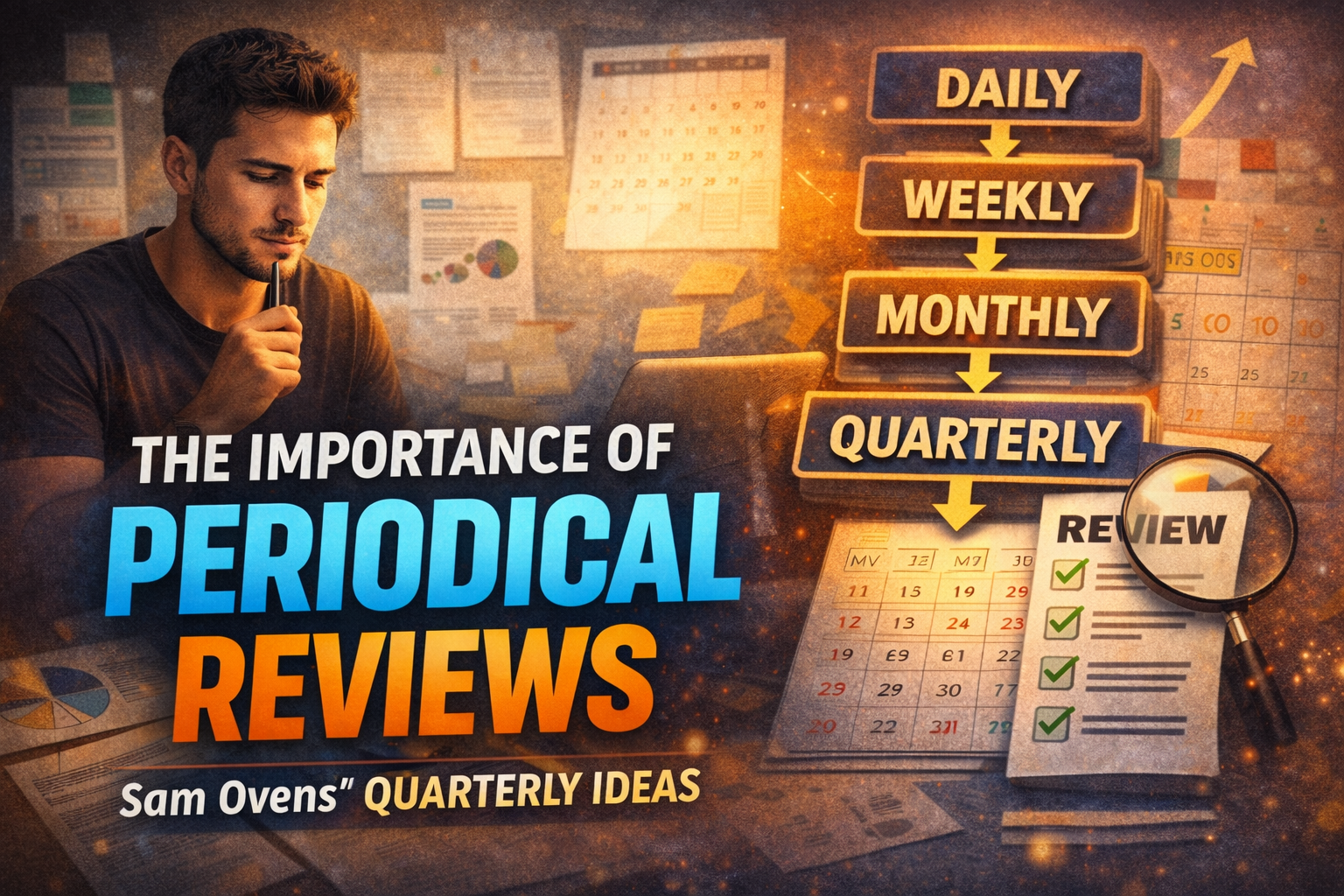
The “review ladder” that keeps you consistent
You don’t need one massive review. You need a rhythm.
Daily (2 minutes): the micro-review
At the end of the day:
- What did I actually finish?
- What’s the one thing I want to move tomorrow?
This prevents your week from becoming fog.
Weekly (15–30 minutes): the reality check
Once a week:
- Wins (what moved forward?)
- Misses (what slipped and why?)
- Time leaks (where did time go?)
- Next week’s top 1–3 outcomes
This is the “keep the ship straight” review.
Monthly (45–90 minutes): the trend review
Once a month:
- What worked repeatedly?
- What didn’t work repeatedly?
- What should I double down on?
- What should I stop doing?
Monthly reviews reduce the “I’m behind” feeling because you can see real progress.
Quarterly (2–4 hours): the “rethink everything” review
This is the one Sam Ovens is pointing at: step back far enough to change the lens.
Quarterly questions that actually matter:
- What are the 1–2 biggest constraints in my life/work right now?
- What’s the highest-leverage project for the next 90 days?
- What am I doing that’s maintenance (keeps things running), but not improvement?
- What would I do if I had to simplify my workload by 50%?
This is where you can get breakthroughs.
Yearly (half day): direction and meaning
Yearly reviews are about:
- what you want your year to stand for
- what you want more of (and less of)
- what goals are truly worth the cost
If you need a structured example, Tim Ferriss’ “past year review” approach is a solid framework.
How to run a quarterly review (simple and effective)
Here’s a format you can copy and use immediately:
1) Score the last quarter (honestly)
Rate 1–10:
- Productivity
- Energy
- Health
- Focus
- Relationships
Low scores usually show the constraint.
2) Extract the lessons
Write:
- Keep: what worked and should continue
- Improve: what’s close but needs adjustment
- Stop: what drains you or doesn’t pay off
3) Choose one primary focus for the next 90 days
One main objective beats ten goals.
Examples:
- Improve onboarding + activation
- Ship the core feature + pricing page
- Publish consistently (1 article/week)
- Fix sleep + training routine
4) Turn it into a quarter → month → week plan
- Quarter mission (the outcome)
- Monthly themes (the sequence)
- Weekly outcomes (small wins that stack)
How Self-Manager makes reviews easier (and faster)
Periodical reviews fail when they’re too hard to do. Self-Manager’s date-centric structure makes review natural because your work is already organized as a timeline:
- tasks, notes, comments, and progress by day/week/month
- you can “scroll the past” like a journal
- you can see busy periods and drift clearly
If you want to reduce review effort, AI summaries help you turn a month of activity into clear takeaways without writing pages of reflection.
The bottom line
Periodical reviews are not “extra work.” They’re the activity that prevents:
- wasted months
- constant stress
- motivation crashes
- burnout from unrealistic expectations
The quarterly review is the keystone: it’s your chance to step above the noise, change perspective, and pick the next 90 days deliberately — exactly the “rise above the day-to-day chaos” idea Sam Ovens emphasizes.

AI Powered Task Manager
Plan smarter, execute faster, achieve more
Create tasks in seconds, generate AI-powered plans, and review progress with intelligent summaries. Perfect for individuals and teams who want to stay organized without complexity.
Get started with your preferred account