How to Stay Consistent Without Willpower (Build a Daily Loop)
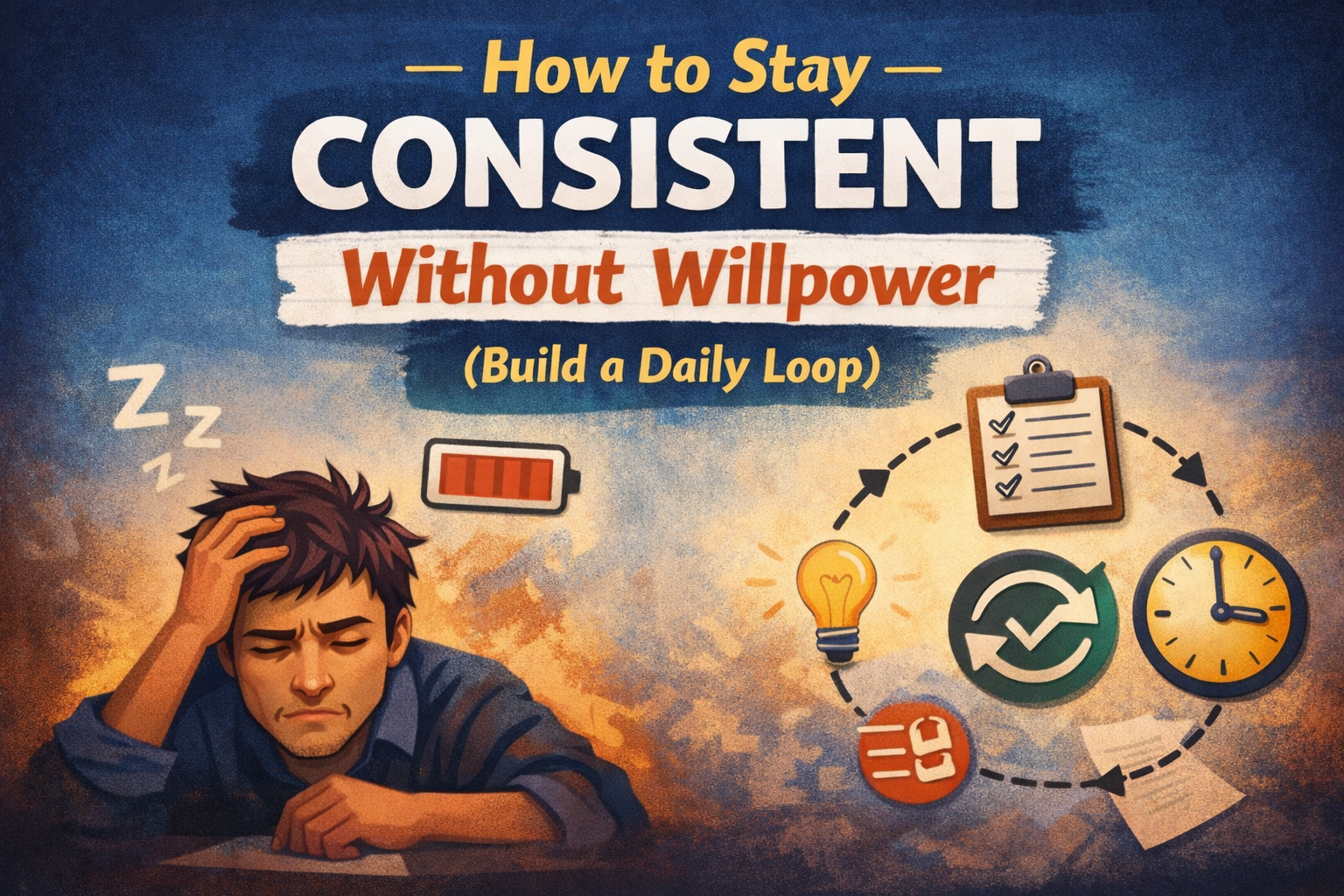
Most people try to “be consistent” by relying on motivation.
That works for a week.
Then life happens: low sleep, stress, a busy day, one missed habit… and the system collapses.
Consistency doesn’t come from willpower.
It comes from a loop you repeat so often that it becomes automatic.
This article gives you a simple daily loop you can build in a weekend and run for years.
Why willpower fails (even for disciplined people)
Willpower is expensive.
It gets drained by:
- decisions (what should I do next?)
- uncertainty (how long will this take?)
- friction (where is the file/link/notes?)
- low energy (afternoon dips, bad sleep)
- emotional weight (avoidance, perfectionism)
The real enemy of consistency isn’t laziness.
It’s restarting every day.
If you have to “decide” how to be productive each morning, you’ll eventually lose.
The solution: build a daily loop
A daily loop is a repeatable sequence that answers 4 questions:
- What matters today?
- What will I actually do?
- When will I do it?
- What did I learn?
If you solve those four things daily, consistency becomes boring—and that’s the goal.
The 4-part Daily Loop
Part 1: Capture (30–90 seconds)
Your brain hates open tabs—mental ones.
So start the day by dumping everything into one place:
- tasks
- reminders
- worries
- ideas
- “don’t forget” items
This prevents the hidden stress of trying to remember.
Rule: capture first, plan second.
Part 2: Plan (5–10 minutes)
Now you choose a realistic day.
Use a simple structure:
- 1 Anchor task (the most important thing)
- 2 Support tasks (meaningful but smaller)
- 3 Quick tasks (admin, replies, small wins)
That’s the loop.
It stops the classic trap of planning 18 tasks and doing 4.
Rule: if it doesn’t fit today, it goes to another date—not “later.”
Part 3: Execute (use triggers, not motivation)
This is where most people fail, because they depend on “feeling ready.”
Instead, use triggers.
A trigger is a predictable moment that starts a behavior.
Examples:
- After coffee → start Anchor task for 25 minutes
- After lunch → do one Support task
- After dinner → 10-minute reset / tidy / prep
Your life already has anchors (meals, coffee, commute, end of work).
Attach work to anchors and it becomes automatic.
Rule: don’t wait for motivation—start at the trigger.
Part 4: Review (2–4 minutes)
This is the compounding step.
Every evening, answer:
- What did I actually do today?
- What mattered?
- What got in the way?
- What is the next best action for tomorrow?
This turns “failure” into feedback.
Without review, you repeat the same mistakes forever.
With review, the system improves weekly.
Rule: review is not judging. It’s steering.
Make it frictionless: the 3 consistency killers
If your loop isn’t sticking, it’s usually one of these:
1) Too many tasks
Your system should protect your confidence.
A day with 6 completed tasks beats a day with 20 planned tasks.
2) No “next action”
If tasks are vague (“work on marketing”), your brain stalls.
Rewrite them into actions (“write 5 tweet hooks”).
3) Context scattered everywhere
If you need 4 tools to finish one task, you’ll avoid starting.
Attach notes, links, and decisions to the task so you can resume instantly.
A practical daily loop you can copy
Morning (7 minutes total)
- Capture everything (1 minute)
- Choose today’s 1–2–3 list (5 minutes)
- Define first action for the Anchor task (1 minute)
During the day (execution triggers)
- After coffee → 25 minutes on Anchor
- After lunch → one Support task
- Before finishing work → quick tasks batch
Evening (3 minutes)
- Mark what’s done
- Write 1–2 lessons
- Pick the next day’s Anchor task
This is boring on purpose.
Boring systems win.
Why the “daily loop” beats goal setting alone
Goals are important, but they’re not executable.
A loop is executable.
The loop turns a goal like:
- “grow my business”
into:
- “daily 25-minute creation block”
- “weekly review”
- “2 outreach tasks”
- “monthly planning”
That’s how progress becomes predictable.
Where Self-Manager.net fits
Self-Manager.net is built around a date-based daily workflow, which matches how consistency actually happens:
- plan tasks on the day you’ll do them
- keep notes/comments/links tied to that day (context stays with the work)
- review daily/weekly/monthly because your history is already organized by date
If you’re trying to stay consistent, the best upgrade isn’t “more discipline.”
It’s a system that makes your loop easy to repeat.
7-day challenge: prove it works
For the next 7 days:
- Plan 1 Anchor + 2 Support + 3 Quick
- Start Anchor at the same trigger every day (coffee, commute, etc.)
- Do a 2-minute review at night
At the end of the week, you’ll notice something:
Consistency feels less like effort—and more like default behavior.

AI Powered Task Manager
Plan smarter, execute faster, achieve more
Create tasks in seconds, generate AI-powered plans, and review progress with intelligent summaries. Perfect for individuals and teams who want to stay organized without complexity.
Get started with your preferred account