How to Review Your 2025 (so 2026 feels intentional)
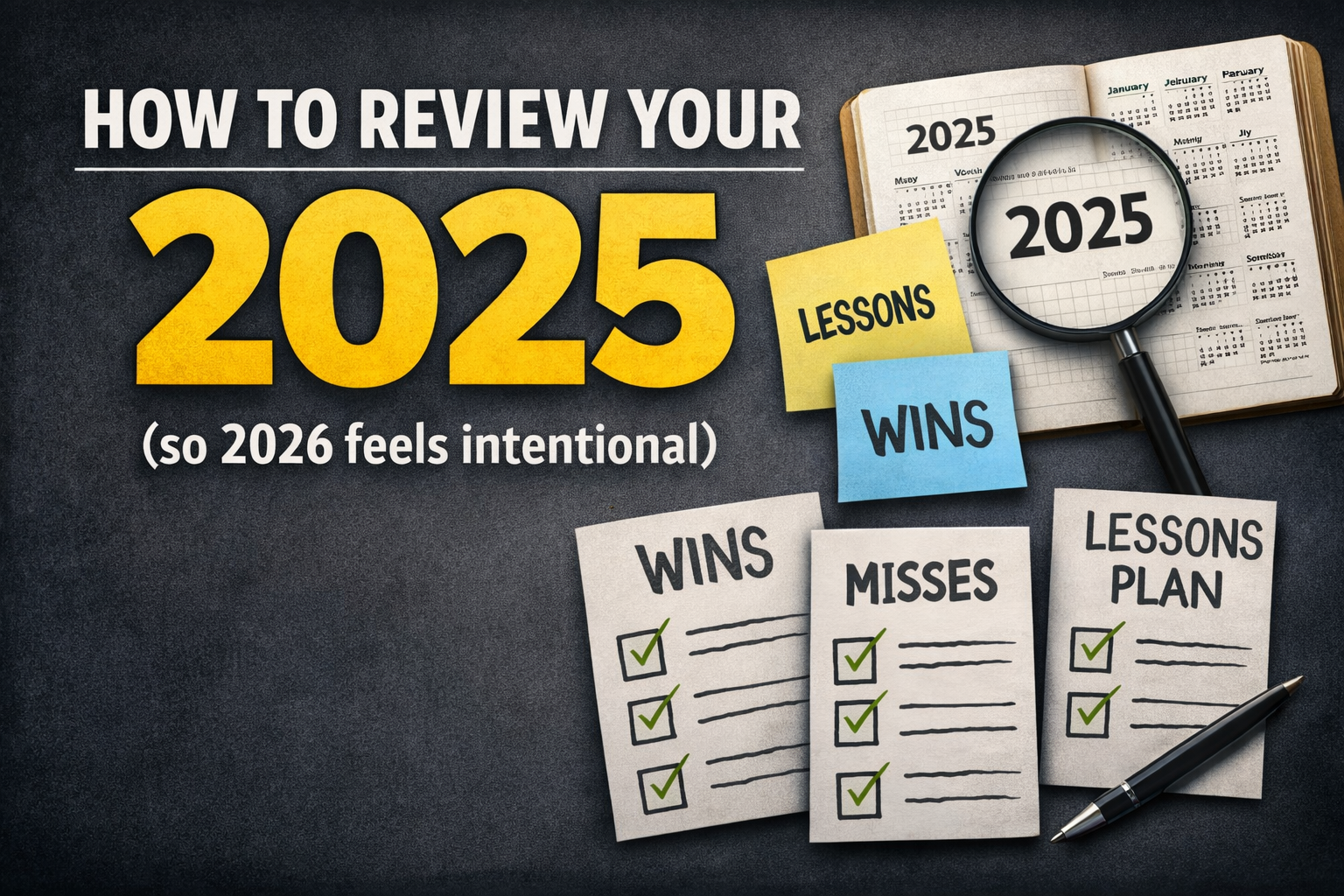
Most people "review" the year by vaguely thinking: "It went fast."
A good review is different: it turns 12 months of noise into clear lessons, decisions, and a plan.
This guide gives you a simple, repeatable annual review you can do in 60–120 minutes.
What a 2025 review should produce
By the end, you want 5 outputs:
- A short summary of what actually happened
- Your biggest wins (and why they worked)
- Your biggest misses (and what you'll change)
- A few lessons worth keeping
- A concrete plan for 2026 (themes + first steps)
If you don't end with actions, it wasn't a review — it was journaling.
Step 1: Collect your 2025 data (15 minutes)
You don't need perfect data. Just enough to be honest.
Pull from:
- Calendar (events, trips, major milestones)
- Notes / journal / task manager
- Photos (camera roll is a timeline)
- Bank statements (spending patterns don't lie)
- Work artifacts (projects shipped, invoices, GitHub, client work)
- Health signals (weight trend, workouts, sleep averages if you track)
Quick rule: Don't start "thinking" yet. First, gather.
Step 2: Rebuild your 2025 timeline (10–20 minutes)
Create a simple month-by-month skeleton:
January:
February:
…
December:
Under each month, add 3–7 bullets:
- big events
- meaningful work projects
- relationship moments
- wins + problems
- any turning points
This step is important because memory lies. The timeline forces reality.
Step 3: Score your year across life domains (10 minutes)
Pick 6–8 domains:
- Health & energy
- Work / business
- Money
- Relationships
- Learning / skills
- Fun / adventure
- Mental health / peace
- Home / environment
Score each 0–10.
Then answer:
- What made the score high?
- What made the score low?
- What is one lever that would raise it by +2 points in 2026?
This gives you direction without overcomplicating.
Step 4: Identify your 10 wins (and extract the recipe)
Write 10 wins from 2025. Keep them concrete.
Examples:
- "Shipped X feature"
- "Lost 7kg"
- "Went on 2 trips"
- "Improved sleep schedule"
- "Cut a bad client relationship"
- "Created a better routine"
- "Made more time for family"
For each win, answer:
- Why did this work? (system, routine, people, environment)
- What should I repeat in 2026?
- What did it cost? (time, stress, trade-offs)
A win that burned you out is not a pure win — it's a warning.
Step 5: Identify your 5 misses (without self-hate)
Now list 5 things you're not proud of or simply didn't handle well.
For each miss, write:
- What happened (facts only)?
- What was the real cause? (not the excuse)
- What will I do differently next time?
- What boundary or rule would prevent it?
This turns regret into strategy.
Step 6: Do a "Start / Stop / Continue" reset (10 minutes)
Write three lists:
Start (add in 2026)
- new habits
- new processes
- new boundaries
- new experiments
Stop (remove in 2026)
- draining commitments
- time leaks
- unhealthy loops
- people/processes that create chaos
Continue (protect in 2026)
- routines that worked
- relationships that mattered
- tools that increased clarity
- practices that created calm
This is one of the simplest ways to "upgrade" your year.
Step 7: Find the patterns that ran your 2025
Look at everything you wrote and answer:
What gave me energy?
- people
- activities
- environments
- types of work
What drained me?
- tasks, clients, habits, routines, contexts
What did I consistently overestimate?
- time available
- focus capacity
- how fast a project would move
What did I consistently underestimate?
- the impact of sleep
- the cost of context switching
- how long recovery takes
These patterns are more valuable than goals.
Step 8: Write your "2025 in 12 sentences" summary
One sentence per month. Done.
This creates closure and makes your year feel real instead of fuzzy.
Step 9: Convert your review into a 2026 plan (this is the point)
Create 3–5 themes for 2026. Themes are better than rigid resolutions.
Examples:
- "Consistency over intensity"
- "Fewer projects, higher quality"
- "Health first = everything improves"
- "Build assets, not just tasks"
- "More deep work, less noise"
- "Protect relationships"
Then choose:
- 3 goals max (big outcomes)
- 1 keystone habit (the one habit that makes everything easier)
- 1 constraint (a boundary that protects your year)
A simple annual review template (copy/paste)
2025 Timeline Highlights
- Jan:
- Feb:
- Mar:
- Apr:
- May:
- Jun:
- Jul:
- Aug:
- Sep:
- Oct:
- Nov:
- Dec:
Domain Scores (0–10)
- Health:
- Work:
- Money:
- Relationships:
- Learning:
- Fun:
- Mental peace:
- Home:
Top 10 Wins (and why they worked)
1.
2.
…
Top 5 Misses (and what I'll change)
1.
2.
…
Start / Stop / Continue
Start:
Stop:
Continue:
2025 Lessons (keep it short)
- Lesson 1:
- Lesson 2:
- Lesson 3:
2026 Themes + First Steps
Themes:
1)
2)
3)
First steps (next 2 weeks):
How to do this inside Self-Manager.net
Here's a clean way to structure it:
- Create a table called "2025 Annual Review"
- sections as rows: Timeline, Wins, Misses, Lessons, Start/Stop/Continue, 2026 Themes
- Create 12 mini tables (or one table grouped by month)
- "2025 January", "2025 February", etc.
- paste your month bullets inside
- Pin these tables (so the review stays visible while you write)
- Use your weekly/monthly/quarterly views to cross-check patterns
- what months were strongest, weakest, most chaotic?
- Finish by creating a "2026 Themes" table
- each theme gets a row + a few measurable indicators
- then link weekly tasks back to these themes
The goal is to keep your annual review from becoming a dead document. It should feed the weeks of 2026.
The key mindset
A year review is not about judging yourself.
It's about learning what worked, removing what didn't, and designing a better default.

AI Powered Task Manager
Plan smarter, execute faster, achieve more
Create tasks in seconds, generate AI-powered plans, and review progress with intelligent summaries. Perfect for individuals and teams who want to stay organized without complexity.
Get started with your preferred account