How Successful People Plan Their 2026 Goals (Without Losing Momentum by February)
Most people don't fail because they lack motivation.
They fail because their goals stay too abstract ("get in shape", "grow my business", "learn X"), and there's no system that turns those goals into weekly actions and daily decisions.
Successful people plan goals differently:
- they choose fewer goals
- they define what "done" looks like
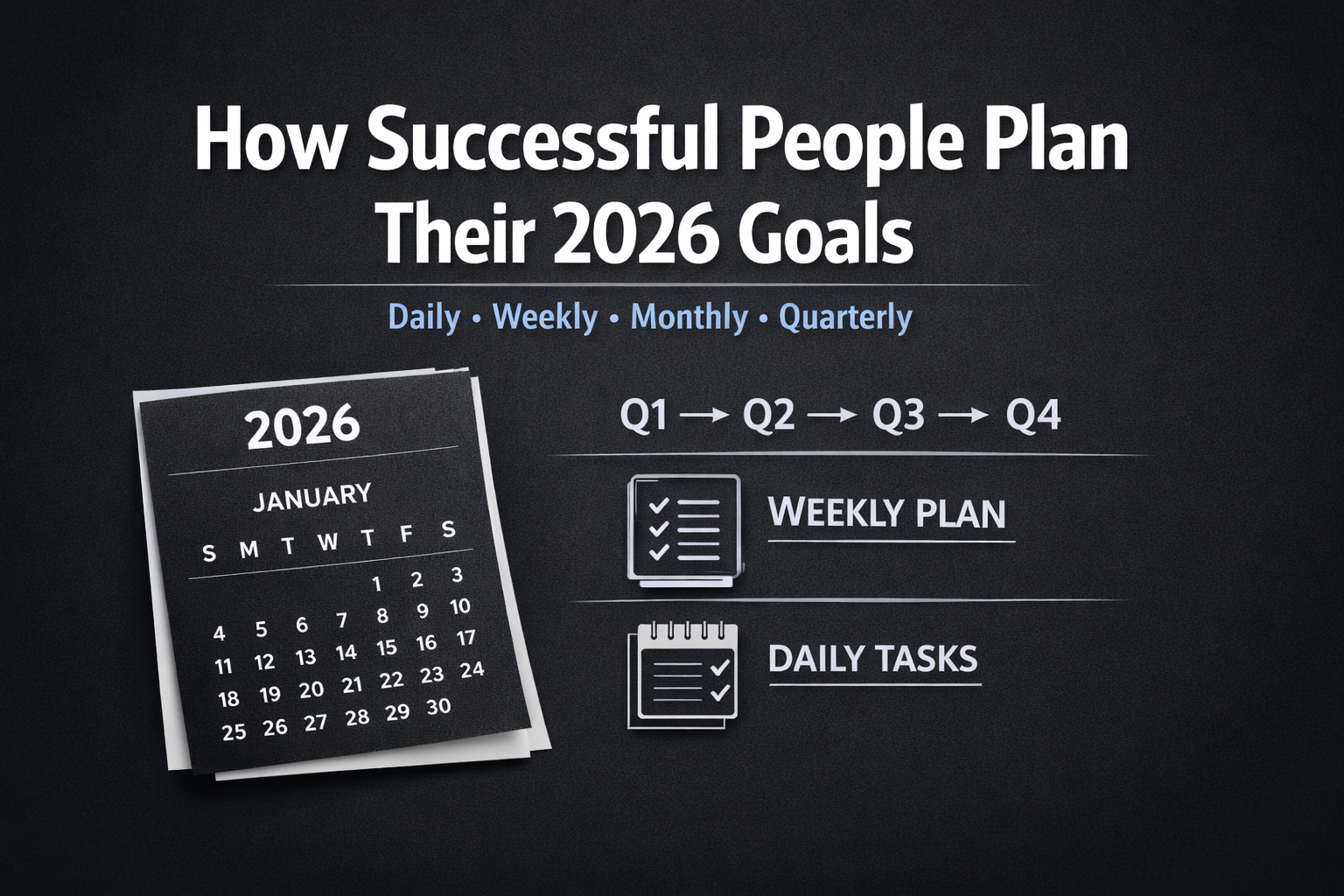
- they build a rhythm (quarters → months → weeks → days)
- they track progress with simple signals
- they review consistently, even when motivation drops
Here's a practical method you can use for 2026.
1) They pick fewer goals, but make them real
A common mistake is having 12 big goals for the year. That becomes a list of guilt.
A better approach:
- 1–3 "core outcomes" for the year (the things that truly matter)
- 2–5 supporting goals (important, but not life-or-death)
Example (simple and realistic):
Core outcomes
- Reach €X revenue from my business by Dec 31, 2026
- Get to a consistent fitness routine (4 workouts/week average)
- Improve mental clarity and energy (sleep + stress management)
Supporting goals
- Read 12 books
- Improve my English (or German) speaking
- Build a stronger online audience
Fewer goals = more focus = more results.
2) They define "success" as measurable evidence
Successful goal planners don't write goals like slogans.
They write goals like outcomes with proof.
Bad goal: "Get healthier."
Better goal: "Train 4x/week and walk 8k steps/day average for 10 months."
Bad goal: "Grow my YouTube."
Better goal: "Publish 2 videos/week and hit 50k monthly views by Q4."
You're not doing this to be "corporate." You're doing it so your brain knows:
- What to do
- When you're winning
- When you need to adjust
3) They plan yearly goals by quarters, not by months
A year is too big for your brain to "feel." Quarters are small enough to execute.
Think of 2026 like 4 mini-years:
- Q1 (Jan–Mar): Setup & momentum
- Q2 (Apr–Jun): Consistency & improvement
- Q3 (Jul–Sep): Expansion & bigger bets
- Q4 (Oct–Dec): Finish strong & consolidate
For each goal, define what "winning" looks like by the end of each quarter.
Example: Grow business revenue
- Q1: tighten offer + improve conversions
- Q2: scale marketing channels that work
- Q3: increase prices + optimize delivery
- Q4: stabilize, retain, repeat what worked
This makes big goals feel manageable.
4) They convert goals into systems, not just tasks
Tasks are easy to write. Systems are what actually deliver results.
A system is a repeatable habit/routine that produces outcomes even on bad days.
Examples of systems:
- Fitness goal → "Workout on Mon/Tue/Thu/Sat no matter what"
- Content goal → "Publish every Tuesday and Friday"
- Learning goal → "30 min/day, tracked"
- Business goal → "Daily lead generation + weekly sales follow-up"
When you have a system, you don't need motivation. You need repetition.
5) They set weekly priorities (not a huge daily to-do list)
Successful planners don't wake up and ask: "What should I do today?"
They decide weekly.
Weekly planning answers:
- What are the top 1–3 outcomes this week?
- What are the non-negotiable habits this week?
- What is the one thing that moves my main goal forward?
Example weekly priorities:
- Close 2 client deals
- Ship 1 feature update
- Work out 4 times
- 5 nights of 7+ hours sleep
Then daily planning is just execution.
6) They track progress with simple metrics
If tracking is complicated, you won't do it.
Successful people keep tracking simple:
Binary / count metrics
- workouts completed
- videos published
- outreach messages sent
- pages written
- hours slept (or bedtime streak)
Score-based metrics (0–5)
- focus quality
- energy level
- stress level
- "how well did I follow the plan today?"
Tracking isn't about perfection. It's about feedback.
7) They review every week and every month
This is the real secret.
People who succeed don't "set goals" once.
They keep adjusting.
A 15-minute weekly review:
- What did I complete?
- What did I avoid?
- What worked?
- What's the most important thing next week?
A 30-minute monthly review:
- Are my goals still correct?
- Am I ahead or behind?
- What should I stop doing?
- What should I double down on?
Reviews prevent drift.
8) They plan for setbacks before they happen
Successful people assume the year will include:
- low motivation weeks
- sick days
- family problems
- unexpected work chaos
- travel interruptions
So they design "minimum versions" of habits:
- Minimum workout: 15 minutes
- Minimum writing: 200 words
- Minimum marketing: 5 messages/day
- Minimum learning: 10 minutes
This keeps momentum alive. Momentum is everything.
A practical 2026 goal planning template (copy/paste)
Step 1: Pick your 3 core outcomes
Step 2: Define proof for each one
- Outcome 1 proof:
- Outcome 2 proof:
- Outcome 3 proof:
Step 3: Define Q1–Q4 milestones
- Q1:
- Q2:
- Q3:
- Q4:
Step 4: Define your weekly systems
- Weekly habit/system #1:
- Weekly habit/system #2:
- Weekly habit/system #3:
Step 5: Tracking signals
- Metric 1:
- Metric 2:
- Metric 3:
Step 6: Review schedule
- Weekly review day/time:
- Monthly review day/time:
How to do this inside Self-Manager.net (date-based planning)
If you're using a date-based system, goal planning becomes much easier because your goals naturally turn into action by time.
Here's a clean way to set it up in Self-Manager.net:
1) Create a "2026 Goals" table on January 1, 2026
- List your core outcomes
- Add proof metrics
- Add the Q1–Q4 milestones as checklist tasks
2) Create a "Q1 2026 Plan" table on January 1
- Translate your yearly goals into Q1 focus
- Add 3–6 key projects for the quarter
3) At the start of each month, create a "Month Plan" table
Example: "February 2026 Plan"
- top outcomes
- key deliverables
- habits focus
4) Every week, create a "Weekly Plan" table (Monday)
- 1–3 weekly outcomes
- systems/habits
- key tasks that must happen
5) Pin your main tables
Pin:
- "2026 Goals"
- Current quarter plan
- Current month plan
- Current week plan
Now you always see your direction while working on daily execution.
6) Use end-of-week summaries
At the end of the week, summarize what happened:
- what got done
- what didn't
- what to change next week
That feedback loop is how goals turn into reality.
Final thought: your 2026 goals won't be achieved by inspiration
They'll be achieved by:
- fewer goals
- clear proof
- quarterly structure
- weekly systems
- simple tracking
- consistent reviews
That's how successful people plan: not as a "vision board"… but as a repeatable process that works even when life gets messy.

AI Powered Task Manager
Plan smarter, execute faster, achieve more
Create tasks in seconds, generate AI-powered plans, and review progress with intelligent summaries. Perfect for individuals and teams who want to stay organized without complexity.
Get started with your preferred account