How "Billionaire Thinking" Works (Sam Ovens' Model) — And How to Apply It to Your Life
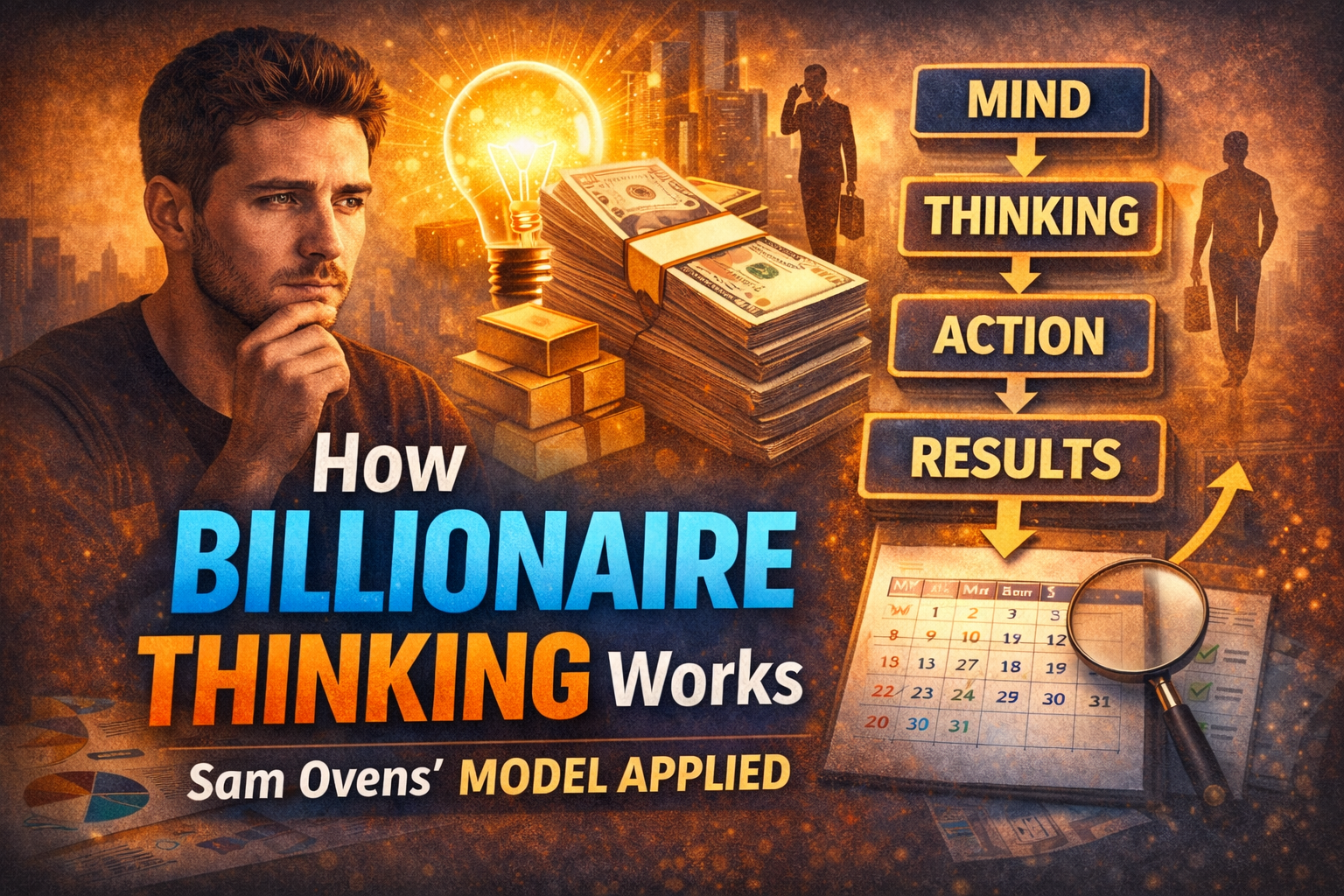
A lot of people assume success comes from information: the right strategy, the right course, the right tactic.
Sam Ovens argues the opposite: if 100 people get the same information, the results are wildly different — which means the "secret" isn’t the information. It’s the mind that processes it.
This isn’t about trying to become a billionaire. It’s about learning a practical mental framework you can use for productivity, decisions, and long-term progress.
The core chain: Mind → Thinking → Action → Results
Sam frames success as cause-and-effect: results come from actions, actions come from thinking, and thinking comes from the mind. If you keep changing tools or copying tactics but your results don’t change, you may be upgrading the surface layer while ignoring the real engine.
The 5-layer mind stack (and why most people only build the top layer)
The model breaks "billionaire mind" into layers. The higher layers depend on the lower layers; if your foundation is weak, tools and tactics won’t save you.
Layer 1: Awareness
Awareness is noticing what’s happening in real time:
- where your attention goes
- what triggers procrastination
- what you avoid
- what drains your energy
Productivity translation: if you can’t see your behavior clearly, you can’t improve it.
Layer 2: Cognition
Cognition is how you think:
- reasoning, tradeoffs, problem-solving
- mental models
- how you interpret events
Productivity translation: two people can have the same day and make totally different decisions because they think differently about it.
Layer 3: Principles
Principles are your "rules of operation" for life and business decisions. Ideas like long-term thinking and first-principles thinking (breaking problems down to fundamentals instead of copying the crowd) live here.
Productivity translation: principles reduce decision fatigue because you stop renegotiating everything daily.
Layer 4: Disciplines
Disciplines are the skill areas you understand (not just your one specialty). High performers tend to be "full-stack" across disciplines, not trapped in one narrow slice.
Productivity translation: you move faster when you understand the whole system, not only your part.
Layer 5: Processes and Tools
This is where people obsess: apps, tactics, workflows, templates. The model warns that if you only learn tools and processes without deeper layers, you get stuck when things break or change.
Productivity translation: tools amplify thinking. They don’t replace it.
How to apply this to your life (without the hype)
1) Upgrade awareness with a distraction + time audit
For 7 days, track just two things:
- What did I plan to do today?
- What did I actually do, and why did it change?
You’re not judging yourself. You’re building awareness. You can’t optimize what you refuse to measure.
2) Improve cognition with 3 questions before big decisions
When you feel rushed or stuck, ask:
- What’s the real problem? (not the symptom)
- What tradeoff am I making? (time, money, stress, focus)
- What’s the second-order effect? (what happens after the first win)
This moves you from reactive productivity (busy) to strategic productivity (effective).
3) Write 3 principles that run your week
Pick principles that reduce chaos. Example set:
- Protect deep work first.
- Do fewer things, but finish.
- Choose long-term wins over short-term comfort.
When you feel pulled in 10 directions, principles decide for you.
4) Become T-shaped instead of only specialized
You don’t need to master everything, but you do need enough cross-skill understanding to avoid bottlenecks.
If you’re a builder or founder, "full-stack" might mean:
- product + marketing basics + finance basics + communication
If you’re a professional, it might mean:
- your craft + negotiation + writing + basic analytics
This is a big real-world multiplier because it reduces dependency and speeds up execution.
5) Use tools last — to enforce the system, not to invent it
Tools should serve your principles and planning, not become the hobby. If you keep switching systems, it’s often not a tool issue. It’s a principles or awareness issue.
How Self-Manager fits this framework
Self-Manager is useful here because it supports the lower layers, not just "task lists":
- Awareness: your work is organized by time (day/week/month), so you can see patterns clearly.
- Principles: pinned tables can act like a "rules and priorities" dashboard.
- Cognition: reviews help you spot cause and effect ("When I did X, my week went better").
- Tools layer: AI summaries reduce review friction so you actually keep the habit.
When your system makes reviews easy, consistency becomes easier too.
A simple "Billionaire Mind" weekly challenge
Try this for one week:
- Daily (2 min): What mattered today? What stole my attention?
- Weekly (20 min): 3 wins, 3 problems, 1 principle to improve next week.
- One principle: Deep work before inbox.
- One discipline upgrade: 30 minutes learning a supporting skill you avoid.
Do that for 4 weeks and you’ll feel the difference — not because you found a magic tactic, but because you upgraded the layers that drive all tactics.
The bottom line
Better results come from better thinking, not just better tools. Build from the foundation up: awareness, cognition, principles, disciplines, then processes and tools.
When you do, the information you already have becomes more valuable—because the mind using it is stronger.
AI Powered Task Manager
Plan smarter, execute faster, achieve more
Create tasks in seconds, generate AI-powered plans, and review progress with intelligent summaries. Perfect for individuals and teams who want to stay organized without complexity.
Get started with your preferred account