Drive and Hunger to Succeed: How to Turn Ambition Into Daily Productivity
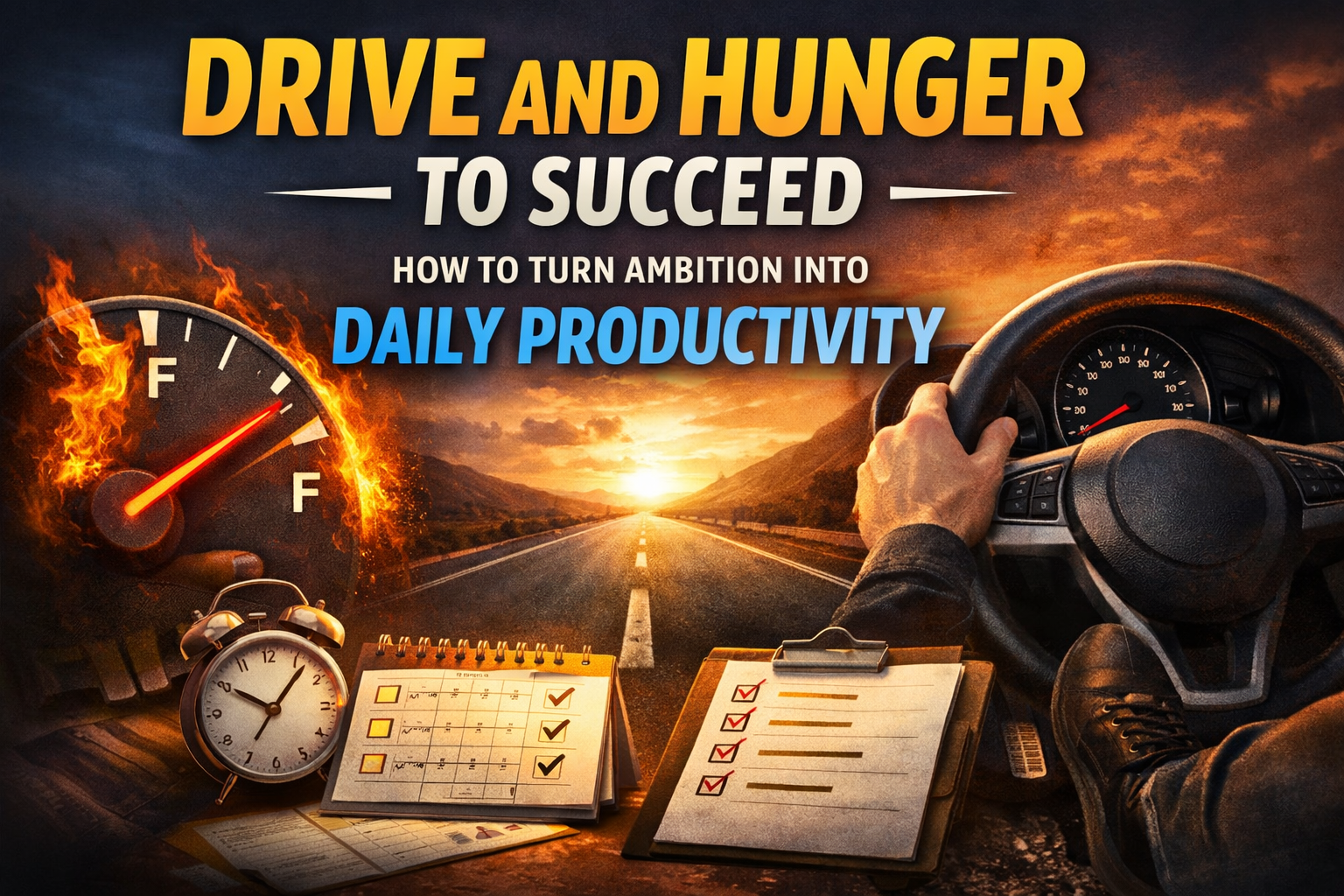
Drive + hunger is the fuel.
Productivity is the steering wheel and the brakes.
That simple idea explains why some ambitious people move fast and keep moving for years, while others burn hot for a month… then disappear.
This article is about using ambition without burning out — and converting "I want more" into consistent daily execution.
What "drive" and "hunger" really are (no hype)
People use these words like they mean the same thing, but they don't.
Drive = long-term energy
Drive is the steady push. It's identity-based:
- "This is the kind of person I am."
- "I build things."
- "I want mastery."
- "I want to win long-term."
Drive is what stays when motivation fades.
Hunger = short-term urgency
Hunger is emotional. It's the itch:
- "I need to prove myself."
- "I can't stay here."
- "I want results now."
- "I'm tired of being behind."
Hunger is powerful — but it's also unstable. It spikes and drops.
The problem
Drive and hunger can produce huge energy… but energy isn't output.
Energy is potential.
Output is direction + friction management + consistency.
That's where productivity comes in.
The biggest trap: hunger feels productive even when it isn't
Hunger is noisy. It can trick you into thinking you're working while you're actually circling.
Here are common "fake progress" behaviors that feel productive:
- Over-planning (endless rewriting of plans, zero execution)
- Tool hopping (switching apps to feel a fresh start)
- Consuming motivation content (dopamine, not progress)
- Starting too many things (busy, not effective)
- Chasing intensity (hero days) instead of continuity (repeatable days)
Hunger is great for starting.
It's terrible for pacing.
If hunger is driving the car, you'll speed up, swerve, slam the brakes, then crash.
Fuel needs a system: ambition → plan → execution
Here's the translation that high-performers do (often without realizing it):
1. "I want more" becomes a target
Vague ambition creates vague action.
Instead of:
- "I want to succeed."
Make it:
- "I want to launch X by March."
- "I want 20 paying customers."
- "I want a portfolio with 10 strong case studies."
- "I want to lose 8kg in 12 weeks."
- "I want to ship 4 features this month."
2. A target becomes a deadline
Deadlines create focus. Not pressure for the sake of stress — but clarity.
When there is no deadline:
- today doesn't matter
- tomorrow looks the same
- procrastination becomes "planning"
3. A deadline becomes weekly commitments
Your week is the bridge between dreams and days.
Ask:
- What must be true by the end of this week?
Weekly commitments should be few and measurable.
4. Weekly commitments become today's 1–3 priorities
Daily productivity isn't "do everything."
Daily productivity is:
- choose the few actions that move the goal forward
- do them even when you don't feel like it
That's steering.
The steering wheel: focus (what matters today)
Drive + hunger often creates a "too much" problem:
- too many goals
- too many tasks
- too many open loops
So the steering wheel is focus, which is mostly about elimination.
A simple rule: 1 goal, 1 season
Pick one primary goal per quarter (or per month if your work cycles are shorter).
You can still do other things, but you decide what's "core."
When everything is core, nothing is.
The "3 priorities" rule
Each day, choose:
- 1 main priority (must move the goal)
- 2 supporting priorities (maintenance or smaller wins)
If you consistently do this, you'll look "disciplined" from the outside.
In reality, you're just not letting hunger hijack your attention.
The brakes: constraints (so you don't burn out)
Ambitious people don't fail only because they're lazy.
They fail because they over-accelerate.
Brakes aren't weakness. Brakes are strategy.
Constraint 1: limit your daily load
If you plan 12 tasks, you'll finish 4 and feel like a failure.
If you plan 3 meaningful tasks and finish them, you build momentum.
Momentum is addictive in a good way.
Constraint 2: time blocks beat vague intentions
"I'll work on it today" is a lie your brain tells itself.
A time block is a commitment:
- "10:00–12:00: build the landing page section"
- "14:00–15:00: outreach to 5 prospects"
- "18:00–18:30: workout"
Constraint 3: define "done"
Hunger wants perfection. Productivity wants completion.
Define "done" for tasks:
- shipped
- sent
- published
- tested
- delivered
Not "worked on."
Consistency beats intensity (and hunger needs to hear that)
Hunger loves heroic days:
- 12-hour sessions
- late nights
- "I'm all-in now"
The problem is: you can't repeat it.
Progress comes from what you can repeat.
Think like training, not like a sprint
The goal is to build a weekly rhythm you can sustain:
- deep work days
- lighter admin days
- recovery days
You're not trying to win today.
You're trying to win the year.
A practical framework: Hunger → Focus → Output → Review
This is the loop that keeps ambition productive:
1. Hunger (capture it)
Write down what's driving you:
- what you want
- why it matters
- what you're avoiding
- what you're proving
Don't rely on mood. Capture it.
2. Focus (choose the few)
Turn that emotion into:
- one goal
- this week's commitments
- today's 1–3 priorities
3. Output (execute the boring part)
Execution is rarely cinematic.
It's:
- showing up
- doing the next small step
- finishing something
4. Review (correct the course)
Review is how you stay ambitious without drifting.
Without review:
- you repeat mistakes
- you overestimate what you did
- you forget what worked
With review:
- you adjust quickly
- you refine your approach
- you get better every week
Review is the discipline that makes hunger sustainable.
How software helps: turning ambition into visible momentum
Ambition is fragile when it lives only in your head.
A productivity system becomes powerful when it does two things:
- It holds your commitments in one place (so you stop renegotiating with yourself daily)
- It makes progress visible (so you build confidence and clarity)
A calendar-first approach is especially effective because it forces honesty:
- what will be done today
- what gets scheduled this week
- what keeps getting postponed (a signal)
When your tasks live on dates, you don't just "want" things — you commit to time.
And when you do weekly/monthly reviews, you stop relying on memory and start relying on evidence.
That's how you keep the fuel but stay in control of the vehicle.
Ambition without burnout: a simple weekly plan you can copy
If you want a practical starting point, use this:
Weekly (15–30 minutes)
- Choose 1 weekly outcome that matters most
- Choose 3 supporting tasks (secondary outcomes)
- Block time for the main outcome (at least 2 sessions)
Daily (2–5 minutes)
- Choose 1 main priority
- Add 2 supporting priorities
- Add a realistic time block for the main one
End of week (10 minutes)
- What did I ship?
- What moved the goal?
- What drained me with little return?
- What should I do more of next week?
The closing truth: hunger is not the goal — output is
Hunger is useful. Drive is useful.
But the goal isn't to feel hungry.
The goal is to ship.
Fuel matters, but direction matters more.
If you can consistently convert ambition into:
- a weekly plan
- a small daily execution list
- a review habit
…then drive and hunger become a superpower.
Not because you're "more motivated," but because you have a system that keeps you moving even when you're not.

AI Powered Task Manager
Plan smarter, execute faster, achieve more
Create tasks in seconds, generate AI-powered plans, and review progress with intelligent summaries. Perfect for individuals and teams who want to stay organized without complexity.
Get started with your preferred account