Deep Focus + Consistency: The Real Productivity Superpower (and How to Build It)
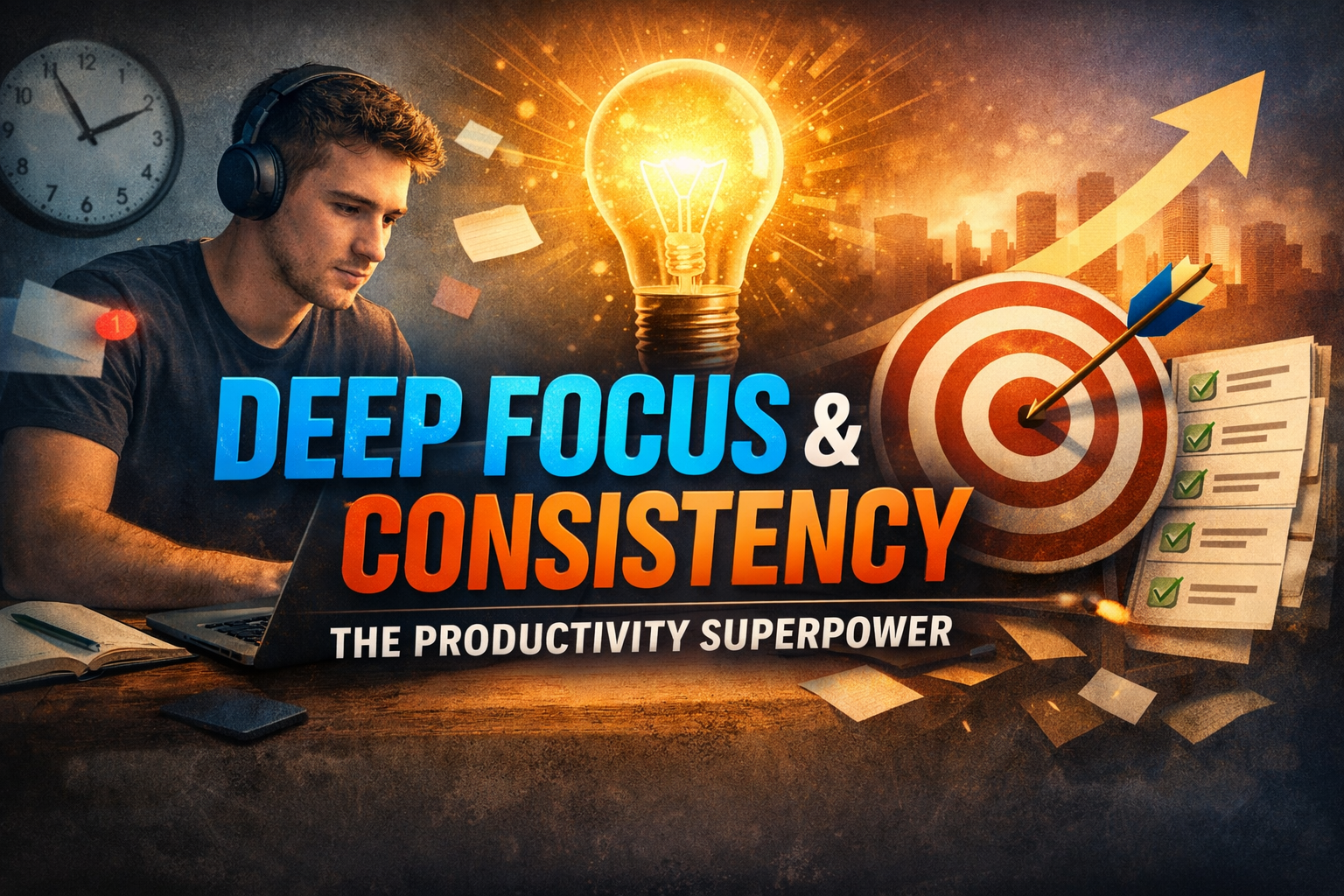
Most productivity advice is about doing more: more tools, more systems, more hacks, more tabs.
But in real life, the people who get the most done usually aren’t the busiest. They’re the most consistent, and they protect uninterrupted focus like it’s a competitive advantage.
Deep focus isn’t just “concentrating harder.” It’s a state where you stop context-switching, stop renegotiating your plan every 3 minutes, and you actually move important work forward.
If you can build even a small daily habit of deep work, you’ll outpace people with “perfect systems” who never sit still long enough to execute.
Why deep focus beats almost everything else
1) Context switching is the silent productivity killer
Every time you jump between tasks (or apps, or notifications), your brain pays a “restart cost.” Even if the switch takes 5 seconds, the mental recovery takes much longer.
Deep focus wins because it removes those restarts.
2) Interruptions don’t just pause you — they reshape your day
One interruption often becomes:
- “Just replying quickly…”
- then a short scroll
- then a new idea
- then a different task
- then you forget what you were doing
That’s not a lack of discipline. That’s normal human behavior in a high-distraction environment.
3) Consistency compounds
A single 3-hour deep work session feels amazing. But the real superpower is doing 45–90 minutes consistently, week after week.
That’s how you ship projects. That’s how you get ahead. That’s how you build a career.
What “deep focus” actually looks like in practice
Deep focus is not:
- a perfect morning routine
- a fancy note-taking system
- waiting for motivation
- “I’ll focus after I clear my inbox”
Deep focus is:
- one clear target
- a protected time block
- zero optional inputs (notifications, social apps, email)
- a simple rule: finish the next tiny milestone before switching
The 3 rules that make focus sustainable
Rule #1: Make the next action painfully clear
If your task is vague (“work on the project”), your brain will resist. Instead, define a next step that’s easy to start:
- “Write the intro section (300 words)”
- “Fix the checkout bug”
- “Draft 3 headline options”
- “Outline the video structure”
Clarity removes friction. Friction creates procrastination.
Rule #2: Work in one window: today
A lot of people lose focus because they constantly re-evaluate:
- “Should I do something else?”
- “Is this the best priority?”
- “Maybe I should reorganize…”
That’s not planning. That’s avoidance disguised as thinking.
Decide what matters today, and treat it like a contract.
Rule #3: End the session with a “restart hook”
This one is underrated.
Before you stop, write a one-line note:
- “Next: implement X function”
- “Next: write paragraph about Y”
- “Next: send message to Z + attach file”
That makes tomorrow’s deep focus session start instantly.
A simple system: Deep Focus → Review → Consistency
Here’s a clean weekly loop that works in the real world:
1) Pick 1–3 “deep work outcomes” for the week
Not 20 tasks. Outcomes.
Examples:
- “Launch the landing page”
- “Ship the onboarding flow”
- “Finish the client proposal”
- “Edit and publish the video”
2) Do one deep focus block per day (minimum)
Start small:
- 25 minutes (if you’re rebuilding the habit)
- 45 minutes (solid default)
- 90 minutes (high-output)
- 2+ hours (only if your life supports it)
3) Review results, not intentions
Consistency grows when you can see reality:
- What did I actually do?
- Where did I get interrupted?
- What caused the drift?
This is where most people level up.
How Self-Manager fits naturally into deep focus + consistency
Deep focus gets easier when your system is fast, clear, and doesn’t pull you into endless organizing.
Here’s a practical way to use Self-Manager to support deep work:
Use the date-centric workflow to reduce decision fatigue
- Put your deep work target on today
- Keep it visible
- Stop re-planning every time you feel resistance
When your day is anchored, you don’t negotiate with yourself all day.
Use pinned tables as a “Focus Dashboard”
Create a pinned table called:
- “Deep Work”
- “This Week’s Outcome”
- “Do Not Forget”
Put only what matters there. If it’s not important enough to be pinned, it’s not important enough to interrupt you.
Use weekly/monthly reviews to build consistency
Your deep focus habit improves when you review patterns:
- Which days were your best?
- What kept interrupting you?
- What tasks always expand?
Self-Manager’s timeline-style history makes this kind of review feel natural instead of “extra work.”
Use AI summaries to speed up reflection
Instead of writing long reflections, you can let AI summarize:
- what happened this week
- what got done
- what repeatedly blocked you
That gives you actionable insight without turning review into a chore.
The “Uninterrupted Focus” checklist (copy/paste)
Before starting:
- One clear next action (tiny milestone)
- Notifications off (phone + desktop)
- One workspace (one tab/window if possible)
- Timer set (25 / 45 / 90 minutes)
- A place to capture distractions (quick notes)
During:
- If distracted, write it down — don’t act on it
- If stuck, reduce the task to the next smallest step
- No tool-hopping
After:
- Write the restart hook (“Next: …”)
- Log what you finished (one line is enough)
The truth: focus isn’t a talent — it’s a habit you protect
Deep focus, uninterrupted work, and consistency are not about being “more disciplined.” They’re about building an environment and a workflow that makes the right behavior easier than the wrong one.
If you can protect one deep focus block per day and review your weeks honestly, your output will change fast — and it will stay changed.
Happy productivity.

AI Powered Task Manager
Plan smarter, execute faster, achieve more
Create tasks in seconds, generate AI-powered plans, and review progress with intelligent summaries. Perfect for individuals and teams who want to stay organized without complexity.
Get started with your preferred account